
Clashing Titans
Tangling with Titans, Fordist waltz of Traditional Business Management Methods and Tools (TBMM) against the adaptive tango of Soft Systems Methodologies (SSM).
Introduction:
Clashing in a Messy Arena
The contemporary business landscape presents a clash of titans: Traditional Business Management Methods and Tools (TBMM)—spreadsheets, SWOT analyses, Porter’s Five Forces—versus Soft Systems Methodology (SSM), with its rich pictures and stakeholder-driven inquiry. TBMM, deeply entrenched in MBA curricula, reflects Fordism’s standardized efficiency, a relic of industrial precision (Puja, n.d.). SSM, conceived by Checkland (1981), thrives on interdependence and ambiguity, leveraging dialogue as a core process (Isaacs, 2008; Brown & Isaacs, 1996/97).
Boulding (1956) situates TBMM at lower system levels—mechanistic and reductive—while SSM operates at higher, complex orders. This study employs Bateson’s (1972) learning orders—1st (efficiency), 2nd (reframing), 3rd (identity)—to dissect their strengths, weaknesses, and implications for MBA programs, critiqued as Fordist factories ill-equipped for post-industrial chaos (Hardjono & van Marrewijk, 2001). Cuijpers (2008) posits that interventions shape system outcomes, underscoring TBMM’s prowess in stable conditions and SSM’s edge in dynamic flux. McKinsey’s (2023) finding—70% of AI adopters gain by rethinking models—highlights the stakes. This analysis probes whether MBAs, wedded to TBMM, can adapt or risk obsolescence.
See the full version on your computer.
1st Order Face-Off:
Efficiency vs. Exploration
Bateson’s (1972) 1st order learning—single-loop, “doing things better”—is TBMM’s domain. Tools like A/B testing or break-even analysis deliver rapid, standardized solutions, aligning with Bigelow’s (1991) emphasis on practical skills. An e-commerce firm lagging in conversions can optimize checkout flows, boosting metrics by lunch—a Fordist triumph (Hardjono, 1995). Schön (1967) critiques this as static, solving symptoms not systems, while Argyris (1974) labels it theory-in-use on autopilot, lacking depth. SSM enters timidly, mapping conflicts with rich pictures—arrows swirling, suggestions vague (Boonstra, 2003). Its slowness cedes ground—TBMM’s precision wins here (Campbell et al., 1970).
Yet TBMM’s dominance frays under scrutiny. Peloton’s 2021 misstep—overproducing bikes amid a post-pandemic slump, losing $1.2 billion [Bloomberg, 2022]—reveals its limits. Linear forecasts ignored behavioral shifts—customers ditching home workouts—echoing the 2020 toilet paper panic’s supply chain chaos. SSM’s sketches might’ve captured this flux, hinting at broader fixes (Hardjono & van Marrewijk, 2001). Puja (n.d.) argues post-industrial success demands understanding, not just efficiency—TBMM’s Fordist lens misses this, though its speed retains utility in tame contexts. MBA programs thrive here, producing grads to tweak the machine, not question it (Boyatzis & Renio, 1989).
2nd Order Showdown:
Efficiency vs. Exploration
Bateson’s (1972) 2nd order—double-loop, “doing better things”—tests TBMM’s rigidity. SWOT, NPV, and Five Forces diagnose but rarely rethink—Argyris (1982) notes defensive reasoning traps firms in rote responses. A gig platform facing driver strikes might tweak pay rates, missing a pivot to equity or partnerships (Senge, 1990). Stacey (2007) critiques TBMM’s lack of dynamism; it pivots clumsily, as Blockbuster’s late DVD shift shows. SSM excels, gathering stakeholders—drivers, users, regulators—to ask, “What’s broken?” (Isaacs, 2008). Airbnb’s 2020 pivot to virtual experiences, netting $100 million [Airbnb, 2021], reframed travel via host dialogue—McKinsey’s (2023) 70% AI winners mirror this, gaining via model shifts [McKinsey, 2023]. Boonstra (2003) sees SSM’s fluidity as key—Brown & Isaacs (1996/97) call it a conversational core.
WeWork’s 2019 overexpansion, burning $2.2 billion [Forbes, 2020], exemplifies TBMM’s failure—optimizing coworking while missing community potential (Waldrop, 1992). SSM’s stakeholder webs could’ve reframed it—Cuijpers (2008) underscores interventions’ systemic impact, favoring SSM’s adaptability (Hardjono, 1995). MBA programs falter here—TBMM dominates curricula, leaving 2nd order skills as cameos (Varela & Burke, 2013). Consequences loom—firms cling to outdated frames, disruptors leap ahead (Puja, 2014).
“ The real voyage of discovery consists
not in seeking new landscapes, but in having new eyes.”
3rd Order Freestyle:
Identity Crisis and the Abyss
Bateson’s (1972) 3rd order—triple-loop, “who are we?”—exposes TBMM’s collapse. MBA dogma fixates on shareholder value—Argyris (1990) sees organizational defenses stifling “why” questions. A fintech stalled by AI might tweak fees, not ask, “Bank or ecosystem?” (Prigogine & Stengers, 1996). SSM masters this, questioning identity with all voices—Checkland (1981) designed it so. Revolut’s 2023 super-app shift—finance, travel, crypto—grew users 25% [Revolut, 2024], reflecting stakeholder dialogue (Isaacs, 2008). Snap’s 2023 ad chase lost 20% market share to TikTok’s ecosystem [Statista, 2024]—TBMM tweaked, blind to “who” (McMillan, 2003). Zillow’s $881 million iBuying flop [Zillow, 2022] optimized homes, not purpose—SSM might’ve redefined it (Hardjono & van Kemenade, 2021).
Schön (1983) sees SSM’s reflection scale up—Prigogine & Stengers (1996) liken it to order from chaos. TBMM’s stasis locks fate (Cuijpers, 2008)—McKinsey’s 70% AI stat [2023] favors SSM’s rethink (Shoji et al., 2001). MBAs hit an abyss—Fordist training stops at optimization, leaving grads brittle (Boulding, 1962). Consequences hit hard—firms falter, unable to dance post-industrial jazz (Chian, n.d.).
cannot be solved at the same level of thinking
we were at when we created them.”
Limits of MBA Programs
Consequences of the 3rd Order Blind Spot
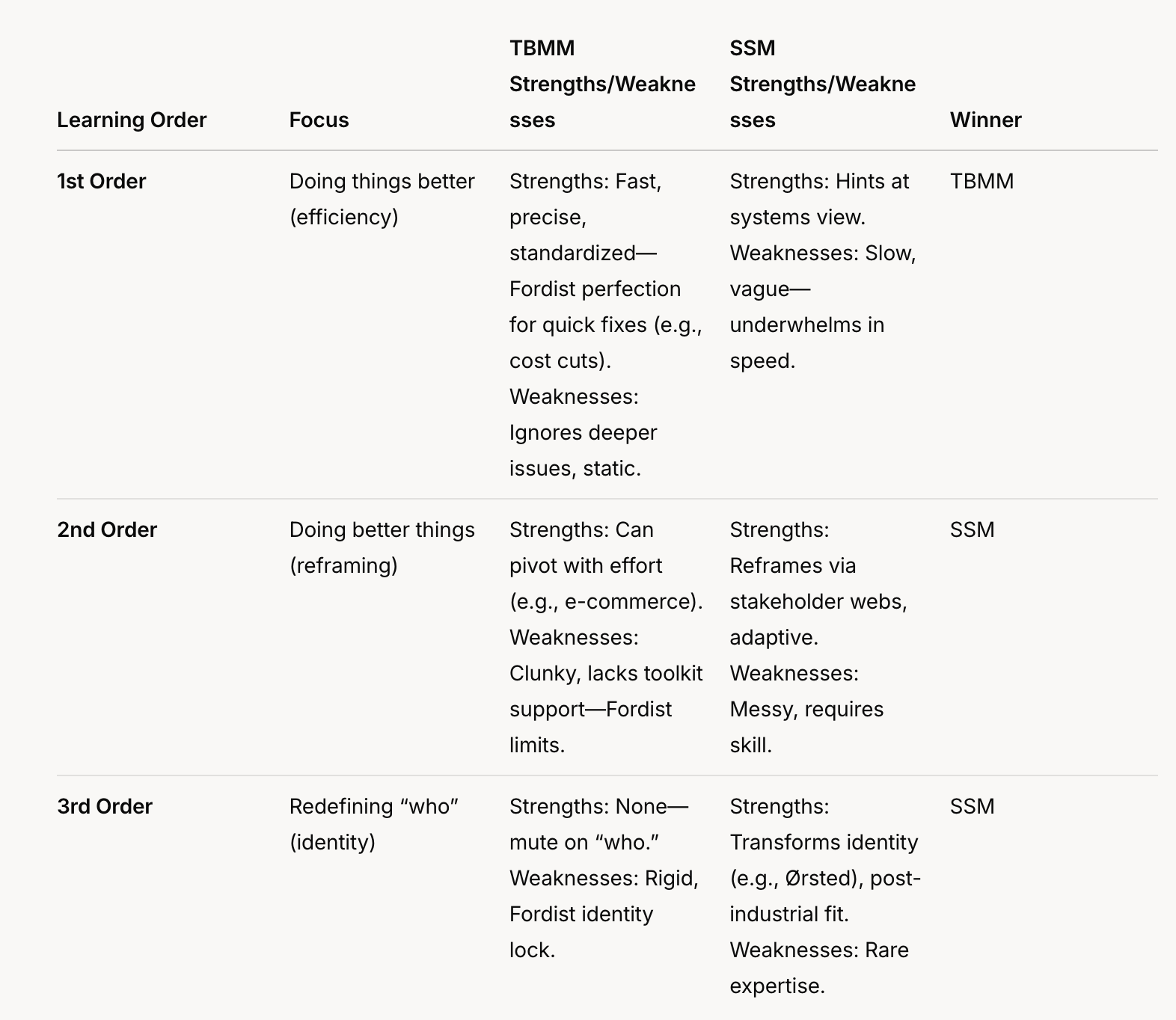
1st Order: TBMM rules—fast, precise, MBA-friendly—Hardjono (1995) might say efficiency peaks—SSM’s too slow—Boulding (1956) might call it underused—Brown and Isaacs (1996/97) might note: no conversation slows it.
2nd Order: SSM shines—reframing beats tweaking—Stacey (2007) might see complexity mastered—TBMM stumbles—Waldrop (1992) might note order’s edge missed—Isaacs (2008) and Brown and Isaacs (1996/97) might say: dialogue wins.
3rd Order: SSM soars—identity shifts rule—Prigogine and Stengers (1996) might see chaos birthing order—TBMM’s mute—Hardjono (2000b) might peg it stalled—Brown & Isaacs (1996/97) might add: conversation redefines.
Conclusion:
Time for a New Dance Card
Final Findings:
– Traditional Bussines Management Methods
Shines in stable, linear contexts (1st order), reflecting its Fordist strengths—efficiency and predictability—but fade in complexity.
– Soft System Methodologies
Why TBMM?
- Speed and Efficiency: TBMM excels at quick, decisive fixes—think break-even analysis or SWOT—delivering measurable results fast, ideal for 1st order tasks like cost-cutting or boosting quarterly profits.
- Precision and Clarity: Tools like NPV and Porter’s Five Forces provide clear, quantifiable outputs, making decisions straightforward and appealing to stakeholders who crave hard numbers.
- Standardization: Rooted in Fordist logic, TBMM offers a uniform, repeatable approach, ensuring consistency across teams and organizations—perfect for stable, predictable environments.
- Ease of Teaching: Its structured, formulaic nature fits the MBA “degree manufactory” model, enabling mass training of grads in practical, executable skills like financial modeling.
- Proven Track Record: TBMM’s industrial-age roots have a legacy of success—think optimizing assembly lines or market share—giving it credibility in traditional business settings.
Why SSM?
- Innovation Trigger: By questioning “why” and “who” (Bateson 1972), SSM sparks transformative ideas—think Netflix’s streaming leap—outpacing TBMM’s tweak-focused limits.
- Holistic Perspective: SSM perceives systems as living webs (Cuijpers 2008), mapping stakeholder views with rich pictures to uncover root causes, not just symptoms—ideal for complex, post-industrial messes.
- Adaptability: Its reflective, iterative approach (Schön 1983) thrives in flux, reframing problems (2nd order) and redefining identities (3rd order), as seen in Ørsted’s oil-to-wind pivot.
- Stakeholder Engagement: SSM pulls in diverse voices—employees, customers, suppliers—fostering collaboration and buy-in, aligning with post-industrial values of knowledge and human-centricity (Pija n.d.)
- Resilience in Chaos: Built for wicked problems (Rittel 1973), SSM navigates ambiguity where TBMM falters, offering a lifeline for firms facing climate crises or societal shifts.
References:
- Ackoff, R. L. (1974). Redesigning the Future.
- Argyris, C, (1982). Reasoning, Learning and Action. Jossey Bass.
- Argyris, C, (1990). Overcoming Organizational Defenses: Facilitating Organizational Learning. Allyn & Bacon.
- Argyris, C, & Schön, D. A. (1974). Theory in Practice (1st ed.). Jossey-Bass Publishers.
- Argyris, C, & Schön, D. A. (1978). Organizational Learning: A Theory of Action Perspective. Addison-Wesley.
- Bateson, G. (1972). Steps to an Ecology of Mind. Chandler.
- Bigelow, J. D. (1991). Managerial Skills: Explorations in Practical Knowledge. Sage Publications.
-
Bloomberg (2022). Peloton’s $1.2 Billion Loss Signals End of Pandemic Boom.
- Boonstra, J. J. (2003). Dynamics of Organizational Change and Learning: Reflections and Perspectives. Utrecht, Amsterdam, The Netherlands, Sioo, Interuniversity Centre for Organizational Development and Learning.
- Boulding, K. E. (1956). General systems theory, the skeleton of science. Management Science, 2(2), 197–208.
- Boulding, K. E. (1962). Conflict and Defense: A General Theory. Harper & Bros.
- Bourgine, P., & Johnson, J (Eds.). (2006). Living Roadmap for Complex Systems Science. 1-71.
- Boyatzis, R. E., & Renio, A. (1989). The Impact of an MBA Program on Managerial Abilities. Journal of Management Development, 8(5), 66-77.
- Brown, J., & Isaacs, D. (1996/97). Conversation as a Core Business understanding. The System Thinker, 7(10), 576-1231.
- Campbell, J. P., Dunnette, M. D., Lawler, E. E., & Weick, K. E. (1970). Managerial Behavior, Performance, and Effectiveness. McGraw-Hill.
-
CNBC (2023). Bed Bath & Beyond Files for Bankruptcy.
- Checkland, P. (1981). Systems Thinking, Systems Practice.
- Chian, C. A. (2007) Complex Systems Approach to Economic Dynamics [Dissertation, lJniversity of Adelaide]. Adelaide.
- Cuijpers, P. H. M. (2008). Professional Learning Processes [Action Research]. Unpublished.
-
Forbes (2020). WeWork’s $2.2 Billion Loss in 2019.
-
Hardjono, T. W., & Kemenade van, E. A. (2021). The Emergence Paradigm in Quality Management: A way towards Radical Innovation. Springer, Cham.
-
Hardjono, T. W. (2000). The Four Phase model: Maturity of Organizations and Business Excellence.;
-
Hardjono, T. W. (1995). Ritmiek en organisatiedynamiek: vierfasenmodel: met aangrijpingspunten voor organisatorische interventies ter vergroting van de effectiviteit, efficiency, flexibiliteit en creativiteit [Proefschrift, Kluwer Bedrijfswetenschappen]. Deventer.; Hardjono, T. W. (2000). The Four Phase model: Maturity of Organizations and Business Excellence.
- Isaacs, W. N. e. (2008). Dialogue: The Art Of Thinking Together. Crown.
- McMillan, E. (2003). Complexity, organizations and change (1st ed.). Routledge.
-
McKinsey (2023). The State of AI in 2023: Generative AI’s Breakout Year.
- Puja, M. (2014). Essential Characteristics of Post-Industrial Society.
- Prigogine, I., & Stengers, I. (1996). The End of Certainty, Time Chaos, and the New Laws of Nature [LA Fin des Certitudes]. The Free Press.
-
Reuters (2023). PayPal Loses 4.5 Million Active Users After Fee Hike.
-
Revolut (2024). Revolut 2023 Growth Report.
- Rittel, H., & Webber, M. (1973). Dilemmas in a General Theory of Planning. Policy Sciences, 4, 155-169.
- Shoji S., W., D. (2001). Four Practical Revolutions in Management: Systems for Creating Unique Organizational Quality. Productivity Press, Center for Quality of Management.
- Schön, D. A. (1967). Technology and Change: The New Heraclitus. Dell Pub. Co.
- Stacey, R. D., (Ed.). (2007). Strategic management and Organizational Dynamics. The Challenge of Complexity. Chapter 10 Essex, Person Education Limited.
-
Statista (2024). Snap vs. TikTok Market Share 2023.
- Varela, O. E., & Burke, E. (2013). The Development of Managerial Skills in MBA Programs: A Reconsideration of Learning Goals and Assessment Procedures. Journal of Management Development, 32(4).
- Waldrop, M. M. (1992). Complexity: The Emerging Science at the Edge of Order and Chaos. Simon & Schuster.
-
Zillow (2022). Zillow iBuying Program Shutdown: $881M Loss.
Further Readings

Quality as a Journey
Reframing Quality as a Heroic Journey towards Virtuosity suggests: a path made by walking to transform leaders, tea...

Performance Teams
Performance Teams in today’s fast-paced, competitive Business Landscape are the engine of commercial success.
...
Strategic Visioning
The science of strategic visioning, planning, and the art of decision-making in today’s complex, rapidly changing a...

Navigating Change
Navigating Change is a wild ride—tech’s nuts, markets flip fast. Plans flop 70%, but a consultant who gets dynami...

Learning to lead
Learning to lead embodies a hybrid, human-centric framework that empowers professionals to attain mastery in agogics,...

Jazzing MBA Programs
MBA programs use Traditional Business Management Methods (TBMM) focused on quick fixes but fail in disruptive busines...
Thinking in Quality
This article maps quality frameworks to four schools—Empirical, Reference, Reflective, Emergence—analyzing their ...

The Origin of Life
A critical analysis highlighting abiogenesis’s empirical and probabilistic shortcomings, exposing biases in nat...

Clashing Titans
Tangling with Titans, Fordist waltz of Traditional Business Management Methods and Tools (TBMM) against the adaptive ...

The Luck Playbook
The Luck Playbook is your guide to make magic with chance, Try the spark. Pick a luck ritual and just check it for a ...

Dynamical Expertise
It’s a Dynamical expertise to master groups dynamics and spark harmony. leading teams, families, and crowds boo...

Intelligence Declining?
Is Intelligence Declining? IQ scores are dropping, threatening our civilization. By 2100, a 15-point decline could fr...

The Concept of Self
The ‘Self’ unfolds as a journey of discovery—mind, body, and spirit weaving a rich tapestry. It traces ...

Path of Virtuosity
Virtuosity isn’t a gift—it’s a sweaty, joyous path of effort. From Ziran’s grace to flow’s spark, exhaustio...

Info Snapping Strategies
Info Snapping Strategies is the art of capturing critical information amplified by AI to master the rhythm of the Inf...

Titans Toolkit
The Titans Toolkit shifts from static cases to real-time analysis. Using SSM, it equips leaders to innovate and navig...
Beyond the Expert Trap
Tired of harming others and falling into the Expert-Trap? Join the League to study and practice GuideWork™ an advan...

The Origin Puzzle
Life’s origin is a cosmic puzzle. Abiogenesis faces challenges like RNA instability, yet progress in labs sparks ho...

Burden of Stress
Release the burden of stress by finding meaning in life, connecting with others, reclaiming your well-being and relax...

Snapshot Your Success
‘Snapshotting’ is a time efficient way of using Action Research to create lasting change. Contact us, we ...

Smart Choices
Make smart choices. Use our 12 tips Compass for personal goals, business strategies and organizational plans. Science...

Who Cares
Have you noticed a shift in care at your doctor’s office or vet clinic? The personal touch—doctors knowing your h...

Stressed Out
Uplifts your team’s mind, body, and spirit with Shendao. Unleash ancient power for modern results to transform stre...

Essentials in Innovation
Essential in Innovation is the ability to change your behavior, driven by imagination reshaping your business and ...

Ignite your life
Ignite your life, elevate family meetings & engage in community projects. Boost your businesses or serve your Na...

Illusion of Control
Change initiatives often assume control is attainable, yet complexity and unpredictability prevail. Embracing emerge...

What is Agogics
Learn more about the origin, concept, theories and methods of Agogics and the applications in modern human and organi...

Exploring Relaxation
Explore the science, heritage, and practice of relaxation. Address the impact of stress across personal, professional...

Crushing your Brand
Crushing your brand in a wild market is a high-stakes showdown. Economic swings are squeezing ad budgets, cultural di...

Fabric of Society
A profound absence of self-respect and inner dignity unravels communities and nations, eroding trust and ethical coop...

Evolution of Science
The evolution of science’s, from ancient history to modern genomics, unveils science’s dynamic evolution, a restl...

Leading by Learning
Leading by Learning is a must for leaders in a world of disruptive change, learning fuels innovation. Embrace it to s...

Transcendental Realism
This preprint article introduces Transcendental Realism, redefining truth; as “a virtuous transcendence of perc...

The Art of Exposure
The Art of Exposure, a rare talent with jazz rhythm and compassion as its tool, offers a sense of direction in human ...

Realms of Groups
Realms of Groups dives into the modern world necessitating new ways of thinking and working while developing 21st-cen...

The Hype of AI
No algorithm steals a chef’s gut-hunch or a jazz riff. Unplug, dance, taste life—keep the spark alive. Partner wi...

Group Dynamics
A Historical Analysis of Group Dynamics: From 1895 crowd theories to modern insights, exploring, concepts, theories a...

Myth of the Teacher
The Myth of the Teacher flourishes selling the masses the idea that teaching guarantees leaning, But is that really t...

Dynamics of Choice
The Dynamics of Choice is a dance between agency, context and stimuli in personal, business and organizational life. ...

Helpings Hidden Harm
The hidden harm of the helping professions and the negative impact caused by the expert model on customers and profes...

The Funnel of Truth
Investigate your Funnel of Truth and discover how your Perception of Reality hinders you to grasp the factual Actuali...

Q4 Unleashed
Q4 redefines quality management. It integrates four paradigms into one cohesive framework, structured around four dir...

Jamming with AI
Jamming with AI is the creative methodology of seeking, gathering and assimilating relevant information to keep a com...

Brainless Bites
Our obsession with soundbites on TikTok and X reduces policy to hashtags, sacrificing nuance. We chase dopamine, not ...

Quality in contexts
This article redefines quality as a dynamic process of consciousness evolving in a three-stage quest with implication...

Crowdy Gossip
Crowdy Gossip fuels the clamor of our lives, turning mistakes into social media sagas. Truth fades while crowds are c...

Qualities at Work
We transform teams into profit engines with a soft systems approach. We ignite qualities, drive revenue and innovatio...

The Future of AI
Check out the trends of AI and how the progress of the technology will shape our future in the next decade and will c...

The Power of Planning
The Lumora™️ Framework is a proprietary methodology for strategic planning, designed to facilitate visioning, goa...

Changing E-Learning
E-learning is outdated, and downgrading Intellectual Autonomy. A-Learning™ is the new way of pursuing wisdom. It re...

2025 © All Rights Reserved