
The Concept of Self
A Multidisciplinary Exploration
The “Self” stands as a profound enigma, a kaleidoscope of dimensions—philosophical, psychological, biological, sociological, cultural, and spiritual—each lens revealing layers of complexity that defy simple definition. In contrast, the “Selfie” emerges as its digital shadow, a curated fragment projected onto screens, a superficial echo of the Self’s depth. This article, covers a vast terrain, from Aristotle’s (c. 350 BCE) vision of a soul seeking eudaimonia to Bandura’s (1997) self-efficacy rooted in agency, from the Torah’s (c. 1200 BCE) divine imprint to Van Lommel’s (2001-2013) evidence of consciousness beyond death, and from Rettberg’s (2017) analysis of digital self-representation to the timeless insights of Vedanta, Mahayana, and Zen.
See the full version on your computer.
Historical timeline
Spanning Western and Eastern traditions, this exploration bridges ancient wisdom with modern science, tracing the Self’s intricate tapestry—woven through memory, emotion, society, narrative, and spirit—against the Selfie’s fleeting sheen. In a world of mirrors—inner, outer, virtual, and eternal—this journey probes the essence of identity, questioning whether the Self is a tangible fact, a constructed illusion, or a transcendent mystery, while Selfies flicker as mere pixels, unable to capture its boundless depth.









© Cuijpers, P. H. M. (2025) – Copy or Citing ? Without Written Consent
The Self as a Question
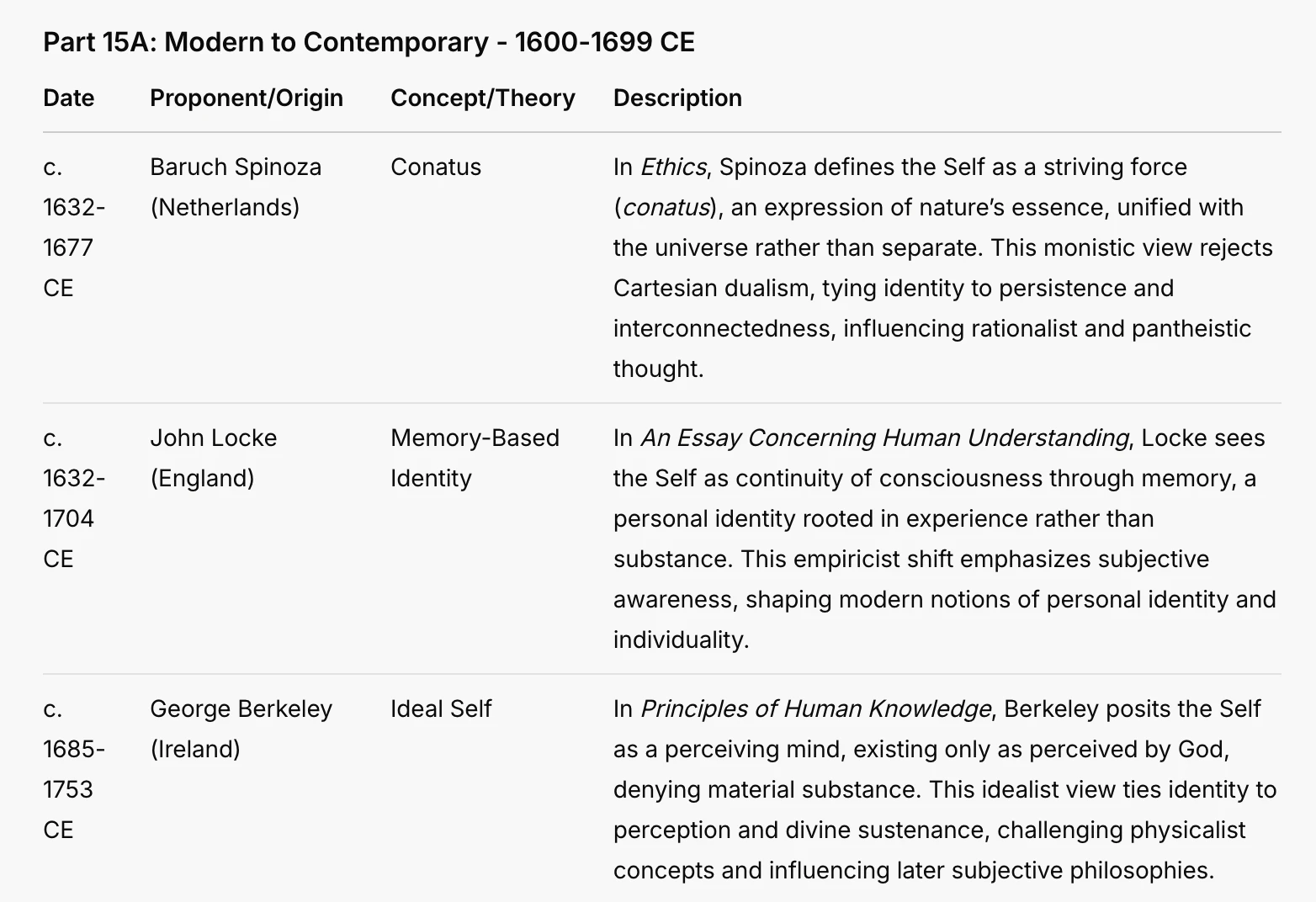
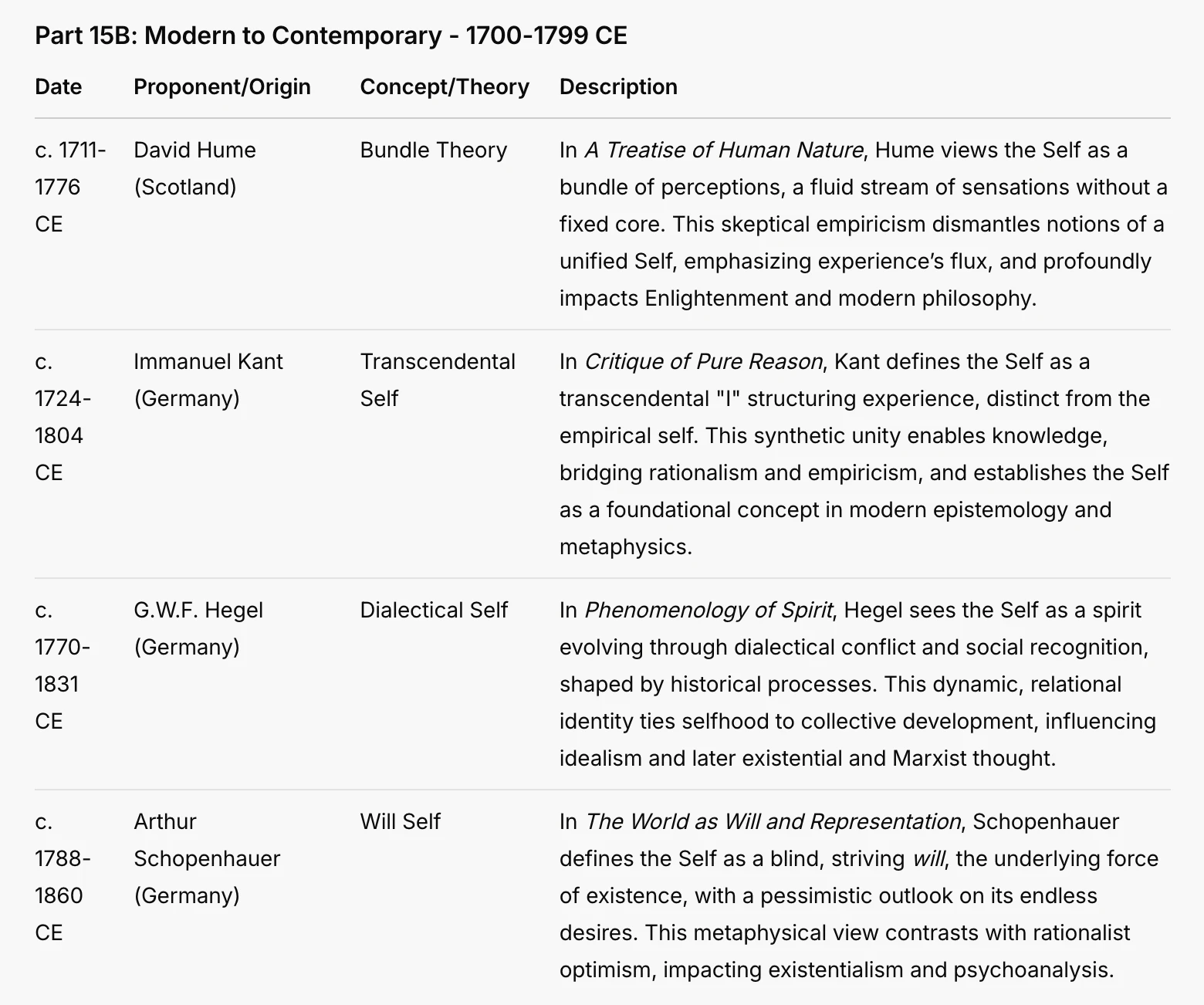
Philosophy casts the Self as an eternal question, a puzzle probed across millennia with no final answer, its contours shifting yet enduring against the Selfie’s static frame. Aristotle (c. 350 BCE) envisions it as a soul pursuing eudaimonia—a flourishing through virtue, weaving courage, wisdom, and justice into a life’s fabric, outlasting Selfies’ transient likes—Locke (1690) anchors it in memory’s unbroken thread, linking past deeds to present identity, a continuity Selfies sever with their instant snaps—Hume (1739), in ‘Of the Understanding and Of the Passions’, dissolves it into a bundle of perceptions, a fluid dance of thoughts and feelings too vast for Selfies’ frozen pose
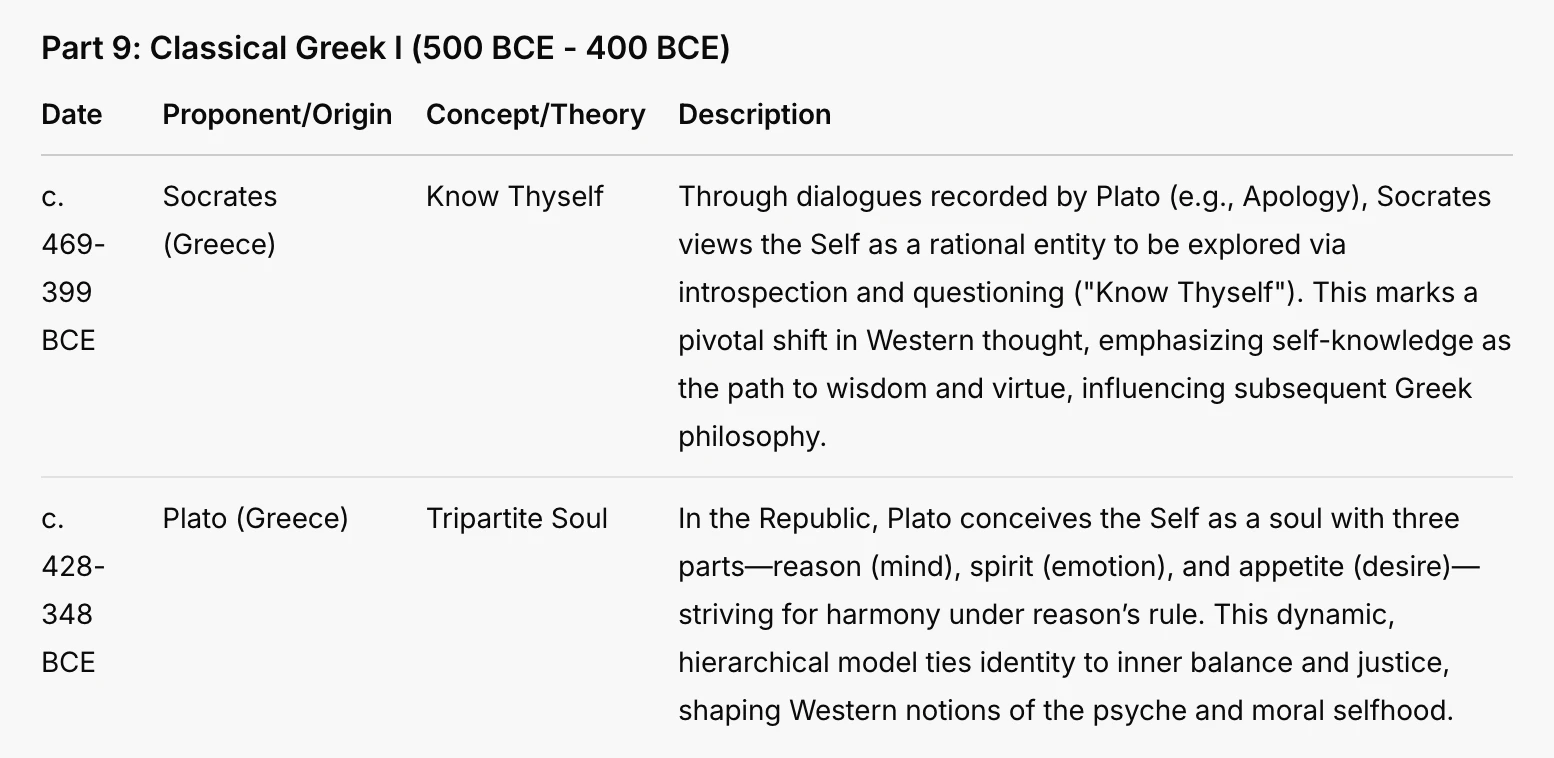
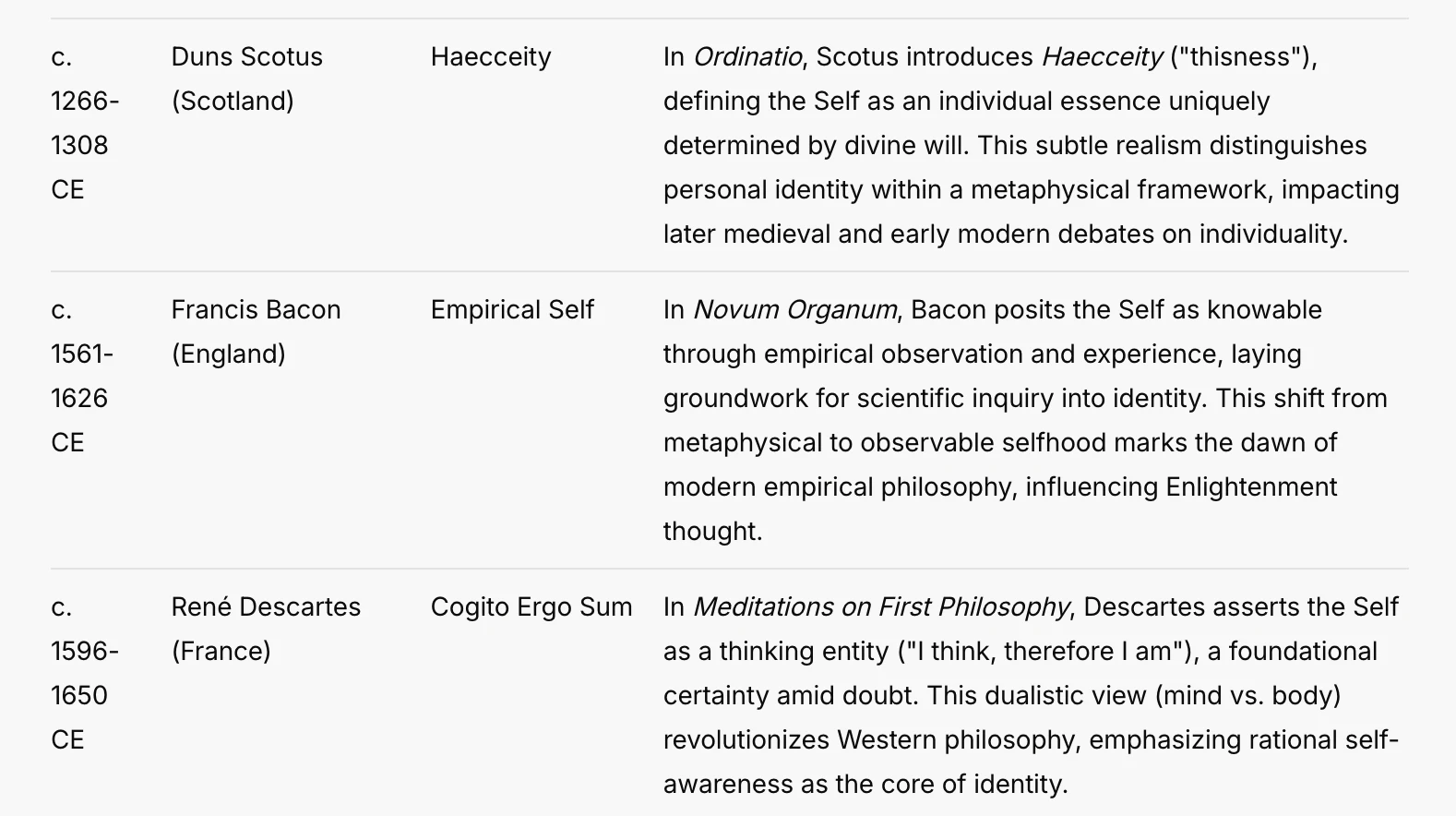
—Hegel (1807) forges it through dialectical growth, a spirit emerging from conflict’s crucible, a depth beyond pixels. Best (1996) infuses it with spiritual yearning, a quest Selfies sidestep. Plato’s tripartite soul—reason, spirit, appetite—offers a balanced harmony no Selfie can mirror. Descartes’ “Cogito, ergo sum” roots it in thought’s certainty, a rock Selfie lenses can’t crack—Kant’s synthetic unity weaves experience into meaning (Difilippo), a loom Selfies can’t thread—Torah (c. 1200 BCE) and Bible (c. 50 CE) elevate it as God’s image and redeemed soul, sacred depths Selfies skim.
The Self as Construct
Psychology maps the Self’s growth, constructing it as a dynamic entity shaped by inner drives, social forces, bodily signals, and hints of transcendent continuity—a richness Selfies distort with their shallow lens. Aristotle (c. 350 BCE) frames it as a soul pursuing virtue—happiness through balance, a goal Selfies cheapen with instant praise—James splits it into “I” that feels and “Me” that reflects, like a child saying “I run” then “I’m fast,” Selfies clinging to the curated “Me” alone—Rogers seeks alignment of real and ideal selves. Selfies feign this congruence—Freud pits id-ego-superego, darkened by Thanatos’s shadow, a veteran reliving trauma Selfies mask with polished facades.
Anna Freud (1946) defends with repression, a shield Selfies mimic but lack depth to sustain. Jung (1940) unites via individuation, facing shadows Selfies shun, blending conscious and unconscious into wholeness. Damasio (1999) ties it to somatic markers, emotions like fear or joy signaling “I am,” a bodily root Selfies pose without feeling. Bandura and Walters (2000) mold it through social learning, where models shape behavior beyond the mirror’s gaze. Bandura (1997) bolsters it with self-efficacy, a belief in control outstripping Selfie’s passivity. Dabrowski (1966, 1967, 1970, 1977) elevates it through crises, five levels from base urges to noble transcendence, a climb Selfies can’t fathom—Torah (c. 1200 BCE) and Bible (c. 50 CE) sanctify it as God’s image and redeemed soul, a divine spark Selfies dim. Van Lommel et al. (2001, 2004, 2006, 2013) suggest NDEs reveal a non-local consciousness persisting beyond cardiac arrest, a continuity Selfies’ static frames can’t capture. Baumeister et al. (2012) frame it as inherently social—Bem (1967) sees it shaped by self-perception—Curran et al. (1995) wield it as an instrument of change.
Erikson stages its arc from trust to identity—Piaget tracks cognition from sensorimotor roots to temporal grasp. Bowlby roots it in love, disrupted by loss. Vygotsky shapes it socially, Thompson through teamwork—Knowles and Merriam steer adult learning. Veblen flaunts its shell, a conspicuous display Selfies amplify but hollow. Razran habits its patterns—Gurdjieff probes its depths with “Know Thyself”. Maslow peaks its potential—Hermans dialogues its multiplicity—Hulley arts its later bloom. Young, Grenberg, Wilson-Dunn deceive with tricks Selfies echo. Bar-On expresses its truth—Konner evolves its roots—van Aken traits its form. Bordin measures its breadth—Best infuses spiritual growth—Fleming conditions its responses—Cuijpers questions its solidity, suggesting an illusory Self if materialism falters—yet Torah, Bible, and Van Lommel affirm a sacred or enduring essence Selfies can’t grasp—Krishnamurti strips it of illusion through inner freedom. Merleau-Ponty embodies it in perception. Liu & Perry explore its consciousness—Brinthaupt & Lipka wrestle with its definition—Selfies mask this construct’s profound richness.
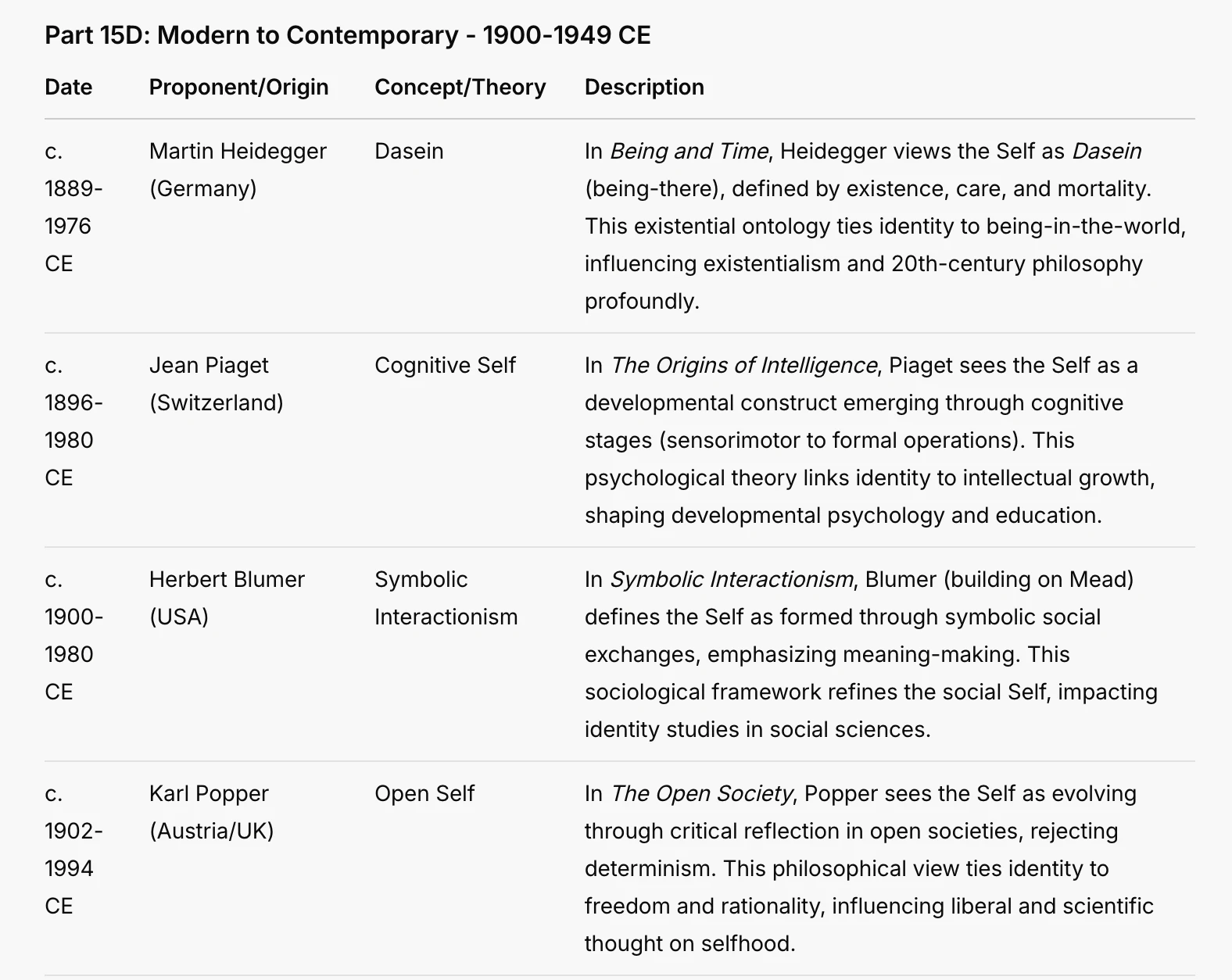
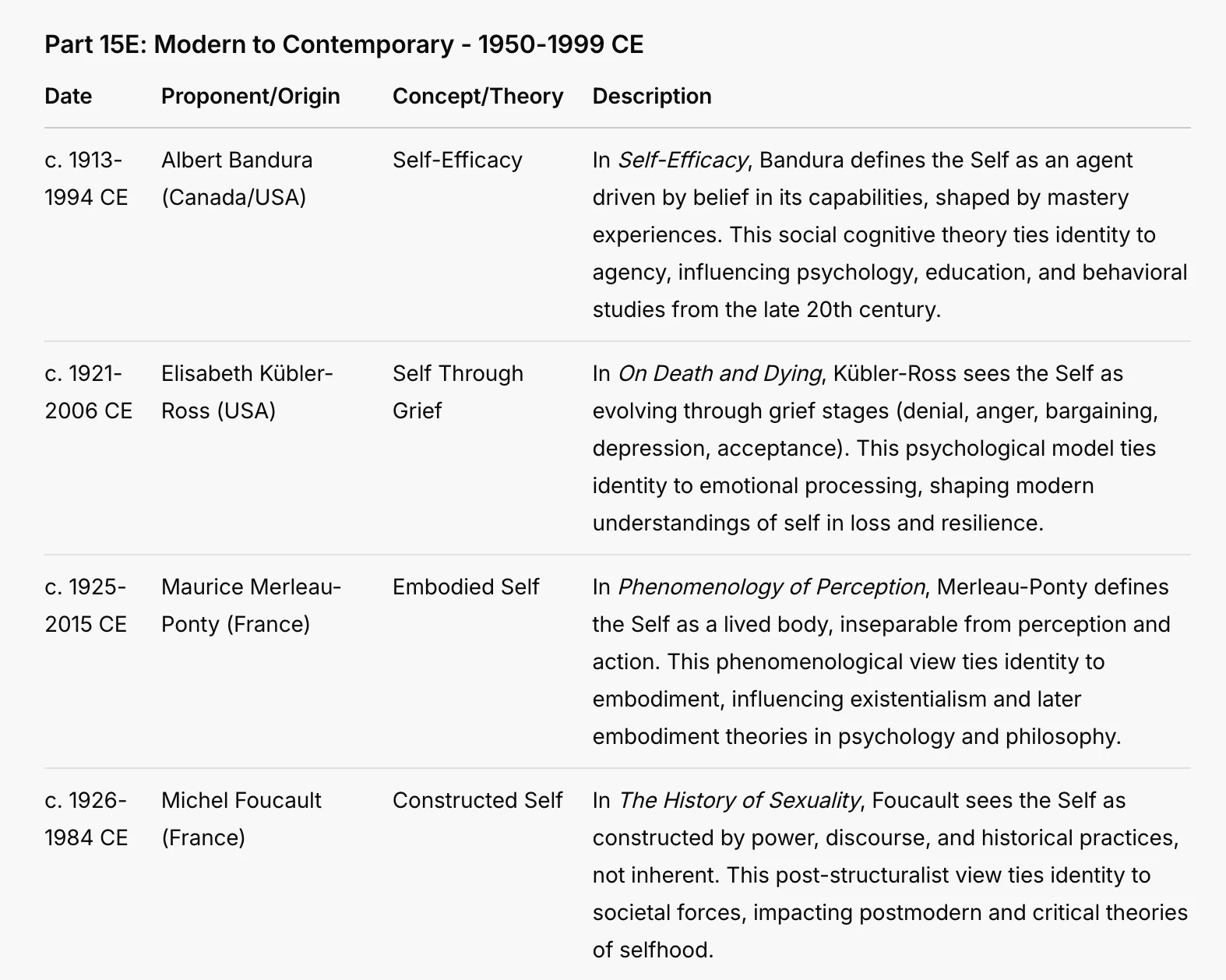
Piaget (1896-1980) – (Cognitive Self): A Swiss brain-whiz, Piaget flipped child psychology on its head with ‘The Origins of Intelligence’ (1936), decoding how kids build their minds from scratch in Geneva.
Overview: Piaget’s Cognitive Self is a brain-built masterpiece! He says you construct your “you” through stages—sensorimotor, preoperational, concrete, formal—stacking smarts like Lego bricks. No preset Self—just a growing puzzle your noggin pieces together!
Jean turns the Self into a DIY project! It’s not born—it’s crafted, layer by layer, as your brain wrestles the world. From babbling to big ideas, you’re a mental architect, building identity from the ground up.
Foucault (1926-1984) – Constructed Self: A French rebel-thinker, Foucault shook the 20th century with The History of Sexuality (1976-1984), digging into power’s dirty secrets from Paris.
Overview: Foucault’s Constructed Self is a puppet on strings! He says society—power, rules, chatter—molds your “you” like clay. No core Self—just a shape smashed out by history’s hammer and culture’s chisel!
Michel calls the Self a rigged game! You’re not a free soul—you’re a mash-up of what power cooks up, from laws to gossip. Identity’s a script society writes, and you’re just playing the part.
Albert Bandura (1925-2021) – Self-Efficacy: A Canadian-American psych titan, Bandura rocked the world with Self-Efficacy (1997), proving belief drives action from Stanford’s labs.
Theory Overview: Bandura’s Self-Efficacy builds the Self brick by brick! He says you’re a doer, forged by belief in your own juice—mastery, modeling, pep talks. No magic “you”—just a confidence tower you stack yourself!
Bandura makes the Self a power-up! It’s not a gift—it’s grit, pieced together from wins and cheers. You construct your “I can” through life’s grind, turning raw nerve into a solid, brain-born badass.
Neuroscience
The Self as Brain
Neuroscience anchors the Self in the brain’s intricate machinery, revealing a dynamic interplay of neural networks, bodily signals, and potential continuity that underpins its depth—a stark contrast to the Selfie’s fleeting, dopamine-driven flicker. Aristotle (c. 350 BCE) vision of a virtuous soul pursuing eudaimonia might find echoes in the brain’s quest for balance—a symphony of neural circuits firing toward well-being, a richness Selfies can’t replicate with their transient bursts. The default mode network (DMN) serves as the Self’s introspective core, igniting during reflection—daydreams, memories, identity weaving a narrative across time—yet fading in Alzheimer’s, where continuity dissolves, a profundity Selfies, mere snapshots, never approach—Damasio (1999) grounds it in somatic markers, bodily signals like a racing heart or clenched gut shouting “I exist!”—a visceral foundation Selfies mimic with posed expressions but lack in lived resonance, their static frames devoid of life’s pulse. Van Lommel (2006) probes NDEs, suggesting consciousness persists beyond brain cessation, a non-local thread Selfies can’t trace. Merleau-Ponty (1963) ties it to behavioral structures—Robinson (2001) shatters its natural evolutionary bounds.
Jung’s Self emerges from a neural dance—prefrontal cortex weaving conscious intent with limbic shadows, a wholeness Selfies crop out—Freud’s Thanatos lurks in amygdala-driven trauma loops, a depth Selfies bury under filters—Anna Freud’s defenses deploy prefrontal suppression, calming storms Selfies can’t weather—Erikson’s maturing “Me” evolves through neural plasticity, synapses pruning and strengthening across life’s stages, a journey Selfies freeze in adolescence’s mirror—Piaget’s temporal Self tracks causality via hippocampal memory, a continuity Selfies sever with their “now”. Bowlby’s oxytocin floods attachment circuits, neural warmth of love Selfies can’t forge, their likes a cold substitute.
Bandura’s self-efficacy sparks prefrontal control, belief driving action where Selfies falter in passivity—Dabrowski’s levels ascend from basal ganglia’s reward chase to prefrontal transcendence. Selfies stall at instant gratification—Vygotsky’s mirror neurons reflect others’ actions, learning Selfies parrot—Knowles’s planning shapes executive function. Razran’s wires habits into enduring pathways. Self persists where Selfies repeat—Gurdjieff’s metacognition watches, a brain observing itself—Maslow’s peak harmonizes networks, a symphony Selfies can’t play. Hermans’s voices juggle circuits, a multiplicity Selfies reduce. Hulley’s art heals through creativity’s wiring—Zahavi’s instant “me” pulses pre-thought—Thomasson’s tales weave memory—Wilson-Dunn’s twists misread—Konner’s evolutionary roots deepen its substrate—Van Lommel extends it beyond, NDEs hinting at a Self unbound by brain death—Liu & Perry probe its conscious roots—Selfies? A shallow buzz against this vast neural canvas.
Jung (1875-1961) -Self as Archetypal Core: A Swiss psyche-probing genius, Jung broke from Freud to map the mind’s depths, dropping The Integration of the Personality (1939) amid a world craving inner truth.
Overview: Jung’s Self is the brain’s big boss—an archetypal core uniting conscious and unconscious, wired into your skull as the total “you.” It’s the hub of individuation, sparking wholeness from your neural jungle.
Carls’s Self is your brain’s deep engine! It’s the master switch, firing up a psychic mash-up of ego, shadow, and soul-stuff. No fluffy myth—it’s the real deal, etched in your neurons, driving the whole crazy show.
Gazzaniga (1939-Present) – Interpreter Self: An American neuroscience trailblazer, Gazzaniga cracked split-brain secrets in the 1960s and penned The Consciousness Instinct (2018), decoding the brain’s storytelling tricks.
Concept: Gazzaniga’s Interpreter Self sees the left brain as a yarn-spinner, weaving a “you” from scattered neural chatter. It’s a hardwired fabulist, making sense of your head’s chaos with a running tale.
Michael’s Self is your brain’s slick narrator! The left lobe’s a chatterbox, spinning a “you” story from right-brain rumbles. It’s no ghost—just a neural bard, stitching a real “I” from the mess upstairs.
van Lommel (1943-Present) – Non-Local Self: A Dutch cardiologist turned consciousness explorer, van Lommel jolted the medical world with his 2001 Lancet study on near-death experiences (NDEs), pushing brain science into wild new territory.
Overview: In Consciousness Beyond Life (2010), van Lommel argues the Self isn’t just brain-bound—it’s a non-local buzz, persisting beyond death via NDEs. Your noggin’s a receiver, not the whole show, tuning into a cosmic signal that keeps “you” humming.
Pim flips the script—your brain’s a radio, not the DJ! The Self’s a signal zipping through neurons, but it doesn’t die when the plug’s pulled. NDEs prove it’s real, wired into your head yet bigger than the box.
Sociology
The Self as a Social Product
Sociology forges the Self within the crucible of social interaction, a dynamic tapestry woven from collective norms, roles, and relationships—an intricate construct starkly contrasting the Selfie’s isolated, performative sheen. Aristotle (c. 350 BCE) envisions it thriving in community—its virtues like courage and justice blooming only through engagement with others, a relational depth Selfies sever with their solitary lens—Durkheim (1893) anchors it in societal norms, a web of shared expectations binding individuals into a cohesive whole, a structure Selfies exploit for likes but lack in substance—Mead (1934) casts it as a product of roles—emerging through the “I” acting and the “Me” reflecting others’ gazes, a dialogue Selfies reduce to a one-way mirror—Cooley’s (1902) “looking-glass self” sees it mirrored in social feedback, like teens craving likes, yet Selfies capture only the reflection, not the interplay.
Jung’s (1940) persona cloaks it, a mask crafted for society’s stage, a complexity Selfies mimic but strip of inner truth—Anna Freud’s (1946) defenses shift blame outward, a social shield Selfies echo in curated perfection—Erikson’s (1959, 1968) crises forge identity through communal challenges, from trust’s cradle to integrity’s twilight, a journey Selfies freeze in youth’s shallow frame—Piaget’s (1965) fairness emerges in peer rules, Self growing through negotiation, not X’s applause—Bowlby’s (1958) love ties it to attachment, a social bond Selfies can’t replicate with digital nods—Bandura and Walters (2000) shape it via social models, learning through observation Selfies twist into imitation—Dabrowski’s (1977) rebellion bucks conformity, a defiance Selfies lack, tethered to trends—Baumeister et al. (2012) frame it as a social creation—Curran et al. (1995) wield it as a tool for change.
Vygotsky’s words craft it through interaction—language as society’s forge—Knowles’s choices tweak it in adulthood, a refinement Selfies bypass—Veblen’s flash displays it, a conspicuous status Selfies amplify but hollow—Razran’s habits root it in collective rhythms—Self endures where Selfies repeat—Gurdjieff’s crowd dulls it, a sleep Selfies deepen—Hermans’s roles dance across contexts, a multiplicity Selfies flatten—Thompson’s teamwork proves it grows through collaboration, not isolation—Taylor’s roots tie it to shared history, a legacy Selfies uproot—Konner’s evolutionary lens traces its social origins—Van Lommel hints at a Self persisting beyond social ties, NDEs suggesting a continuity Selfies can’t reflect—Torah and Bible sanctify it within community—Selfies amplify this forge’s sheen but miss its fire, a superficial echo of a Self made by society’s embrace, a product both shaped and shaping the collective.
George H. Mead (1863-1931) – Social Self: An American sociology trailblazer, Mead flipped identity on its head with Mind, Self, and Society (1934), cooking up big ideas at Chicago’s brain hub.
Overview: Mead’s Social Self is a society-baked blockbuster! He splits you into the wild “I” and the tame “Me,” built from chats and the crowd’s vibe—the “generalized other.” No social buzz, no “you”—just a blank screen!
Mead says your Self’s a group project! The “Me” mirrors what folks expect—friends, family, the whole gang—shaping you like clay. You’re a selfie snapped by society’s lens, not a solo star.
Herbert Blumer (1900-1987) – Symbolic Interactionism: A sharp American sociologist, Blumer took Mead’s torch and lit up Symbolic Interactionism (1969), decoding human vibes from Chicago to Berkeley.
Overview: Blumer’s Self is a social remix! You’re spun from symbols—words, winks, nods—tossed around in a chatty dance with others. No script, no Self—just a jam session society plays on repeat!
Blumer turns your Self into a crowd-sourced hit! Every wink or word tweaks the tune—your “you” is a collab, not a solo. It’s a live feed from the social stream, built by the buzz around you.
Erving Goffman (1922-1982) – Dramaturgical Self : A Canadian-American social wizard, Goffman dropped The Presentation of Self in Everyday Life (1959), spotlighting life’s stage from Berkeley to Philly.
Overview: Goffman’s Dramaturgical Self is a spotlight steal! He says you’re an actor, strutting your stuff for the audience—friends, foes, strangers—swapping masks to fit the scene. No core “you”—just a show society directs!
Goffman casts your Self as a play’s lead! You’re all costume and cues—smiling for the boss, tough for the crew—crafted by the crowd’s cheers or boos. It’s a social script, not a soul, shining under the stage lights.
Cultural Studies
The Self as Narrative
Culture weaves the Self into a rich narrative—a sprawling tapestry of stories spun across time, place, and tradition, a living saga of meaning that starkly contrasts with the Selfie’s fleeting, fragmented snippets. Aristotle (c. 350 BCE) casts it as a protagonist pursuing eudaimonia—a narrative of virtuous acts unfolding through courage, wisdom, and justice, a tale of purpose Selfies reduce to a single frame of vanity—Western traditions crown it a hero, individual triumphs etched in epic arcs, while Eastern chorus blends it into communal sagas, depths Selfies can’t harmonize with their solo poses. Jung’s (1940) archetypal tales span myths, universal threads of shadow and light Selfies clip into surface gloss. Erikson’s (1968) struggles mark chapters from trust’s cradle to wisdom’s twilight, a life story Selfies truncate to youth’s mirror—Piaget’s (1965, 1969) rules clock its moral and temporal rhythm—fairness and time weaving a narrative arc Selfies snap into “now”. Bowlby’s (1958, 1960) love roots it in bonds, a story of attachment Selfies can’t tell with likes—Dabrowski’s (1977) climb rises through crises, a redemptive plot Selfies stall at base—Vygotsky’s (1980) yarns stitch it with cultural voices, a dialogue Selfies mute.
Knowles’s (1973) and Merriam’s (2001) growth stretch it through learning’s chapters, a maturation Selfies bypass—Veblen’s (2003) brag shines as a boastful subplot, a flair Selfies amplify but hollow—Razran’s (1971) mix colors it with East-West hues, a blend Selfies bleach. Gurdjieff’s (1973) wake stirs it to awareness, a call Selfies sleep through. Maslow’s (1966) peak crowns it with self-actualization, a summit Selfies can’t scale—Hermans’s (2001) voices thread a polyphonic tale, a chorus Selfies flatten. Hulley’s (2017) art paints its later strokes, a canvas Selfies can’t touch. Taylor’s (1989) roots ground it in history’s soil, a legacy Selfies uproot. Torah (c. 1200 BCE) and Bible (c. 50 CE) sanctify it with divine purpose. Van Lommel (2001-2013) extends it beyond, NDEs narrating a Self persisting past death. Konner’s (2010) evolutionary roots deepen its origins—Levine’s (1992) constructions layer its narrative complexity—a story Selfies, Rettberg’s snippets, fade as mere footnotes against.
Taylor– Historical Self:
Charles dropped Sources of the Self in 1989, wrestling with modernity’s big questions from his perch in Montreal.
Overview: Your Self’s a history blockbuster! Taylor says you’re a story stitched from centuries—faith, fights, and freedom—passed down like a family heirloom. No past, no plot, no you—just a blank page!
Dennet – Narative Self:
Daniel shook things up with Consciousness Explained in 1991, mixing philosophy with mind-blowing science from Tufts.
Overview: The Self’s a brain-spun yarn! Dennett calls you a “center of narrative gravity”—a tale your noggin knits from life’s scraps. It’s fiction with flair, not fact—your Self’s the star of a made-up movie!
Whitehead (1861-1947) –Process Self:
He unleashed Process and Reality in 1929, blending science and soul from Cambridge to Harvard.
Overview: You’re a living script! Whitehead sees the Self as a reel of cosmic scenes—each moment a new frame, rolling with the universe’s beat. No still shot, just a story that keeps playing!
Hermans (Dialogical Self)
Hubert cooked up the Theory in the 1990s, shaking up identity studies from Nijmegen.
Overview: Your Self’s a chatty cast! Hermans says you’re a story of voices—inner characters like “the dreamer” or “the critic”—bickering and blending into a wild narrative. No single script, just a noisy stage play of you!
The Selfie:
A Digital Mirror
Rettberg’s (2017) Selfie emerges as a curated artifact—a digital mirror reflecting a polished, partial glimmer of the Self, a shallow veneer that pales against the vast, intricate depths charted by thinkers across centuries, revealing its profound limitations as a distortion of human experience’s richness. It captures Hume’s (1739) fleeting bits—a kaleidoscope of perceptions frozen in a single frame, stripped of the fluid richness that defines true experience, a mere snapshot where the Self flows unbound—Jung’s (1940) persona, a mask meticulously crafted for X’s stage, devoid of the unconscious wholeness beneath, presenting a facade that obscures the shadow Selfies dare not reveal—Freud’s (1920) shield, a fragile barrier against Thanatos’s lurking shadows, a superficial guard crumbling under the Self’s deeper drives—Erikson’s (1959, 1968) adolescent “Me,” stalled mid-stage in a snapshot of youth’s quest for identity, missing the full arc of growth from trust to wisdom.
Piaget’s (1969) moment, a tick of time severed from the Self’s expansive temporal narrative, lacking past-future continuity—Bowlby’s (1958) cry for love, met with hollow likes rather than enduring bonds anchoring the Self, a digital nod absent oxytocin’s warmth—Dabrowski’s (1966-1977) base level, clinging to instant gratification Selfies never rise above, stuck at the foothills of transcendence—Vygotsky’s (1980) group echo, a parroted nod Selfies mimic without learning’s depth—Veblen’s (2003) brag, a flaunted shell Selfies inflate into a hollow show—Razran’s (1971) habit, a repetitive scroll perpetuated without grounding—Gurdjieff’s (1973) sleep, a dulled “I” lulled by X’s stream—Maslow’s (1966) low rung, a plateau far from self-actualization—Hermans’s (2001) single voice, a whisper where the Self resounds as a chorus—not Aristotle’s virtuous “I,” woven with purpose—nor Bandura’s (1997) mastery of action—Selfies chase likes instead—Baumeister et al.’s social Self shrinks to a digital shell.
This digital mirror reflects a curated illusion. Young (2007) and Grenberg (2015) uncover its deception, a facade hiding flaws beneath filters—Wilson-Dunn’s (2004) misread introspection, a surface Selfies polish without probing—Zahavi’s “mineness” eludes it, a raw essence Selfies can’t feel. Thomasson’s awareness-knowledge split leaves Selfies blind—Taylor’s roots lie buried—Torah and Bible sanctify beyond—Knowles’s and Merriam’s learning flattens to posing—Hulley’s healing finds no echo. Bar-On’s truth stays mute—Locke’s memory, Hegel’s evolution, Konner’s roots weave continuity—Van Lommel’s NDEs hint at persistence. Damasio’s markers signal life—Selfies shine as a pixelated mirage, a hollow echo of the Self’s depth.
Butler (1956-Present) – Performative Self: An American feminist firebrand, Butler rewrote the rules with Gender Trouble (1990), shaking up identity from Berkeley’s radical roots.
Overview: Butler’s Performative Self is a Selfie on steroids! You’re a live reel—gender, quirks, all—repeating moves for the social feed. No fixed Self—just a mirrored dance of clicks and filters, reflecting the world’s script!
Butler’s Selfie is your TikTok truth! Every post’s a performance—strutting, posing—bouncing back what culture craves. You’re a digital echo, not a solid soul, crafting a “you” that shines in the screen’s glare.
Overview: Rettberg’s Selfie is the ultimate digital mirror! She says your snap’s a curated cut—cropped, filtered, posted—reflecting a polished “you” for the online crowd. It’s not the real Self—just a glossy echo bouncing off the net!
Rettberg’s Selfie is your screen’s shine! You snap, tweak, and share—a perfect pose staring back from the digital glass. It’s a mirrored “you”—all surface, no depth—crafted for likes, not truth, a pixel puppet of the social scroll.
The Self as an Illusion
The Self as an illusion posits a radical challenge—perhaps it lacks inherent essence, a mere construct spun from fleeting perceptions, social roles, and cognitive tricks, a mirage masquerading as substance. Hume (1739) lays its groundwork, casting the Self as a bundle of perceptions—no fixed core, just a stream of sensations Selfies echo in their fragmented bits—Jung’s (1940) persona suggests a crafted mask, a social illusion Selfies amplify without the depth beneath—Freud’s (1920) drives swirl as impulses, not a unified “I,” a chaos Selfies shield with curated calm—Bandura and Walters (2000) shape it through observed models, Self as mimicry, not origin—Bandura’s (1997) efficacy builds belief, yet what believes if the Self dissolves?—Young (2007) and Grenberg (2015) unveil deception, a Self tricked into being by its own tales—Wilson-Dunn’s (2004) misread introspection, a mirror Selfies polish without piercing—Zahavi’s (2000) “mineness” feels real, yet might be a brain’s sleight—Thomasson’s (2006) awareness-knowing split questions its solidity—Damasio’s markers signal a felt “I” that may deceive—Selfies fit this illusion, Rettberg’s curated flickers reflecting a “Me” with no anchor—Cuijpers (2001) probes its fragility if materialism falters—Bem (1967) suggests perception crafts it.
Yet, Aristotle’s virtuous soul resists—a purpose-driven “I” defying dissolution—Maslow’s peak crowns a real ascent—Gurdjieff’s “Know Thyself” demands a knower—Taylor’s historical roots ground a continuity—Erikson’s stages weave a thread—Piaget’s time builds a narrative—Bowlby’s bonds tie a core—Vygotsky’s mediation forges a social “I”—Knowles’s learning shapes a subject—Dabrowski’s crises elevate a being—Hermans’s voices hum a chorus—Hulley’s art heals a presence—Bar-On’s truth speaks a reality—Konner’s evolution tracks more than dust—Van Lommel hints at persistence beyond—Torah and Bible affirm a sacred core. If illusion, why this persistence? Selfies thrive as illusions—X’s stage suits a phantom—but the Self’s depth hints at more, a tension unresolved between mirage and fact.
Guatama Buddha (563-483 BCE) India’s enlightenment guru, the Buddha flipped Vedic wisdom upside down with his radical teachings, sparking a global mindshift.
Overview: The Self’s a fake-out! In Anatta (no-self), Buddha says you’re just a flicker of five aggregates—body, feelings, thoughts—no core, no “you.” It’s a mirage we cling to, gone in a puff when you see through the trick!
Hume (1711-1776) Scotland’s Enlightenment rebel, Hume torched sacred cows with A Treatise of Human Nature in 1739, shaking up the 18th-century brain game.
Overview: Self’s a sham! Hume’s Bundle Theory calls you a jumble of perceptions—sights, sounds, vibes—no glue, no real “I.” It’s a wild stream we slap a name on, but peek inside—nothing’s holding it together!
Churchland – Neuroself:
A Canadian-American neuro-wizard, Churchland zapped old ideas with Neurophilosophy in 1986, rewiring self-talk from her science throne.
Overview: Self’s a brain bluff! Churchland says it’s just neurons firing—no soul, no magic “you,” just a slick illusion cooked up by your skull. You’re a bio-trick, not a big truth—deal with it!
The Self as a Fact
Beyond empirical bounds, the Self emerges as a potential spiritual fact—a proposition Cuijpers (2001) frames succinctly: “As long as the materialist cannot indisputably prove that the soul does not exist, they should at least admit the possibility that it could exist.” This stance challenges the materialist paradigm, which reduces the Self to physical processes (e.g., Damasio’s (1999) somatic markers, Bandura’s (1997) neural efficacy), by highlighting its failure to disprove an immaterial essence—thus opening a space for the soul’s plausibility. Aristotle (c. 350 BCE) hints at this with eudaimonia—a flourishing beyond mere matter—while Jung’s (1940) wholeness bridges conscious and unconscious, suggesting a transcendent core Selfies can’t touch. Gurdjieff’s (1973) “Know Thyself” invokes a metaphysical awakening, a Self irreducible to X’s scroll.
Freud’s Thanatos and Bowlby’s bonds imply drives and connections materialists struggle to fully explain—Maslow’s peak transcends physicality, a spiritual summit—Hermans’s voices weave a polyphony hinting at a soul’s chorus—Taylor’s historical roots anchor it in a narrative beyond atoms. Zahavi’s pre-reflective “mineness” feels pre-material, Husserl’s (1999) pure experience eludes physical grasp—Young and Grenberg’s deception veil what Bar-On’s truth unveils: a Self not wholly corporeal. Bandura and Walters model behavior, yet the “why” of choice persists—Konner’s evolution tracks bodies, not their spark—Piaget’s time and Erikson’s stages suggest a continuity materialists can’t pin—Selfies, Rettberg’s flickers, reflect a surface this depth defies. Van Lommel (2001-2013) bolsters this with NDE research, showing consciousness persists beyond clinical death, a non-local essence Selfies can’t grasp. Torah and Bible affirm it as divine image and redeemed soul—Krishnamurti strips away illusion for inner freedom. Polanyi guards it against tyranny while Sen links it to developmental liberty.
Eastern traditions enrich this view: Indian Vedanta sees the Self (Atman) as eternal, one with Brahman, beyond illusion (maya) Selfies perpetuate—Mahayana Buddhism posits a boundless Self, empty yet luminous, transcending anatta’s negation—Tibetan Buddhism’s clear-light mind endures beyond death, a continuity Van Lommel echoes. Daoism’s Self flows with the Dao, an unnameable essence Selfies can’t frame—Zen Buddhism strips to pure awareness, a “no-self” Selfies parody with blank stares. Materialism’s silence—its inability to disprove the soul—invites possibility. If Knowles’s learning shapes, Dabrowski’s crises elevate, and Hulley’s art heals, what animates these? The Self as a spiritual fact stands not as proven, but as plausible—a mystery science can’t yet bury, a thread from Aristotle to Zen, weaving beyond the physical.
Descartes (1596-1650 CE):
In 17th-century France, Descartes, a key figure of the Scientific Revolution, wrote Meditations on First Philosophy (1641) amid a shift toward rationalism and skepticism about traditional knowledge.
Concept: Descartes’ “Cogito Ergo Sum” (“I think, therefore I am”) asserts the Self as a thinking substance, an undeniable fact established through doubt—since doubting proves thinking, and thinking proves existence.
Descartes nails the Self as rock-solid! You can doubt everything—God, the world—but not that you’re thinking right now. That’s the Self—a real, rational mind, no tricks, no fluff, just pure, unshakable truth staring back at you.
Aquinas (1225-1274 CE) (Rational Soul):
In 13th-century Italy, Aquinas, a Dominican friar and Scholastic titan, penned Summa Theologica during the High Middle Ages, blending Aristotelian philosophy with Christian theology.
Concept: Aquinas defines the Self as a rational soul, a substantial union of body and intellect, created by God as a real entity with an eternal purpose, distinct from mere appearances.
Aquinas says the Self’s no ghost—it’s a God-made fact! Your soul’s the real deal, fusing flesh and smarts into one solid package, built to chase truth forever. It’s not a maybe; it’s a divine stamp of existence, plain as day.
Damasio (1950-Present) – Somatic Self:
In late 20th-century Portugal/USA, Damasio, a neuroscientist, wrote Descartes’ Error (1994) during a boom in brain science, challenging mind-body dualism with empirical evidence.
Concept: Damasio’s Somatic Self views the Self as a biological fact, rooted in bodily emotions and neural processes, a measurable reality of brain-body feedback loops sustaining consciousness.
Damasio grounds the Self in flesh and sparks! It’s no fairy tale—your brain and body churn out a real “you” through feelings and signals. Cut the wires, and it’s gone—proof the Self’s a hardwired, living truth, not a flimsy guess.
The Self Across Traditions
The Self spans spiritual traditions, a prism refracting diverse truths against Selfies’ flat gleam. Vedanta’s Atman—eternal, unified with Brahman—casts the Self as ultimate reality, beyond maya’s veil Selfies thicken. Aristotle’s (c. 350 BCE) virtuous soul aligns with its purpose, Maslow’s (1966) peak its echo. Mahayana Buddhism’s boundless Self—empty of inherent existence yet radiant—transcends Hume’s (1739) bundle, a luminous void Selfies can’t reflect—Jung’s (1940) wholeness finds kinship here. Tibetan Buddhism’s clear-light mind persists beyond death—Van Lommel’s (2001-2013) NDEs resonate—Torah (c. 1200 BCE) and Bible (c. 50 CE) mirror this with divine endurance—Selfies fade where this shines.
Daoism’s Self flows with the Dao—formless, eternal—Gurdjieff’s awakening nods—Bandura’s (1997) efficacy shapes it within flux—Selfies’ static poses clash. Zen Buddhism’s “no-self”—pure awareness—strips Veblen’s (2003) shell, Zahavi’s (2000) “mineness” reimagined—Damasio’s markers ground it, yet it soars—Selfies mimic this void with empty frames. Erikson’s stages, Piaget’s time, Bowlby’s bonds weave continuity—Vygotsky’s social Self, Knowles’s learning, Dabrowski’s crises align with growth—Taylor’s roots tie it to history—Hermans’s voices hum across traditions—Hulley’s art heals universally—Konner’s evolution traces its arc—Van Lommel extends it beyond—Selfies, Rettberg’s flickers, reflect none of this tapestry’s depth, a shallow parody of a Self both universal and unique, a narrative echoing through Vedanta’s unity, Mahayana’s radiance, Tibetan’s clarity, Dao’s flow, and Zen’s silence—Sen’s freedom nurtures its unfolding.
Philosophical Tradition:
Kant’s Transcendental Self posits the Self as a necessary condition of experience, a unifying apperceptive structure inherent to rational cognition. Within the philosophical tradition, it is the transcendental “I” that synthesizes sensory data into coherent knowledge, serving as the epistemic foundation for all understanding, distinct from empirical contingencies.
Religious Tradition:
Secular Tradition:
Bandura’s – Self-Efficacy reflects the secular tradition’s reliance on empirical evidence, establishing the Self as a constructed yet real phenomenon within the observable domain of human behavior. Its factual basis emerges from the systematic study of agency, aligning with the tradition’s emphasis on scientific validation over speculative abstraction, rendering the Self a concrete product of psychosocial dynamics.
Synthesis
Convergence and Contrast
The Self converges as a grand synthesis—a vibrant confluence of perspectives weaving a resilient, multifaceted identity that spans material, social, cultural, and spiritual realms, starkly contrasting the Selfie’s shallow flicker. Aristotle’s (c. 350 BCE) virtue lays its foundation—a soul pursuing eudaimonia through acts of courage and wisdom, a purpose Selfies dilute with instant likes—Locke’s (1690) memory threads its continuity, a lifeline Selfies snap. Hume’s (1739) bits dance in flux, a richness Selfies freeze—Hegel’s (1807) growth rises through conflict, a depth Selfies can’t fathom. Zahavi’s (2000) “mineness” pulses raw, a being Selfies can’t see. Jung’s (1940) wholeness blends shadow and light, a tapestry Selfies crop—Freud’s drives churn beneath, a force Selfies mask—Bandura’s (1997) efficacy empowers action, a strength Selfies lack. Erikson’s stages arc from trust to wisdom, a journey Selfies halt—Piaget’s arc spans thought’s growth, a timeline Selfies shrink.
Bowlby’s bonds anchor in love, a warmth Selfies can’t hold—Dabrowski’s levels climb to nobility, a height Selfies miss. Vygotsky’s mediation weaves social threads—Knowles’s learning shapes its course—Veblen’s status glints. Gurdjieff’s wake calls it forth—Maslow’s peak crowns its ascent—Hermans’s voices hum a chorus. Hulley’s art heals—Taylor’s roots ground—Torah (c. 1200 BCE) and Bible (c. 50 CE) sanctify—Van Lommel extends—Young, Grenberg shadow—Bar-On lights—Damasio signals—Konner evolves—Vedanta’s Atman, Mahayana’s radiance, Tibetan’s clarity, Dao’s flow, Zen’s silence weave a transcendent thread. Selfies (Rettberg) fade as pixels against this vast quest. Baumeister et al.’s social lens binds it further.
References:
- Aristotle (c. 350 BCE). Nicomachean Ethics.
- Bandura, A. (1997). Self-efficacy: The exercise of control. Freeman.
- Bandura, A., & Walters, R. (2000). Social learning and personality development. Paidós.
- Bar-On, D. (2015). Philosophical Explorations, 18(2), 134-152.
- Baumeister, R. F., Masicampo, D. E. J., & Twenge, J. M. (2012). The Social Self. In Handbook of Psychology (2nd ed., Vol. 5: Personality and Social Psychology).
- Bem, D. J. (1967). Self-perception: An alternative interpretation of cognitive dissonance phenomena. Psychological Review, 74(3), 183-200.
- Best, R. (1996). Education, spirituality, and the whole child. Cassell.
- Bible (c. 50 CE). Christian scriptures on the Self as soul.
- Bordin, I. A., et al. (2013). Cadernos de Saúde Pública, 29(1), 13-28.
- Bowlby, J. (1958). The nature of the child’s tie to his mother. British Psychoanalytic Society.
- Bowlby, J. (1960). Grief and mourning in infancy and early childhood. British Psychoanalytic Society.
- Brinthaupt, T. M., & Lipka, R. P. (1992). The Self: Definitional and methodological issues (Vol. VI). State University of New York Press.
- Cuijpers, P. H. M. (2001). “As long as scientists cannot indisputably prove that the soul does not exist, they should at least admit the possibility that it could exist.”
- Curran, K. M., Seashore, C. N., & Welp, M. G. (1995). Use of Self as an instrument of Change. ODN National Conference, Seattle, WA.
- Dabrowski, K. (1966). International Journal of Psychiatry in Clinical Practice, 2, 229-244.
- Dabrowski, K. (1967). Personality-shaping through positive disintegration. Little Brown.
- Dabrowski, K., Kawczak, A., & Piechowski, M. M. (1970). Mental growth through positive disintegration. Gryf.
- Dabrowski, K., & Piechowski, M. M. (1977). Theory of levels of emotional development (Vols. 1-2). Dabor Science.
- Damasio, A. R. (1999). Descartes’ Error: Emotion, Reason, and the Human Brain. Vintage Books.
- Difilippo, J. P. (1975). Kant’s concept of the Self [Master’s thesis]. McMaster University, Hamilton.
- Erikson, E. H. (1959). Identity and the life cycle. International Universities Press.
- Erikson, E. H. (1968). Identity, youth and crisis. W.W. Norton.
- Fleming, G. (1933). Archives of Psychology, 148.
- Freud, A. (1946). The ego and the mechanisms of defense. International Universities Press.
- Freud, S. (1920). Beyond the pleasure principle. Hogarth Press.
- Gertler, B. (2011a). Self-Knowledge. In The Stanford Encyclopedia of Philosophy. New York: Routledge.
- Grenberg, J. M. (2015). International Journal of Philosophy, 1-15.
- Gurdjieff, G. I. (1973). Views from the real world: Early talks. E.P. Dutton & Co.
- Hegel, G. W. F. (1807). Phänomenologie des Geistes.
- Hermans, H. J. M. (2001). Culture & Psychology, 7(3), 243–281.
- Hulley, P. (2017). The transpersonal in shadow and self [Thesis]. University of KwaZulu-Natal.
- Hume, D. (1896). A treatise: Of the understanding (Vol. 1). Henry Frowde. (Orig. 1739)
- Hume, D. (1896). A treatise: Of the passions (Vol. 2). Henry Frowde. (Orig. 1739)
- Husserl, E. (1999). Husserl Studies, 16(3), 183–254.
- Jongepier, F. S., & Strijbos, D. (2015). Philosophical Explorations, 18(2), 123-133.
- Jung, C. G. (1940). The integration of the personality. Kegan Paul.
- Katsafanas, P. Kant and Nietzsche on Self-Knowledge. Boston University.
- Knowles, M. S. (1973). The adult learner. G.P. Company.
- Konner, M. (2010). The evolution of childhood. Belknap Press.
- Krishnamurti, J. (1975). The First and Last Freedom. Harper One Publishers.
- Lafour, F. D. (2013). Transfiguratie (1st ed.). Franklin D. Lafour.
- Levine, G. L. (1992). Constructions of the self. Rutgers University Press.
- Liu, J. L., & Perry, J. (Eds.). (2011). Consciousness and the Self. Cambridge University Press.
- Locke, J. (1690). An essay concerning human understanding.
- Manis, J. (Ed.). (2003). The theory of the leisure class. Pennsylvania State University. (Orig. 1899)
- Maslow, A. H. (1966). The psychology of science. Henry Regnery.
- Merleau-Ponty, M. J. J. (1963). The structure of behavior [La Structure du Comportement] (A. L. Fischer, Trans., Ed. 1942 by Presses Universitaires de France ed.). Beacon Press.
- Merleau-Ponty, M. (1978). Phenomenology of Perception. Routledge & Kegan Paul.
- Merriam, S. B. (2001). New Directions for Adult and Continuing Education, 89, 3-13.
- Piaget, J. (1952). The origins of intelligence. International Universities Press. (Orig. 1936)
- Piaget, J. (1954). The construction of reality. Basic Books. (Orig. 1950)
- Piaget, J., & Inhelder, B. (1962). The psychology of the child. Basic Books. (Orig. 1950)
- Piaget, J. (1964). The early growth of logic. Routledge & Kegan Paul. (Orig. 1959)
- Piaget, J. (1965). The moral judgment of the child. The Free Press. (Orig. 1932)
- Piaget, J., & Inhelder, B. (1967). The child’s conception of space. W.W. Norton. (Orig. 1956)
- Piaget, J. (1969). The child’s conception of time. Routledge & Kegan Paul. (Orig. 1946)
- Piaget, J. (1977a). Intellectual evolution. Cambridge University Press. (Orig. 1970)
- Piaget, J. (1977b). The grasp of consciousness. Routledge & Kegan Paul. (Orig. 1974)
- Polanyi, M. (1958). Tyranny and Freedom, Ancient and Modern. Quest.
- Razran, G. H. S. (1971). Mind in evolution. Houghton Mifflin.
- Rettberg, J. W. (2017). Self-representation in social media. Sage.
- Robinson, A. (2001). The Shattered Self: The End of Natural Evolution – Book Review. British Medical Journal, 323(7314), 699.
- Sen, A. (1999). Development as Freedom. Alfred A. Knopf.
- Taylor, C. (1989). Sources of the self. Harvard University Press.
- Thomasson, A. L. (2006). Psyche, 12(2).
- Thompson, I. (2013). Research in the Teaching of English, 47(3).
- Torah (c. 1200 BCE). Jewish text on the Self as God’s image.
- van Aken, M. A. G. (2006). De personality of children [Inaugural address]. Utrecht University.
- Van Lommel, P., Wees van, R., Meyers, V., & Elfferich, I. (2001). Lancet, 358.
- Van Lommel, P. (2004). Brain Death and Disorders of Consciousness. Kluwer Academic/Plenum.
- Van Lommel, P. (2006). World Futures, 62, 134-151.
- Van Lommel, P. (2013). Journal of Consciousness Studies, 20(1,2), 7-48, Article 1234.
- Vygotsky, L. S. (1980). Mind in society. Harvard University Press.
- Vygotsky, L. S. (1997a). Problems of the theory and history. Plenum Press. (Orig. 1926)
- Wilson, T. D., & Dunn, E. W. (2004). Annual Review of Psychology, 55, 493-518.
- Wyatt, J. F. (2006). Karl Jaspers, The Idea of the University: An existentialist argument for an institution concerned with freedom. Studies in Higher Education, 7(1).
- Young, H. P. (2007). Self-knowledge and self-deception. Johns Hopkins University/University of Oxford.
- Zahavi, D. (2000). Exploring the self. John Benjamins Publishing Company.
Further Readings

Essentials in Innovation
Essential in Innovation is the ability to change your behavior, driven by imagination reshaping your business and ...
The Concept of Self
The ‘Self’ unfolds as a journey of discovery—mind, body, and spirit weaving a rich tapestry. It traces ...
Action Research at Work
Discover the impact of Action research to create lasting change, Cut sunk costs and empower organizations by increasi...

Performance Teams
Performance Teams in today’s fast-paced, competitive Business Landscape are the engine of commercial success.
...
What About Quality?
What About Quality is the main question regarding the Theories, Schools and Management practices matching modern chal...

Luck & Chances
In “Luck and Chance: A Multidisciplinary Exploration”, we delve into probability theory. Stripping away c...

Changing E-Learning
E-learning is outdated, and downgrading Intellectual Autonomy. A-Learning™ is the new way of pursuing wisdom. It re...
The Funnel of Truth
Investigate your Funnel of Truth and discover how your Perception of Reality hinders you to grasp the factual Actuali...

Evolution of Science
The evolution of science’s, from ancient history to modern genomics, unveils science’s dynamic evolution, a restl...
Beyond the Expert Trap
Tired of harming others and falling into the Expert-Trap? Join the League to study and practice GuideWork™ an advan...

Q4 Unleashed
Q4 redefines quality management. It integrates four paradigms into one cohesive framework, structured around four dir...

Strategic Visioning
The science of strategic visioning, planning, and the art of decision-making in today’s complex, rapidly changing a...

Info Snapping Strategies
Info Snapping Strategies is the art of capturing critical information amplified by AI to master the rhythm of the Inf...
The Origin of Life
A critical analysis highlighting abiogenesis’s empirical and probabilistic shortcomings, exposing biases in nat...

Quality as a Journey
Reframing Quality as a Heroic Journey towards Virtuosity suggests: a path made by walking to transform leaders, tea...

Burden of Stress
Release the burden of stress by finding meaning in life, connecting with others, reclaiming your well-being and relax...

Dynamics of Choice
The Dynamics of Choice is a dance between agency, context and stimuli in personal, business and organizational life. ...

2025 © All Rights Reserved