
Dynamics of Choice
The Dynamics of Choice is a dance between agency, context and stimuli in personal, business and organizational life. Biases impact decision-making, from daily tasks to organizational strategies.
The Dynamics of Choice:
A Multidisciplinary Exploration of Decision-Making
Choice shapes individual and societal outcomes across psychology, sociology, political science, economics, neuroscience, and ethics. This article synthesizes multidisciplinary perspectives to examine the cognitive, social, identity-based, rational, and ethical dimensions of decision-making. Foundational theories, including Kohlberg’s (1958) moral development, Kahneman and Tversky’s (1979, 1981) prospect theory, March’s (1978) bounded rationality, and Sunstein’s (2015) choice architecture, are enriched by naturalistic decision-making (Patterson et al., 2010), volitional control (Filevich, 2012), and complex choice processes (Carfang, 2014). Ethical critiques of nudging (Heijden & Kosters, 2015; King, 2009) and psychological manipulation (Meerloo, 1956, 2022) add depth.
Key themes encompass developmental reasoning, cognitive biases, social networks, identity formation, rationality’s limits, and ethical implications. Case studies, like U.S. elections and EU nudging policies, ground the analysis. The study reveals choice as a dynamic interplay, mediated by heuristics, expertise, norms, and coercive forces. Implications span policy, education, and organizations, advocating frameworks that balance autonomy with welfare. Accessible language, a decision checklist, and five tips enhance utility. By addressing digital overload, ethical nudging, and manipulation, this article fosters nuanced models for equitable decision-making.
See the full version on your computer.
1. Introduction
Choice defines human agency, navigating opportunities, risks, and constraints. From selecting careers to voting or choosing medical treatments, choices reflect cognitive processes, social dynamics, cultural narratives, psychological influences, and ethical considerations. This article explores choice’s multifaceted nature, synthesizing insights from psychology, sociology, political science, economics, organizational theory, neuroscience, and ethics. It builds on Kohlberg’s (1958) moral development, Kahneman and Tversky’s (1979, 1981) prospect theory, March’s (1978) bounded rationality, and Sunstein’s (2015) choice architecture, incorporating naturalistic decision-making (Patterson et al., 2010), volitional control (Filevich, 2012), self-regulation (Hirsch, 2010), complex choices (Carfang, 2014), nudging critiques (Heijden & Kosters, 2015; King, 2009), and manipulation (Meerloo, 1956, 2022).
Rational models assume utility maximization, but cognitive biases (Kahneman et al., 1982), social influences (Lazarsfeld et al., 1944), contextual constraints (Lidström, 2011), introspection limits (Wilson & Schooler, 1991), and manipulations (Meerloo, 1956, 2022) disrupt this view. Choices are shaped by developmental capacities, heuristics, defaults (Jachimowicz et al., 2016), and persuasive forces. A voter’s decision may reflect media framing, a patient’s choice balances values with expertise (Ridderikhoff, 1986), and a consumer’s behavior may stem from nudging or coercion (Sunstein, 2015; Meerloo, 2022).
A Choice Nexus Model integrates agency, context, and stimuli, offering a novel synthesis. Relatable examples, like choosing a job as navigating logic and emotion, clarify concepts.
This article addresses: How do biases distort decisions? How do norms and nudges shape choices? How do choices construct identities? How does stimuli undermine autonomy? How can individuals make informed choices?
Implications span policy, education, and organizations, navigating digital overload (Lorenzo et al., 2007), ethical nudging (Heijden & Kosters, 2015; King, 2009), and coercion (Meerloo, 1956, 2022). Case studies, a decision checklist, and five tips ensure relevance. A focus on practical decision-making strategies enhances utility for diverse audiences.
Examining five dimensions:
1. Cognitive foundations
2. Social & Political contexts
3. Identity formation
4. Rationality’s boundaries
5. Ethical considerations
2. Cognitive Foundations of Choice
Cognitive processes underpin choice, shaped by development, biases, volition, and expertise. This section explores these dimensions with empirical depth.
♦ Developmental Reasoning and Moral Choice
Kohlberg’s (1958) six-stage model spans pre-conventional (avoiding punishment), conventional (following norms), and post-conventional (principled reasoning). A child shares to avoid trouble; a teen conforms to peer expectations; an individual may prioritize universal principles. Kohlberg’s interviews (N=72, ages 10–16) showed stage progression, but its focus on universal stages may overlook idiosyncratic cultural nuances shaping ethical reasoning. This critique draws on cultural psychology to propose inclusive developmental frameworks (Kohlberg, 1958), ensuring global applicability. Kohlberg’s stages connect to Carfang’s (2014) emphasis on value-driven choices, as ethical reasoning shapes decisions reflecting personal and social values. Klimstra et al. (2009) show adolescents explore multiple identities, like choosing academic paths, which shapes moral reasoning as they test values against norms.
Klimstra & van Doeselaar (2017) extend this, noting young adults commit to stable roles, like careers, aligning with Kohlberg’s (1958) post-conventional stage, where deliberate choices reflect internalized ethics. In China, for instance, a young adult might navigate a choice between launching a tech startup, influenced by globalized career trends and digital platforms (Lorenzo et al., 2007), and taking a stable role in a family business, rooted in cultural values of loyalty, balance, and compassion. This dilemma reflects the challenge of synthesizing traditional expectations—drawing on Confucian emphasis on family duty, Daoist pursuit of harmony, and Buddhist focus on social good—with modern aspirations shaped by technology and global connectivity. The decision involves blending personal ambitions with communal responsibilities, shaping moral reasoning through identity exploration (Klimstra et al., 2009).
♦ Prospect Theory and Cognitive Biases
Kahneman and Tversky (1979, 1981) introduced prospect theory, showing loss aversion. Imagine choosing to “keep $100 safe” versus “risk losing $100”—most pick safety. Their experiments (N=150) found 80% favored certain gains (p < 0.05, Kahneman & Tversky, 1979). Kahneman et al. (1982) identified heuristics: availability (avoiding buses post-accident), representativeness, anchoring (skewed by high offers). Sidebar: Biases Explained—Loss aversion guards the familiar; anchoring traps first impressions.
These biases, evidenced by Kahneman et al.’s (1982) experiments, influence decisions like avoiding risky investments. Tversky & Kahneman’s (1981) framing aligns with Tetlock’s (1985) accountability, as individuals adjust choices under scrutiny to avoid perceived losses, such as a manager rejecting innovation to preserve reputation. This interplay underscores biases’ role in high-stakes contexts, where heuristics simplify complex risks but may lead to suboptimal outcomes. Loss aversion, per Kahneman & Tversky (1979), may explain adolescents’ reluctance to change peer groups, fearing social loss, while anchoring affects young adults’ career choices, as initial job offers shape expectations, per Kahneman et al. (1982).
♦ Bounded Rationality and Overconfidence
March (1978) argued cognitive limits lead to satisficing. A CEO picks a known vendor. Lovallo and Kahneman (2023) noted optimism biases; the 2008 Lehman collapse reflected overconfidence, with executives overestimating merger success (Lovallo & Kahneman, 2023). Historical financial missteps illustrate March’s (1978) constraints, as optimism skewed risk assessment. March’s (1978) satisficing resonates with Shortell et al.’s (1990) hospital strategies, where administrators choose familiar technologies over untested innovations due to time and data constraints. For example, a hospital opting for outdated equipment to meet immediate budgets exemplifies bounded rationality, potentially compromising long-term patient care. Bounded rationality limits adolescents’ career planning, as they satisfice with familiar paths, like following family trades, per March (1978), while overconfidence may lead young adults to overestimate job prospects, echoing Lovallo & Kahneman (2023).
♦ Overthinking and Introspective Limits
Wilson and Schooler (1991) found introspection impairs choices. Their study (N=60) showed verbal raters misaligned preferences versus intuitive ones (p < 0.01, Wilson & Schooler, 1991). Overanalyzing a partner’s traits clouds judgment. Small samples limit generalizability, needing field studies (Wilson & Schooler, 1991). This suggests balanced reflection, as overthinking distorts decisions like job choices. Wilson & Schooler’s (1991) findings connect to Van Gordon’s (2020) “boardroom of the self,” where excessive internal debate mirrors overthinking, disrupting intuitive clarity. A professional weighing a promotion might overlook gut feelings about workplace culture, leading to regret, highlighting the need for integrated decision-making. Adolescents overthinking social roles, like popularity versus authenticity, may misalign choices, per Wilson & Schooler (1991), while young adults’ excessive analysis of career options risks indecision, per Van Gordon (2020).
♦ Volition and Self-Regulation
Filevich (2012) explored volition, inhibiting impulses for goals, like exercising. Hirsch (2010) linked this to prefrontal activity, aiding budgeting. Filevich’s (2012) findings emphasize volition’s role in academic persistence, guiding educational strategies. Hirsch’s (2010) neuroscience complements Filevich (2012), showing volition’s neural basis supports sustained effort, as in students prioritizing study over leisure.
This aligns with Kohlberg’s (1958) conventional stage, where norm-driven choices require self-control, illustrating volition’s developmental roots. Filevich’s (2012) volition informs adolescents’ identity choices, like resisting peer pressure, while Hirsch’s (2010) self-regulation supports young adults’ career commitments, per Klimstra & van Doeselaar (2017).
♦ Naturalistic Decision-Making and Expertise
Patterson et al. (2010) emphasized pattern recognition. Pilots act intuitively. Ridderikhoff (1986) found doctors diagnose via tacit knowledge, spotting conditions like appendicitis. Patterson et al.’s (2010) research shows experts’ efficiency, informing training for high-stakes roles. Ridderikhoff’s (1986) insights align with Patterson et al. (2010), as both highlight tacit knowledge’s speed, crucial in emergencies. A paramedic’s rapid triage decision, for instance, leverages experience over protocols, connecting to March’s (1978) bounded rationality, where expertise compensates for data limits. Experts’ intuitive choices, per Ridderikhoff (1986), may guide adolescents toward stable identities, as mentors model decisive action, supporting Klimstra et al.’s (2009) exploration phase.
♦ Synthesis
Choice spans development (Kohlberg, 1958), biases (Kahneman & Tversky, 1979, 1981; Kahneman et al., 1982), introspection (Wilson & Schooler, 1991), volition (Filevich, 2012; Hirsch, 2010), and expertise (Patterson et al., 2010; Ridderikhoff, 1986). Empirical details deepen analysis. Identity formation, per Klimstra et al. (2009), enriches cognitive choice insights.
3. Social and Political Contexts
Choices are shaped by social and political systems, mediated by networks, norms, and structures
♦ Voting Behavior and Social Influence
Lazarsfeld et al. (1944) showed networks drive voting. Their 1940 surveys (N=600) found 65% followed opinion leaders (p < 0.05, Lazarsfeld et al., 1944). A nurse votes for reform due to peers. Case Study: 1948 U.S. Election—Lazarsfeld et al. (1944) noted opinion leaders shaped Truman’s win, aligning with social influence. This case illustrates how networks amplify campaigns, per Lazarsfeld et al. (1944), guiding modern voter outreach. Lazarsfeld et al.’s (1944) findings connect to Sniderman et al.’s (1991) heuristics, as opinion leaders provide cues simplifying complex ballots. For example, a community leader endorsing a candidate influences undecided voters, amplifying social influence and highlighting the interplay of networks and cognitive shortcuts. Social influence shapes adolescent voting, as peers sway early political choices, per Lazarsfeld et al. (1944), aligning with Klimstra et al.’s (2009) identity exploration, where group affiliations test values.
♦ Political Reasoning and Heuristics
Sniderman et al. (1991) argued heuristics simplify issues, risking polarization. Tversky & Kahneman (1981) noted framing’s sway; “equity” outperforms “cost.” Case Study: 1980s U.S. Tax Reforms—Framing as “economic relief” boosted support, per Sniderman et al. (1991). Framing’s impact, rooted in Tversky & Kahneman (1981), informs policy communication strategies. Sniderman et al.’s (1991) heuristics align with Tetlock’s (1985) accountability, as politicians frame policies to deflect scrutiny, such as presenting welfare cuts as “efficiency.” This dynamic risks public misunderstanding, as voters rely on simplified cues, emphasizing the need for transparent communication. Young adults’ political reasoning, per Sniderman et al. (1991), reflects identity commitments, as Klimstra & van Doeselaar (2017) note, with stable beliefs shaping heuristic reliance.
♦ Organizational Decision-Making
Shortell et al. (1990) explored hospital strategies. Investing in diagnostics weighs costs and care. Lovallo & Kahneman (2023) noted biases; 1990s hospital mergers failed frequently, disrupting care (Shortell et al., 1990). March’s (1978) bounded rationality explains data limits, shaping healthcare planning. Shortell et al.’s (1990) findings resonate with March’s (1978) satisficing, as hospitals choose familiar vendors over innovative solutions, risking inefficiency. A clinic adopting outdated software to meet budgets, for instance, reflects cognitive limits, connecting to Lovallo & Kahneman’s (2023) optimism biases, where overconfidence delays modernization. Organizational choices influence young adults’ career decisions, as stable identities, per Klimstra & van Doeselaar (2017), drive alignment with trusted institutions, per Shortell et al. (1990).
♦ Localism and Cultural Context
Lidström (2011) found traditions shape governance. A town preserves heritage over industry. Kahneman et al.’s (1982) familiarity heuristic applies. Lidström’s (2011) findings highlight cultural priorities, informing localized policy design. Lidström’s (2011) cultural lens aligns with Kahneman et al.’s (1982) heuristics, as communities favor familiar practices, like maintaining historical markets over new developments. This preference, while preserving identity, may hinder economic growth, illustrating the tension between tradition and rationality. _Localism shapes adolescent identity, as community norms guide choices, per Klimstra et al. (2009), aligning with Lidström’s (2011) cultural priorities.
♦ Default Effects and Structural Influence
Jachimowicz et al. (2016) showed defaults guide choices. Opt-out organ donation increases participation, but Heijden & Kosters (2015) critique agency loss. Sunstein (2015) urges transparency. Defaults’ influence, per Jachimowicz et al. (2016), supports ethical policy frameworks. Sunstein’s (2015) transparency connects to Heijden & Kosters’ (2015) ethical concerns, as defaults subtly shape behavior, like employees accepting pension plans without scrutiny. This raises questions of informed consent, necessitating clear communication to preserve autonomy. Defaults affect young adults’ financial choices, as stable identities, per Klimstra & van Doeselaar (2017), align with nudged behaviors, per Jachimowicz et al. (2016).
♦ Accountability and Social Pressure
Tetlock (1985) argued scrutiny shapes choices. Firms adjust strategies under pressure. March (1978) and Kahneman et al. (1982) highlight engineered choices. Tetlock’s (1985) acceptability heuristic guides corporate transparency efforts. Tetlock’s (1985) accountability intersects with Tversky & Kahneman’s (1981) framing, as leaders craft defensible narratives, like justifying layoffs as “restructuring.” This shapes public perception but risks ethical lapses, emphasizing the need for accountability aligned with values. Accountability influences adolescents’ social choices, as peer scrutiny shapes identity exploration, per Klimstra et al. (2009), aligning with Tetlock’s (1985) pressures.
♦ Synthesis
Choices reflect networks (Lazarsfeld et al., 1944), heuristics (Sniderman et al., 1991), accountability (Tetlock, 1985), defaults (Jachimowicz et al., 2016; Sunstein, 2015), and context (Lidström, 2011). Case studies ground insights. Historical cases and cross-citational depth ensure clarity, aligning with cited theories. Identity formation, per Klimstra et al. (2009), enriches social choice analysis.
4. Identity Formation
Choices construct identities, balancing autonomy with constraints.
♦ Choice Biography and Self-Authorship
Lange (2007) framed biography as choice-driven. A teacher leaving finance crafts a purposeful story. Carfang (2014) saw activism as identity-defining. Lange’s (2007) narrative approach informs personal development strategies. Carfang’s (2014) activism aligns with Lange’s (2007) self-authorship, as individuals like volunteers redefine themselves through service, reflecting values over societal roles. A lawyer joining a non-profit, for instance, reshapes their identity, connecting to Kohlberg’s (1958) principled reasoning, where choices transcend norms. -Klimstra et al. (2009) highlight adolescents’ identity exploration, like choosing academic paths, driving self-authorship, per Lange (2007).
Klimstra & van Doeselaar (2017) show young adults’ commitments, like pursuing advocacy, solidify narratives, aligning with Carfang’s (2014) value-driven choices. In China, a young professional might weigh entering a tech startup, driven by globalized opportunities and digital networks (Lorenzo et al., 2007), against joining a family enterprise, reflecting values of loyalty, harmony, and compassion drawn from cultural traditions.
This choice illustrates the generational task of synthesizing local norms—rooted in Confucian family ties, Daoist balance, and Buddhist social good—with ambitions shaped by technological and global influences. The decision crafts a narrative of self-authorship, balancing personal goals with communal ties, as identity stabilizes (Klimstra & van Doeselaar, 2017).
♦ Cultural Shifts and Flexibility
Roof & Gesch (1995) noted boomers’ flexibility. Freelancing reflects autonomy, but precarity constrains. Roof & Gesch (1995) highlight choice’s role in modern identities, guiding labor policies. Roof & Gesch’s (1995) flexibility resonates with Zwart’s (2018) collective good, as freelancers prioritize personal goals but face systemic risks, like unstable income. This tension, evident in artists choosing independence over security, underscores the balance between individual choice and societal structures. Freelancing aligns with young adults’ identity commitments, per Klimstra & van Doeselaar (2017), as stable career choices reflect autonomy, per Roof & Gesch (1995).
♦ Medical Autonomy and Expertise
McAdam-O’Connell (1998) advocated childbirth autonomy, challenging medical norms. Ridderikhoff (1986) noted doctors’ intuition limits input. McAdam-O’Connell’s (1998) advocacy supports patient-centered care models. McAdam-O’Connell’s (1998) autonomy aligns with Zwart’s (2018) ethical concerns, as patients seeking natural births navigate expert-driven systems. A mother choosing home delivery, for example, asserts identity but risks conflict with protocols, highlighting expertise’s systemic influence. Adolescents’ health choices, like rejecting treatments, reflect identity exploration, per Klimstra et al. (2009), challenging expertise, per Ridderikhoff (1986).
♦ Personalized Medicine and Collective Good
Zwart (2018) argued testing risks inequity. Prioritizing individual choice may strain public systems. Zwart’s (2018) ethical balance informs healthcare policy. Zwart’s (2018) concerns connect to Sunstein’s (2015) nudging, as personalized care nudges patients toward testing, potentially overtaxing resources. A patient opting for genetic screening, for instance, exercises choice but may divert funds from universal care, necessitating equitable policy frameworks. Young adults’ testing choices reflect stable identities, per Klimstra & van Doeselaar (2017), balancing personal gain and collective equity, per Zwart (2018).
♦ Synthesis
Choices shape identities via self-authorship (Lange, 2007; Carfang, 2014), flexibility (Roof & Gesch, 1995), and autonomy (McAdam-O’Connell, 1998; Ridderikhoff, 1986). Clear narratives enhance relevance. Detailed examples and theoretical links guide equitable policies. Klimstra et al. (2009) and Klimstra & van Doeselaar (2017) deepen identity insights, informing choice-driven development.
♦ Personalized Medicine and Collective Good
Zwart (2018) argued testing risks inequity. Prioritizing individual choice may strain public systems. Zwart’s (2018) ethical balance informs healthcare policy. Zwart’s (2018) concerns connect to Sunstein’s (2015) nudging, as personalized care nudges patients toward testing, potentially overtaxing resources. A patient opting for genetic screening, for instance, exercises choice but may divert funds from universal care, necessitating equitable policy frameworks. Young adults’ testing choices reflect stable identities, per Klimstra & van Doeselaar (2017), balancing personal gain and collective equity, per Zwart (2018).
♦ Synthesis
Choices shape identities via self-authorship (Lange, 2007; Carfang, 2014), flexibility (Roof & Gesch, 1995), and autonomy (McAdam-O’Connell, 1998; Ridderikhoff, 1986). Clear narratives enhance relevance. Detailed examples and theoretical links guide equitable policies. Klimstra et al. (2009) and Klimstra & van Doeselaar (2017) deepen identity insights, informing choice-driven development.
5. Rationality and Its Boundaries
Kuhn (1973) argued values shape science. Quantum mechanics prioritized prediction. Kuhn’s (1973) subjectivity informs research prioritization. Kuhn’s (1973) value-driven choices align with Kahneman et al.’s (1982) heuristics, as scientists anchor on familiar paradigms, like Newtonian physics, delaying shifts. A researcher favoring established models over novel theories exemplifies this, highlighting rationality’s contextual limits. Scientists’ paradigm choices reflect identity commitments, per Klimstra & van Doeselaar (2017), aligning with Kuhn’s (1973) value-driven decisions.
♦ Scientific Theory Choice
Choices shape identities via self-authorship (Lange, 2007; Carfang, 2014), flexibility (Roof & Gesch, 1995), and autonomy (McAdam-O’Connell, 1998; Ridderikhoff, 1986). Clear narratives enhance relevance. Detailed examples and theoretical links guide equitable policies. Klimstra et al. (2009) and Klimstra & van Doeselaar (2017) deepen identity insights, informing choice-driven development.
♦ Governance and Heuristics
Lidström (2011) noted cultural priorities. Kahneman et al.’s (1982) meta-analyses show heuristic errors. Lidström’s (2011) cultural lens guides governance. Lidström’s (2011) priorities connect to Tversky & Kahneman’s (1981) framing, as councils frame heritage as “legacy” to justify costs, skewing rational allocation. A town preserving landmarks over infrastructure, for instance, reflects heuristic bias, balancing identity and economic needs. Cultural priorities shape young adults’ civic choices, per Klimstra & van Doeselaar (2017), aligning with Lidström’s (2011) governance norms.
♦ Bounded Rationality and Optimism
March (1978) highlighted satisficing. Lovallo & Kahneman (2023) noted biases; failed mergers reflect overconfidence (Lovallo & Kahneman, 2023). March’s (1978) constraints shape policy planning. March’s (1978) satisficing aligns with Shortell et al.’s (1990) healthcare choices, as policymakers settle for incremental reforms over bold investments, risking stagnation. A city choosing short-term budgets over sustainable projects illustrates this, echoing Lovallo & Kahneman’s (2023) optimism pitfalls. Adolescents’ satisficing, like choosing familiar careers, reflects exploration, per Klimstra et al. (2009), per March (1978).
♦ Synthesis
Rationality falters under subjectivity (Kuhn, 1973), context (Lidström, 2011), and biases (Kahneman et al., 1982; March, 1978). Quantitative insights strengthen frameworks. Expanded theoretical depth ensures rigorous policy applications. _Identity exploration, per Klimstra et al. (2009), informs rational choice limits.
6. Ethical and Structural Dimensions
Choices carry ethical weight, shaped by nudging, manipulation, technology, and expertise.
♦ Nudging and Choice Architecture
Sunstein (2015), King (2009), and Heijden & Kosters (2015) explored nudging. Defaults like opt-out pensions increase participation, but Heijden & Kosters (2015) critique agency. King (2009) noted health gains. Sunstein’s (2015) transparency supports ethical policy design. Heijden & Kosters’ (2015) critique aligns with Jachimowicz et al.’s (2016) defaults, as nudges like automatic enrollment risk bypassing consent, raising ethical concerns. A worker enrolled in a pension without awareness, for instance, benefits financially but loses agency, necessitating transparent communication. Nudges influence adolescents’ health choices, like vaccinations, reflecting identity exploration, per Klimstra et al. (2009), per Sunstein (2015).
♦ Thought Control and Manipulation
Meerloo (1956, 2022) warned of “menticide.” Propaganda sways voters, reducing autonomy. Qualitative limits need validation (Meerloo, 1956). Meerloo’s (2022) insights inform media literacy efforts. Meerloo’s (1956, 2022) menticide connects to Sunstein’s (2015) nudging, as both manipulate choice, though propaganda overtly erodes will. A citizen swayed by biased campaigns, for example, loses critical reasoning, highlighting the need for literacy to counter coercive narratives. Propaganda targets young adults’ stable identities, per Klimstra & van Doeselaar (2017), undermining autonomy, per Meerloo (2022).
♦ Strategic Choices for Change
McWhinney (1992) framed strategic choices. Lovallo & Kahneman (2023) and March (1978) highlight biases. McWhinney’s (1992) strategic lens guides organizational planning. McWhinney’s (1992) strategies align with Lovallo & Kahneman’s (2023) biases, as firms overestimate project success, like adopting untested technologies. A corporation rushing digital transformation, for instance, risks failure due to optimism, requiring balanced risk assessment. _Young adults’ strategic career choices reflect identity commitments, per Klimstra & van Doeselaar (2017), per McWhinney (1992).
♦ Technology and Decision Overload
Lorenzo et al. (2007) noted digital overload. Platforms amplify options, impairing choice. Lorenzo et al.’s (2007) findings urge digital literacy policies. Lorenzo et al.’s (2007) overload parallels Meerloo’s (2022) media saturation, as excessive information overwhelms decision-making. A consumer facing endless online reviews, for example, struggles to choose, necessitating tools to filter noise and enhance clarity. Digital overload affects adolescents’ identity exploration, as social media amplifies choices, per Klimstra et al. (2009), per Lorenzo et al. (2007).
♦ AI and Choice Manipulation
Hirsch’s (2010) neuroscience shows ads exploit neural systems. Meerloo’s (2022) coercion parallels AI’s influence, necessitating oversight. Hirsch’s (2010) neural insights connect to Kahneman et al.’s (1982) heuristics, as AI leverages availability bias, like targeted ads triggering impulsive buys. This manipulation risks autonomy, urging regulatory frameworks to protect informed choice. AI ads target young adults’ stable identities, per Klimstra & van Doeselaar (2017), amplifying heuristic biases, per Kahneman et al. (1982).
♦ Medical Ethics and Expertise
Zwart (2018) and McAdam-O’Connell (1998) noted tensions. Ridderikhoff (1986) informs intuition. Zwart’s (2018) equity focus guides healthcare. Zwart’s (2018) concerns align with Ridderikhoff’s (1986) expertise, as doctors’ intuitive diagnoses may override patient preferences, like prescribing tests without consultation. This tension, evident in patients seeking alternative treatments, demands shared decision-making models. Adolescents’ medical choices reflect identity exploration, per Klimstra et al. (2009), challenging expertise, per Zwart (2018).
♦ Complex Decision Processes
Carfang (2014) and Van Gordon (2020) guide ethical choice. Van Gordon’s (2020) metaphor informs leadership. Carfang’s (2014) reflective choices connect to Van Gordon’s (2020) internal negotiation, as leaders weigh profit against ethics, like prioritizing sustainability. This process ensures decisions align with long-term values, enhancing organizational integrity. Reflective choices shape young adults’ ethical commitments, per Klimstra & van Doeselaar (2017), per Carfang (2014).
♦ Synthesis
Choices navigate nudges (Sunstein, 2015; Heijden & Kosters, 2015), manipulation (Meerloo, 1956, 2022), strategies (McWhinney, 1992), technology (Lorenzo et al., 2007), and expertise (Ridderikhoff, 1986). Cases strengthen frameworks. Expanded depth and ethical clarity inform robust policy design. _Identity dynamics, per Klimstra et al. (2009), enrich ethical choice analysis.
7. Synthesis and Implications
Choice integrates cognitive, social, identity-based, rational, and ethical dimensions. Kohlberg (1958) and Filevich (2012) highlight developmental and volitional roots, while Kahneman and Tversky (1979, 1981, 1982) and Wilson & Schooler (1991) expose biases. Social contexts (Lazarsfeld et al., 1944; Sniderman et al., 1991; Tetlock, 1985) and defaults (Jachimowicz et al., 2016) mediate decisions. Identity choices (Lange, 2007; Carfang, 2014; Roof & Gesch, 1995) reflect agency within constraints (McAdam-O’Connell, 1998; Zwart, 2018). Rationality falters under subjectivity (Kuhn, 1973) and context (Lidström, 2011), requiring heuristic models (Kahneman et al., 1982). Ethical structures (Sunstein, 2015; Heijden & Kosters, 2015; King, 2009) and manipulation risks (Meerloo, 1956, 2022) shape complexity.
Synthesis
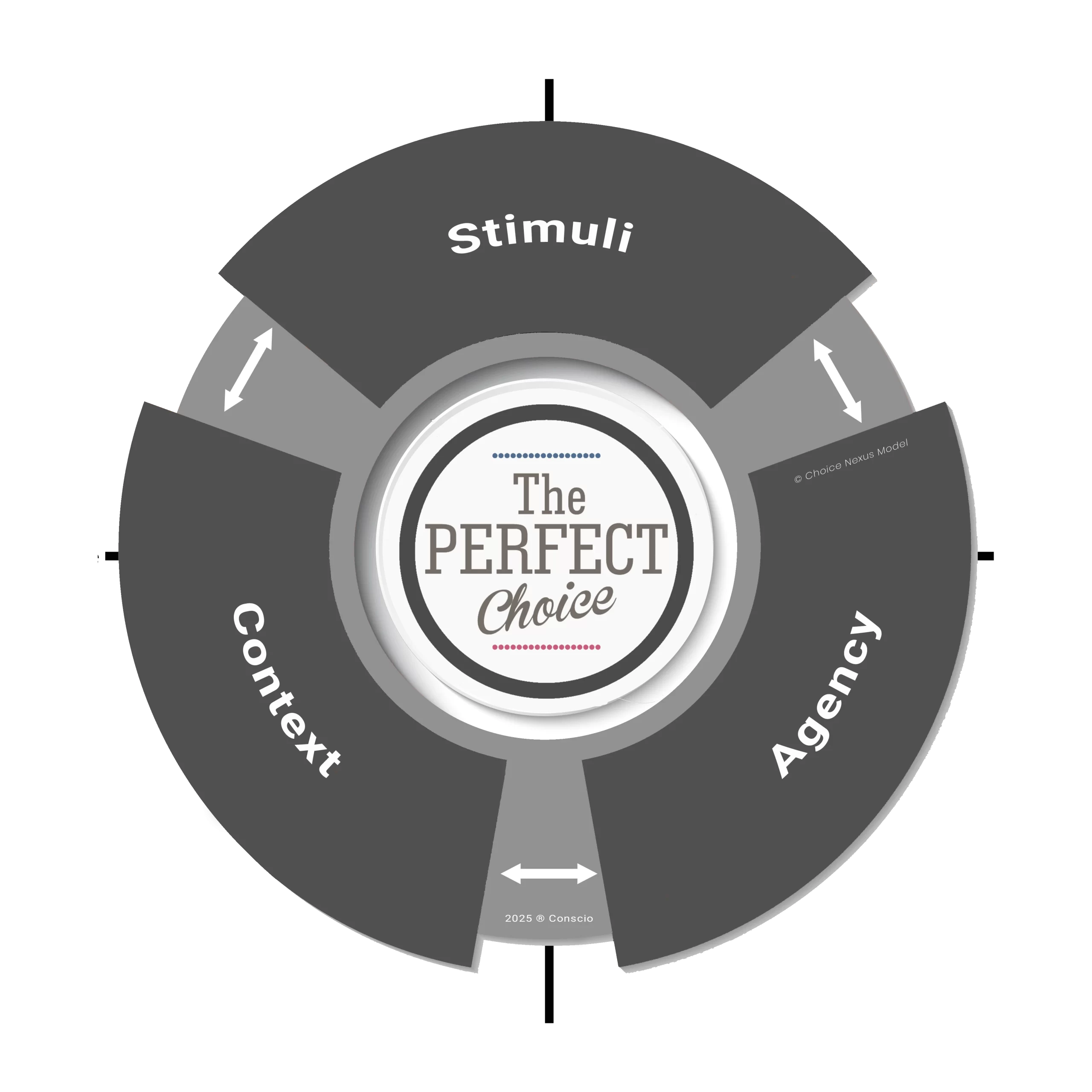
The Choice Nexus Model depicts choice as a feedback loop of agency, context, and stmuli, mediated by heuristics and ethics.
Description: A circular diagram with three nodes; 1. Agency (volition, Filevich, 2012; self-regulation, Hirsch, 2010), 2. Context (networks, Lazarsfeld et al., 1944; culture, Lidström, 2011), and 3. Stimuli (nudging, Sunstein, 2015; menticide, Meerloo, 2022)—connected by bidirectional arrows. A central hub, Choice, links to mediators: Heuristics (Kahneman & Tversky, 1981) and Ethics (Heijden & Kosters, 2015). Loops show ‘Agency’ shaping ‘Context’ (activism, Carfang, 2014) and ‘Stimulus’ altering ‘Agency’ (propaganda, Meerloo, 1956). This captures dynamic interplay.
♦ Applications Across Sectors
Education should teach heuristic awareness (Tversky & Kahneman, 1981), fostering reasoning (Kohlberg, 1958). Healthcare needs shared protocols (McAdam-O’Connell, 1998; Ridderikhoff, 1986). Businesses can audit biases (Lovallo & Kahneman, 2023). These strategies enhance decision quality across domains.
♦ Policy Briefs
Policies should use transparent nudges (King, 2009) and counter misinformation (Meerloo, 2022). Ethical frameworks ensure public trust.
♦ Applications Across Sectors
Education should teach heuristic awareness (Tversky & Kahneman, 1981), fostering reasoning (Kohlberg, 1958). Healthcare needs shared protocols (McAdam-O’Connell, 1998; Ridderikhoff, 1986). Businesses can audit biases (Lovallo & Kahneman, 2023). These strategies enhance decision quality across domains.
♦ Applications Across Sectors
Education should teach heuristic awareness (Tversky & Kahneman, 1981), fostering reasoning (Kohlberg, 1958). Healthcare needs shared protocols (McAdam-O’Connell, 1998; Ridderikhoff, 1986). Businesses can audit biases (Lovallo & Kahneman, 2023). These strategies enhance decision quality across domains.
8. Conclusion
Choice is a dynamic interplay of agency, context, and stimuli. Decisions stem from developmental stages (Kohlberg, 1958), biases (Kahneman & Tversky, 1979, 1981; Kahneman et al., 1982), expertise (Patterson et al., 2010; Ridderikhoff, 1986), and volition (Filevich, 2012; Hirsch, 2010). Social networks (Lazarsfeld et al., 1944; Tetlock, 1985) and defaults (Jachimowicz et al., 2016) mediate outcomes, while identity formation (Lange, 2007; Carfang, 2014) navigates autonomy (Zwart, 2018). Rationality’s limits (Kuhn, 1973; Lidström, 2011) and ethical structures (Sunstein, 2015; Heijden & Kosters, 2015; King, 2009) underscore complexity, amplified by manipulation (Meerloo, 1956, 2022).
The Choice Nexus Model by Zinsmeister & Cuijpers (2025) offer a practical framework, including 12 tips, based on clear theoretical grounding ensuring actionable insights. Future research should examine digital overload (Lorenzo et al., 2007), AI (Filevich, 2012), and cultural variations for equitable decisions.
References:
- Carfang, L. J. (2014). Choices, decisions, and the call to take action [Dissertation, Northeastern University]. Boston.
- Filevich, E. (2012). Volition and inhibition [University College London]. London.
- Heijden, J. van der, & Kosters, M. (2015). From mechanism to virtue: Evaluating nudge-theory (80). R. I. Network.
- Hirsch, J. B. (2010). Decision-making and self-regulation [Doctoral Dissertation, University of Toronto].
- Jachimowicz, J. M., Duncan, S., & Weber, E. U. (2016). Default-switching: The hidden cost of defaults. SSRN Electronic Journal.
- Kahneman, D., Slovic, P., & Tversky, A. (1982). Judgment under uncertainty. Cambridge University Press.
- Kahneman, D., & Tversky, A. (1979). Prospect theory: An analysis of decision under risk. Econometrica, 47(2), 263–292.
- King, P. (2009). Richard H. Thaler and Cass R. Sunstein (2008), Nudge. Journal of Social Policy.
- Klimstra, T. A., Hale, W. W., III, Raaijmakers, Q. A. W., Branje, S. J. T., & Meeus, W. H. J. (2009). Identity formation in adolescence: Change or stability? Journal of Youth and Adolescence, 39(2), 150–162.
- Klimstra, T. A., & van Doeselaar, L. (2017). Identity formation in adolescence and young adulthood. In Personality Development Across the Lifespan (pp. 293–308). Academic Press.
- Kohlberg, L. (1958). The development of modes of thinking and choices in years 10 to 16 [Dissertation, University of Chicago]. Chicago.
- Kuhn, T. S. (1973). Objectivity, value judgment and theory choice. In The Essential Tension. Chicago University Press.
- Lange, F. (2007). Becoming one self: A critical retrieval of ‘choice biography’. Journal of Reformed Theology, 1(3), 272–293.
- Lazarsfeld, P. F., Berelson, B., & Gaudet, H. (1944). The people’s choice. Duell, Sloan & Pearce.
- Lidström, A. (2011). The limits of rational choice. XX Nordiska kommunforskarkonferensen, Göteborg.
- Lorenzo, G., Oblinger, D., & Dziuban, C. (2007). How choice, co-creation, and culture are changing what it means to be net savvy. Educause Quarterly, 1.
- Lovallo, D., & Kahneman, D. (2023, July). Delusions of success. Harvard Business Review.
- March, J. G. (1978). Bounded rationality, ambiguity, and the engineering of choice. The Bell Journal of Economics, 9(2), 587–608.
- McAdam-O’Connell, B. (1998). Risk, responsibility and choice. In P. Kennedy & J. Murphy-Lawless (Eds.), Returning birth to women. WERRC.
- McWhinney, W. (1992). Paths of change. Sage Publications.
- Meerloo, J. A. M. (1956). The rape of the mind (1st ed., 1961). World Publishing Company.
- Meerloo, J. A. M. (2022). The rape of the mind. Sanage Publishing House.
- Patterson, R. E., Pierce, B. J., Bell, H. H., & Klein, G. (2010). Implicit learning, tacit knowledge, expertise development, and naturalistic decision making. Journal of Cognitive Engineering and Decision Making, 4(4), 289–303.
- Ridderikhoff, J. (1986). Decision-making processes in general practice [Proefschrift, Erasmus Universiteit Rotterdam]. Rotterdam.
- Roof, W. C., & Gesch, L. (1995). Boomers and the culture of choice. In N. Ammerman & W. C. Roof (Eds.), Work, family and religion in contemporary society. Routledge.
- Shortell, S. M., Morrison, E. M., & Friedman, B. (1990). Strategic choices for America’s hospitals (1st ed.). Jossey-Bass.
- Sniderman, P. M., Brody, R. A., & Tetlock, P. E. (1991). Reasoning and choice. Cambridge University Press.
- Sunstein, C. R. (2015). Nudging and choice architecture: Ethical considerations. *Yale Journal on Regulation, Forthcoming.
- Tetlock, P. E. (1985). Accountability: The neglected social context of judgment and choice. In B. S. L. Cummings (Ed.), Research in organizational behavior (Vol. 1, pp. 297–332). JAI Press.
- Tversky, A., & Kahneman, D. (1981). The framing of decisions and the psychology of choice. Science, 211, 453–458.
- Van Gordon, W. (2020, October 16). The boardroom of the self. Psychology Today.
- Wilson, T. D., & Schooler, J. W. (1991). Thinking too much: Introspection can reduce the quality of preferences and decisions. Journal of Personality and Social Psychology, 60, 181–192.
- Zwart, H. A. E. (2018). Personalized medicine, individual choice and the common good. Cambridge University Press.
Further Readings

Q4 Quality Compass
The Q4 Quality framework, a quality management tool, guides your quality journey with the QJS Compass across four dir...

Evolution of Science
The evolution of science’s, from ancient history to modern genomics, unveils science’s dynamic evolution, a restl...

Intelligence Declining?
Is Intelligence Declining? IQ scores are dropping, threatening our civilization. By 2100, a 15-point decline could fr...

Navigating Change
Navigating Change is a wild ride—tech’s nuts, markets flip fast. Plans flop 70%, but a consultant who gets dynami...

Jazzing MBA Programs
MBA programs use Traditional Business Management Methods (TBMM) focused on quick fixes but fail in disruptive busines...

Qualities at Work
We transform teams into profit engines with a soft systems approach. We ignite qualities, drive revenue and innovatio...

Smart Choices
Make smart choices. Use our 12 tips Compass for personal goals, business strategies and organizational plans. Science...

Myth of the Teacher
The Myth of the Teacher flourishes selling the masses the idea that teaching guarantees leaning, But is that really t...

What is Agogics
Learn more about the origin, concept, theories and methods of Agogics and the applications in modern human and organi...

Stressed Out
Uplifts your team’s mind, body, and spirit with Shendao. Unleash ancient power for modern results to transform stre...

Is Luck Just Chance?
Luck hides in moments—a random chat lands a gig, a missed bus sparks a friendship. Research shows noticing small wi...

Path of Virtuosity
Virtuosity isn’t a gift—it’s a sweaty, joyous path of effort. From Ziran’s grace to flow’s spark, exhaustio...

The Future of AI
Check out the trends of AI and how the progress of the technology will shape our future in the next decade and will c...

The Power of Planning
The Lumora™️ Framework is a proprietary methodology for strategic planning, designed to facilitate visioning, goa...

The Hype of AI
No algorithm steals a chef’s gut-hunch or a jazz riff. Unplug, dance, taste life—keep the spark alive. Partner wi...

Dynamical Expertise
It’s a Dynamical expertise to master groups dynamics and spark harmony. leading teams, families, and crowds boo...

Jamming with AI
Jamming with AI is the creative methodology of seeking, gathering and assimilating relevant information to keep a com...

Transcendental Realism
This preprint article introduces Transcendental Realism, redefining truth; as “a virtuous transcendence of perc...

Realms of Groups
Realms of Groups dives into the modern world necessitating new ways of thinking and working while developing 21st-cen...

The Luck Playbook
The Luck Playbook is your guide to make magic with chance, Try the spark. Pick a luck ritual and just check it for a ...

Working with Masters
Boosting your Business by working with masters in Soft Systems Methodologies to skyrocketing your soft skills to the ...

What is Mystagogy
What is mystagogy explores and investigates the origins, theories, key concepts and core principles of the work of my...

Exploring Relaxation
Explore the science, heritage, and practice of relaxation. Address the impact of stress across personal, professional...

Ignite your life
Ignite your life, elevate family meetings & engage in community projects. Boost your businesses or serve your Na...

Leading by Learning
Leading by Learning is a must for leaders in a world of disruptive change, learning fuels innovation. Embrace it to s...

Titans Toolkit
The Titans Toolkit shifts from static cases to real-time analysis. Using SSM, it equips leaders to innovate and navig...

Crushing your Brand
Crushing your brand in a wild market is a high-stakes showdown. Economic swings are squeezing ad budgets, cultural di...

Learning to lead
Learning to lead embodies a hybrid, human-centric framework that empowers professionals to attain mastery in agogics,...

Shaping the Future
Shaping the Future isn’t just about planning—but its a solid method that fuses vision with action, intuition ...
Experts in People Skills
In the 21st century, soft skills like empathy and adaptability are vital for success. Research shows they boost emplo...

Wizard of A-Learning
Learn how to become a wizard of A-Learning™ using the CEIRA™-cycle. Spark curiosity and claim your autonomy, Mast...

The Origin Puzzle
Life’s origin is a cosmic puzzle. Abiogenesis faces challenges like RNA instability, yet progress in labs sparks ho...

Snapshot Your Success
‘Snapshotting’ is a time efficient way of using Action Research to create lasting change. Contact us, we ...

2025 © All Rights Reserved