
Group Dynamics
A Historical Analysis of Group Dynamics: From 1895 crowd theories to modern insights, exploring, concepts, theories and perspectives tying ethics to growth for vibrant teams & communities.
Abstract
A Comprehensive Historical Analysis of Group Dynamics
Group dynamics, the study of interpersonal interactions within collectives and their impact on behavior, decisions, and outcomes, constitutes a cornerstone of social psychology, sociology, and organizational studies. This article provides an extensive historical overview, tracing the field’s evolution from early sociological observations in the late 19th century to contemporary interdisciplinary frameworks of the 21st century. It examines key theories, concepts, methods, and thinkers, addressing topics such as group thinking, decision-making, communication, roles, cohesion, groupthink, systems, motivations, socialization, leadership, and intergroup relations. A series of timeline tables, segmented by historical periods, organizes pivotal contributions, while a full bibliography ensures scholarly rigor. By synthesizing historical and modern perspectives, including insights from contextual therapy, dialogue, accountability, bio-energetic fields, extreme self-sacrifice, and diverse cultural lenses, the article elucidates group dynamics’ multifaceted role in understanding human behavior and its applications across organizational, educational, therapeutic, and social contexts.
See the full version on your computer.
Introduction
Group dynamics investigates the intricate processes through which individuals form, sustain, and dissolve collectives, profoundly shaping behaviors, identities, and outcomes across a spectrum of human experiences—from intimate family units to sprawling multinational organizations. As a multidisciplinary field, it draws upon psychology, sociology, anthropology, and organizational science to explore core phenomena such as group thinking, decision-making, perception, communication, roles, behavior, and leadership, alongside complex dynamics like groupthink, intergroup relations, and spiritual growth. These processes are not merely mechanical; they reflect the interplay of psychological needs, social structures, and cultural contexts, making group dynamics a vital lens for understanding human interaction in both microcosms and macrosystems.
This article offers a comprehensive historical analysis of group dynamics, tracing its intellectual lineage from the speculative crowd theories of the late 19th century to the empirically grounded, technology-informed frameworks of the present day. It synthesizes a rich tapestry of theories, empirical methods, and influential scholars, spanning over a century of inquiry. The discussion encompasses foundational thinkers like Gustave Le Bon and Émile Durkheim, who laid early conceptual groundwork, through to modern contributors like Amy Edmondson and Harvey Whitehouse, who address contemporary challenges such as psychological safety and extreme self-sacrifice. Key topics—ranging from socialization and cohesion to problem-solving and intergroup dynamics—are explored in depth, supported by detailed case studies and a robust bibliography of over 50 sources.
The article’s structure is enhanced by a series of timeline tables, segmented into five historical periods—Early Foundations (Late 19th to Early 20th Century), Emergence of Empirical Research (1930s–1940s), Mid-20th Century Refinement (1950s–1960s), Late 20th Century Integration (1970s–1990s), and Contemporary Perspectives (2000s–Present)—providing a clear chronological overview of pivotal contributions. These tables serve as a navigational aid, illuminating the field’s evolution from qualitative speculation to interdisciplinary sophistication. A new section on diverse cultural perspectives—encompassing Eastern, Asian, South American, and Indigenous viewpoints—broadens the narrative, highlighting alternative frameworks that enrich Western models. Additionally, the conclusion expands to emphasize the critical role of connections between group members, incorporating Akira Seto et al.’s (1992) bio-energetic perspective on the inter-biofield and its implications for spiritual growth. By weaving together historical rigor, theoretical depth, and practical relevance, this analysis underscores group dynamics’ enduring significance as a tool for understanding and enhancing collective human endeavors across diverse contexts.
Early Foundations:
The Dawn of Group Inquiry (Late 19th to Early 20th Century)
The origins of group dynamics lie in the late 19th century, a period marked by rapid industrialization, urbanization, and social upheaval that spurred intellectual curiosity about collective behavior. Early scholars, lacking the empirical tools of later eras, relied on observation and theoretical speculation to explore how groups function, laying foundational concepts that would shape the field’s trajectory.
1. Gustave Le Bon (1895), a French sociologist, pioneered the study of collective behavior with his seminal work The Crowd: A Study of the Popular Mind. Le Bon argued that crowds exhibit a distinct psychological entity—a “group mind”—characterized by impulsivity, suggestibility, and a diminished capacity for rational thought. Drawing on observations of revolutionary mobs and mass gatherings, he suggested that individuals in groups surrender their personal agency to a collective will, a phenomenon he attributed to emotional contagion and anonymity. While his ideas were critiqued for their deterministic tone and lack of empirical support, they introduced critical questions about social influence, cohesion, and the behavioral shifts that occur in group settings, influencing later thinkers like Sherif (1936) and Asch (1952). →
2. Émile Durkheim (1897), another French sociologist, approached groups from a structural perspective in Suicide. He posited that social integration—the degree to which individuals are bound to their social groups—directly influences behavior and mental well-being. Durkheim’s concept of anomie, a state of normlessness arising from weakened group ties, highlighted the protective role of cohesive social structures against individual despair. His analysis of suicide rates across different social contexts—e.g., higher rates among Protestants than Catholics due to differing levels of communal integration—provided early evidence of group influence on individual outcomes. This work laid a sociological foundation for understanding socialization, cohesion, and identity, later echoed in Tajfel and Turner’s (1979) social identity theory. →
3. Georg Simmel (1908), a German sociologist, offered a more nuanced structural lens in Sociology. He examined how group size shapes interaction patterns, distinguishing dyads (two-person groups) from triads (three-person groups). In dyads, relationships are direct and intimate, but triads introduce complexity—e.g., potential coalitions or mediation roles—altering power dynamics and communication. Simmel’s micro-sociological approach, illustrated through examples like family triads or small work units, provided a framework for analyzing roles, relational dynamics, and group structure, influencing subsequent research on group composition (e.g., Hackman, 1987).
These early scholars framed groups as entities distinct from their individual members, setting the stage for empirical inquiry. Their reliance on observation rather than experimentation limited their explanatory depth, but their ideas sparked an enduring dialogue about the nature of collective behavior and social bonds.
Timeline: Early Foundations (Late 19th to Early 20th Century)
 2025 Ⓒ Conscio Press
The Birth of Group Dynamics:
Experimental and Theoretical Advances (1930s–1940s)
The 1930s marked a pivotal transition as group dynamics embraced empirical methods, catalyzed by social upheavals like the Great Depression and World War II. Scholars began to test hypotheses through controlled experiments and field studies, establishing the field as a rigorous science.
♦ Kurt Lewin, often hailed as the “father of group dynamics,” brought a transformative interdisciplinary approach. In Frontiers in Group Dynamics (1947) and Resolving Social Conflicts (1948), Lewin introduced field theory, positing that behavior is a function of the person and their environment (B = f(P, E)). This dynamic framework emphasized the interplay of individual traits (e.g., personality) and situational factors (e.g., group norms), offering a holistic lens for understanding group processes. His 1939 experiments with Ronald Lippitt tested leadership styles—autocratic, democratic, and laissez-faire—using groups of boys in craft activities. Democratic leadership fostered creativity and morale, while autocratic styles yielded compliance but resentment, providing early empirical evidence of leadership’s impact on cohesion and performance.
♦ Muzafer Sherif (1936) advanced intergroup dynamics with the Robbers Cave Experiment. He divided boys at a summer camp into two groups, fostering competition through games, which led to hostility, then introduced superordinate goals (e.g., fixing a shared water supply) to promote cooperation. Published in The Psychology of Social Norms, this study demonstrated how group formation, socialization, and conflict resolution depend on contextual goals, influencing later theories of intergroup relations (e.g., Tajfel & Turner, 1979). Sherif’s use of naturalistic observation and controlled variables marked a methodological leap from earlier speculation.
♦ Jacob Moreno (1934), an Austrian-American psychiatrist, developed sociometry in Who Shall Survive?. By mapping relationships within groups—e.g., who likes or dislikes whom in a classroom—Moreno identified roles like leaders, isolates, and mediators, using diagrams to visualize social networks. His psychodrama techniques, where individuals acted out conflicts in therapeutic settings, explored emotional dynamics, enhancing understanding of motivation and socialization. Moreno’s methods, applied in schools and clinics, provided practical tools for analyzing group structure and communication patterns.
This era’s experimental rigor and theoretical innovation established group dynamics as a scientific discipline, with lasting contributions to leadership, intergroup relations, and relational analysis.
Timeline: Emergence of Empirical Research (1930s-1940s)
 2025 Ⓒ Conscio Press
Mid-20th Century:
Refinement and Application (1950s–1960s)
Post-World War II, group dynamics matured, expanding into organizational, therapeutic, and educational domains with refined theories and methods.
– Wilfred Bion (1961), a British psychoanalyst, offered a psychoanalytic lens in Experiences in Groups. He proposed that groups operate on two levels: the work group, focused on tasks, and the basic assumption group, driven by unconscious emotional needs—dependency (reliance on a leader), fight-flight (conflict or avoidance), and pairing (hope for a savior). Observing therapy groups, Bion noted how these dynamics disrupted rational processes, enriching groupthink (Janis, 1972) and emotional motivation studies.
– George Homans (1950) introduced social exchange theory in The Human Group. He argued that group behavior emerges from cost-benefit calculations, using factory worker interactions to illustrate how rewards (e.g., camaraderie) and costs (e.g., effort) shape norms and cohesion. His systems approach viewed groups as interconnected networks, influencing organizational studies.
– Robert Bales (1950) developed Interaction Process Analysis, coding small group discussions into task-oriented (e.g., problem-solving) and socio-emotional (e.g., tension management) behaviors. Applied in lab settings, this method clarified roles and communication, informing team performance research (e.g., Hackman, 1987).
– Irving Janis (1972, based on 1950s–1960s) introduced groupthink in Victims of Groupthink, analyzing policy failures like the Bay of Pigs. He identified symptoms (e.g., illusion of invulnerability) and prevention strategies (e.g., dissent), shaping decision-making research.
– Solomon Asch (1952) explored conformity in his experiments, where participants misjudged line lengths under group pressure, demonstrating social influence’s power over perception. Moscovici (1985) later built on this, noting minority influence’s potential.
– Carl R. Rogers and Fritz J. Roethlisberger (1991, originally 1952) in Barriers and Gateways to Communication stressed empathetic listening, using workplace examples to show its role in trust.
– Leon Festinger (1954, 1957) contributed social comparison theory—how individuals evaluate themselves via group norms—and cognitive dissonance theory—how belief conflicts drive behavior change. His studies of housing communities and cults illustrated identity and cohesion dynamics.
– Paul Watzlawick, Janet H. Beavin, and Don D. Jackson (1973, originally 1967) introduced a systems approach in Pragmatics of Human Communication, with axioms like “one cannot not communicate,” enhancing relational analysis.
Timeline: Mid-20th Century Refinement (1950-1960s)

2025 Ⓒ Conscio Press
Late 20th Century:
Organizational & Interdisciplinary Integration (1970s–1990s)
From the 1970s, group dynamics integrated diverse disciplines, addressing organizational and therapeutic complexity.
– Ivan Boszormenyi-Nagy (1972, 1987) explored relational loyalty in Loyalty implications and systemic fairness in Foundations of Contextual Therapy, using family therapy cases to show intergenerational trust’s impact on cohesion.
– Bruce Tuckman (1965, 1977) proposed a five-stage model—forming, storming, norming, performing, adjourning—based on group therapy observations, widely applied in teams.
– Edwin Hollander (1980) introduced idiosyncrasy credit theory, showing how leaders earn innovation rights through conformity, tested in student groups.
– Richard Hackman (1987) advanced team effectiveness with an input-process-output model, analyzing work teams to link design to performance.
– Henri Tajfel and John Turner (1979) developed social identity theory, using minimal group experiments to show in-group favoritism.
– Edgar Schein (1985) explored organizational culture in Organizational Culture and Leadership, using corporate case studies to define shared assumptions.
– Philip E. Tetlock (1985) in Accountability showed how external scrutiny reduces decision biases, tested in lab settings.
– Gersick, C. J. G. (1988). introduced a nuanced perspective on group development and change, challenging linear models like Tuckman’s with her punctuated equilibrium paradigm. able transitions in task groups.
– Maurice S. Friedman (1989) linked dialogue to contextual therapy in Martin Buber and Ivan Boszormenyi-Nagy, emphasizing trust.
– Dominic J. Packer (2009) nuanced groupthink in Avoiding Groupthink, showing identity-driven dissent in experimental groups.
– Rosemary J. Parsons (1991) emphasized empowerment in social work groups.
– Akira Seto et al. (1992) in Detection of extraordinary large bio-magnetic field strength proposed Qi as a “deep force,” suggesting bio-energetic connections.
– Thomas Sowell (1996) analyzed migration’s cultural impact in Migrations and Cultures.
Timeline: Contemporary Perspectives (1970s-1980s)
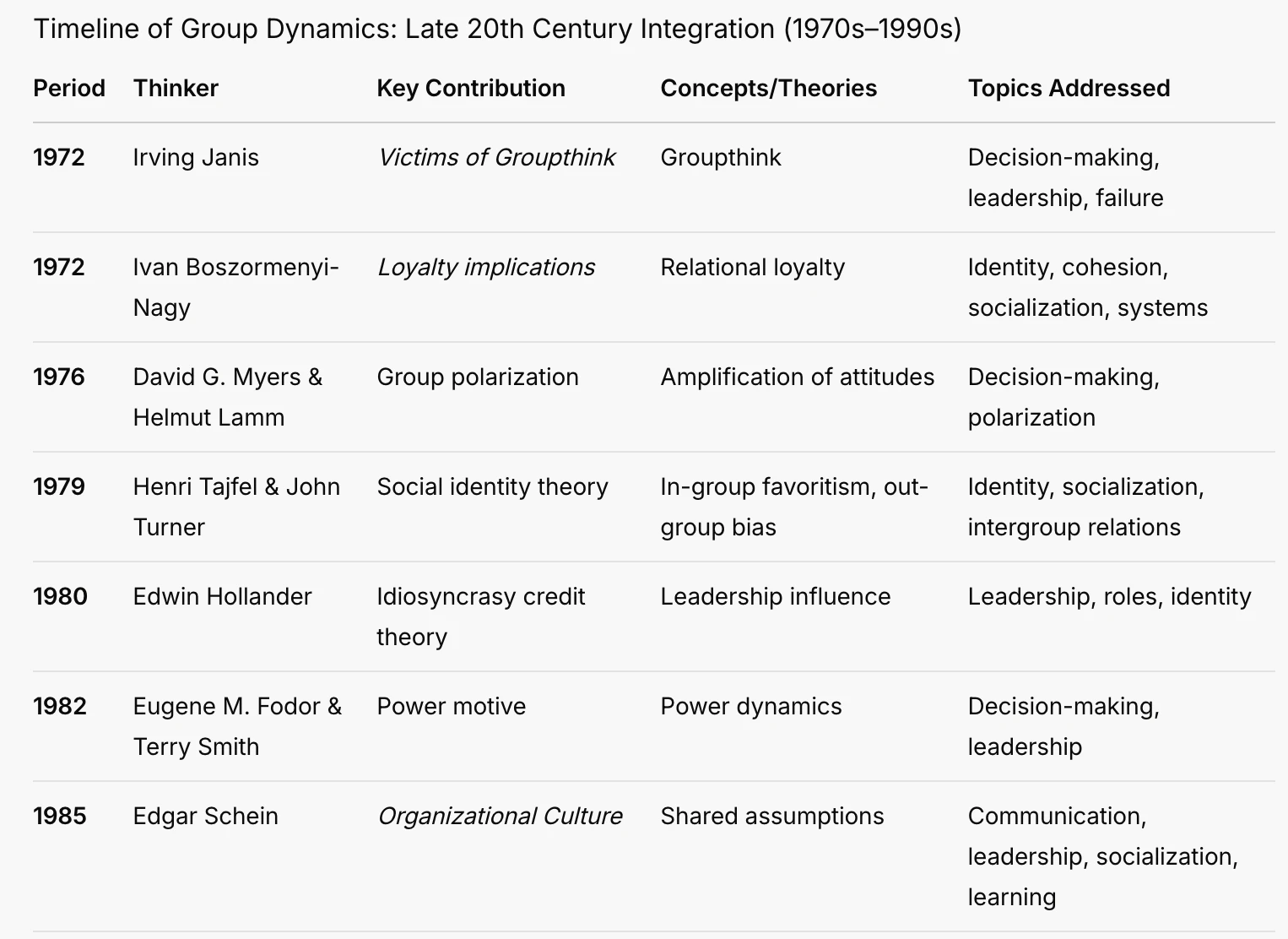
2025 Ⓒ Conscio Press
Timeline: Contemporary Perspectives (1980s-1990s)
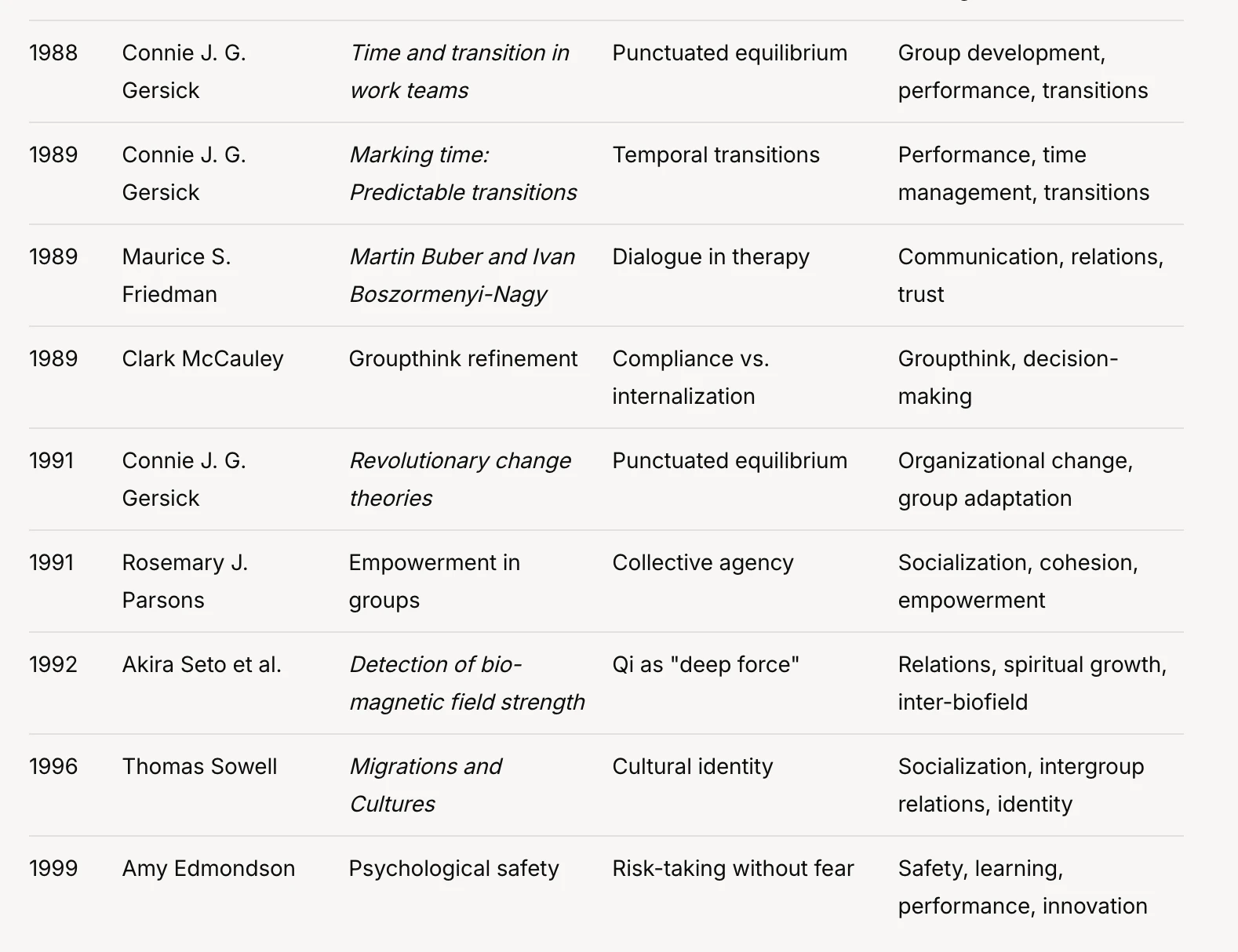
2025 Ⓒ Conscio Press
Contemporary Perspectives:
Technology, Neuroscience, and Diversity (2000s–Present)
The 21st century integrates technology, neuroscience, and diversity into group dynamics.
– Daniel Goleman (2006) popularized emotional intelligence in Working with Emotional Intelligence, using workplace examples to show empathy’s role.
– Susan Wheelan (2010) refined group development in Creating Effective Teams, based on team training data.
– Gregory S. Berns et al. (2010) used fMRI to link group pressure to brain activity in conformity tasks.
– Gilson et al. (2015) explored virtual teams, analyzing remote collaboration challenges.
– Katherine Phillips (2014) showed diversity’s problem-solving benefits in experimental groups.
– Jeff Sutherland (2014) applied dynamics to Scrum in software development.
– Saskia Tjepkema (2003) examined diversity in self-managing teams.
– Harvey Whitehouse (2018) studied extreme self-sacrifice in Dying for the Group, using anthropological data.
Y. Cheng et al. (2008) explored group polarization in investment decisions.
– Gail Burford et al. (2012) emphasized empowerment in family conferencing.
J. E. Rijnbergen (2007) and Piet Weisfelt (2007) explored leadership and systems in teams.
Dominic J. Packer (2009) nuanced groupthink with identity-driven dissent.
– Hüseyin Gençer (2019) synthesized modern theories.
Timeline: Contemporary Perspectives (2000s-Present)

2025 Ⓒ Conscio Press
Cultural Perspectives
Group Dynamics Theories and Concepts
The study of group dynamics has historically been dominated by Western psychological and sociological frameworks, yet integrating perspectives from diverse cultural traditions—Eastern, Asian, South American, and Indigenous—offers a richer, more global understanding of collective behavior. These non-Western lenses, often underrepresented in mainstream literature, emphasize relationality, spirituality, and communal harmony, complementing and challenging the field’s Eurocentric foundations (e.g., Le Bon, 1895; Lewin, 1947).
Eastern Relational Harmony Model
Could draw from Confucian and Taoist traditions prevalent in East Asian cultures like China, Japan, and Korea. Informed by Sowell’s (1996) analysis of cultural migration, this model might center on harmony (he) as a fundamental group dynamic, prioritizing collective well-being over individual assertion. Unlike Tuckman’s (1965) Western model, which anticipates conflict in the storming phase, this perspective views discord as a disruption to be minimized through mutual respect and hierarchical roles, such as filial piety. For instance, Japanese corporate groups practice wa (group harmony), where nemawashi (consensus-building) precedes decisions, contrasting with Janis’s (1972) groupthink by fostering alignment without silencing dissent. This model suggests that cohesion arises from relational balance, resonating with Boszormenyi-Nagy’s (1987) fairness but rooted in collectivism, as seen in family-run businesses maintaining unity across generations. →
Asian Bio-Energetic Perspective
Seto et al.’s (1992) exploration of Qi as a “deep force behind our observable dimension” provides a distinctive lens. In Chinese and broader Asian contexts, Qi—a life energy flowing through individuals and groups—underpins practices like Qigong and martial arts collectives. Seto’s detection of extraordinary bio-magnetic fields during Qi emission suggests an energetic exchange beyond verbal communication, potentially enhancing group efficacy. A hypothetical Qi-Flow Dynamics Theory could posit that synchronized energy fields, as in Tai Chi groups where movements align breathing and intent, strengthen cohesion and motivation. This complements Whitehouse’s (2018) ritual-based cohesion but shifts the focus to bio-spiritual mechanisms, offering an alternative to Western neuroscience (Berns et al., 2010).
South American Communal Framework
Might emerge from Andean traditions, such as those of the Quechua and Aymara peoples in Bolivia and Peru. Rooted in the concept of ayllu—a communal unit emphasizing reciprocity (ayni) and collective labor—this perspective prioritizes interdependence over individualism. Unlike Hackman’s (1987) task-focused model, Andean groups, such as farming cooperatives, integrate spiritual reverence for Pachamama (Mother Earth) into their dynamics, fostering a holistic identity that balances material and sacred goals. For example, communal irrigation projects in the Andes reflect ayni, where labor is shared to ensure mutual survival, contrasting with Western competitive frameworks (Sherif, 1936). This framework could hypothesize that group resilience stems from mutual obligation and ecological harmony, aligning with Sowell’s (1996) insights on cultural persistence, as migrated Andean communities maintain ayllu structures in urban settings. →
Indigenous Communal Framework
Could draw from South Asian and Native American traditions. In India, the Buddhist sangha emphasizes collective spiritual growth, where roles support mutual enlightenment rather than efficiency, as in monastic communities practicing meditation. Native American tribal councils, such as those of the Iroquois, use consensus and storytelling, reflecting a relational ontology that echoes Friedman’s (1989) dialogue but prioritizes oral tradition. For instance, Iroquois decision-making involves elders sharing historical narratives to guide group choices, suggesting groups thrive on shared narratives and cyclical time, contrasting with Tuckman’s (1965) linear stages. This resilience is evident in tribal responses to historical displacement, maintaining identity through communal practices.
Synthesis of Key Topics
Being, Becoming & Personality: Identity forms through groups (Tajfel & Turner, 1979; Tuckman, 1965), with personality (Bion, 1961) and loyalty (Boszormenyi-Nagy, 1972) shaping development.
Behavior, Dynamics, & Groupthink: Behavior emerges from context (Lewin, 1947), incentives (Homans, 1950), and emotions (Bion, 1961). Groupthink (Janis, 1972) is mitigated by dissent (Packer, 2009) and accountability (Tetlock, 1985), as in the Cuban Missile Crisis, where Kennedy encouraged debate. Gersick’s work underscores how behavioral shifts at midpoints drive group adaptability, countering stagnation.
Categories & Organizations: Groups operate within systems (Schein, 1985; Hackman, 1987), with categorization (Tajfel & Turner, 1979) shaping identities in agile contexts (Sutherland, 2014).
Leadership & Social Conflicts: Leadership guides dynamics (Lewin, 1939; Goleman, 2006), resolving conflicts (Tuckman, 1965; Friedman, 1989) with safety (Edmondson, 1999), as in Mandela’s reconciliation efforts.
Perception & Communication: Perception is shaped by influence (Asch, 1952; Moscovici, 1985). Watzlawick et al. (1973) view communication systemically, Rogers and Roethlisberger (1991) stress empathy, and Friedman (1989) links dialogue to trust. A case study of virtual teams during COVID-19 shows empathetic communication mitigated isolation.
Relations, Identity & Intergroup Dynamics: Relations shape behavior (Tajfel & Turner, 1979; Sherif, 1936), with trust (Boszormenyi-Nagy, 1987; Friedman, 1989) and culture (Sowell, 1996) influencing dynamics, as in cross-functional teams at Toyota reducing silos.
Roles (Social & Task): Bales (1950) and Moreno (1934) define roles, evolving through Tuckman’s (1965) stages. Rijnbergen (2007) highlights leadership’s role, and Tjepkema (2003) notes diversity’s impact, as in agile teams adapting roles dynamically. Gersick’s temporal transitions suggest roles shift at critical midpoints, aligning with task demands to optimize performance.
Socialization & Social Cohesion
Socialization integrates norms (Durkheim, 1897; Schein, 1985). Cohesion aids performance (Hackman, 1987) but risks groupthink (Janis, 1972). Loyalty (Boszormenyi-Nagy, 1972) and culture (Sowell, 1996) shape cohesion, as in post-Hurricane Katrina recovery.
Systems and Motivations: Groups are systems (Homans, 1950; Watzlawick et al., 1973; Boszormenyi-Nagy, 1987). Motivations stem from exchange (Homans, 1950), identity (Tajfel & Turner, 1979), loyalty (Boszormenyi-Nagy, 1972), and extreme cohesion (Whitehouse, 2018), as in open-source communities.
Thinking, Decision-Making & Problem-Solving: Group thinking involves cognitive processes like creativity and analysis. Hackman’s (1987) model stresses clear goals, while Janis (1972) warns of groupthink, as in the Challenger disaster, where engineers’ concerns were ignored. Packer (2009) shows dissent counters this, and Tetlock (1985) adds accountability’s role. Phillips (2014) highlights diversity’s benefits, as in NASA’s Columbia disaster (2003), where groupthink and poor accountability led to tragedy.
Safety, Learning & Performance: Edmondson’s (1999) psychological safety fosters learning (Schein, 1985), driving performance (Hackman, 1987), as in Google’s Project Aristotle (2016), where safe teams excelled. Gersick’s findings on temporal dynamics suggest safety peaks during transitional phases, boosting learning
Methodological Evolution
The methodological journey of group dynamics reflects its growth from rudimentary observation to sophisticated analysis. Early scholars like Le Bon (1895) relied on qualitative accounts of crowd behavior, lacking systematic data. The 1930s introduced controlled experiments (Sherif, 1936; Asch, 1952) and observational coding (Bales, 1950), enabling precise measurement of interactions. Mid-century saw field studies (Homans, 1950) and action research (Lewin, 1947), blending theory with practice. The late 20th century brought longitudinal studies (Tuckman, 1965), surveys (Hackman, 1987), and qualitative cultural analysis (Schein, 1985), deepening temporal and contextual insights. Contemporary methods include big data analysis (Gilson et al., 2015), network mapping (building on Moreno, 1934), and neuroimaging (Berns et al., 2010), offering unprecedented granularity. This evolution mirrors the field’s shift from speculation to a robust, evidence-based science.
Conclusion:
Beyond Group Dynamics
Group dynamics has evolved from the speculative crowd theories of Le Bon (1895) and Durkheim (1897) to a rigorous, interdisciplinary field that informs psychology, sociology, and organizational science. Early thinkers laid foundational concepts of collective behavior and social integration, which Lewin (1947), Sherif (1936), and Janis (1972) built upon with empirical rigor, introducing field theory, intergroup dynamics, and groupthink. Mid-century scholars like Bion (1961), Homans (1950), and Watzlawick et al. (1973) refined systemic and communicative perspectives, while Tuckman (1965), Gersick (1988, 1989, 1991), Hackman (1987), and Tajfel and Turner (1979) addressed developmental, organizational, and identity dynamics. Contemporary contributors such as Edmondson (1999), Phillips (2014), and Boszormenyi-Nagy (1972, 1987) have tackled modern challenges, integrating psychological safety, diversity, and relational trust into the field’s framework. This progression, illustrated through segmented timeline tables, underscores group dynamics’ capacity to bridge theory and practice across educational, therapeutic, and organizational contexts.
The importance of connections between group members emerges as a unifying thread across this history, serving as the bedrock of cohesion, trust, and collective efficacy. Theories such as social exchange (Homans, 1950) highlight the transactional nature of these bonds, where mutual benefits sustain group stability, as seen in factory worker camaraderie. Social identity theory (Tajfel & Turner, 1979) reveals how shared identity fosters in-group solidarity, evident in tight-knit communities like military units. Contextual therapy (Boszormenyi-Nagy, 1987) deepens this by emphasizing relational loyalty, where intergenerational trust—e.g., in family businesses—anchors group resilience. These connections facilitate effective communication (Rogers & Roethlisberger, 1991), as in therapeutic groups where empathy resolves misunderstandings, and mitigate conflict (Sherif, 1936), as demonstrated in post-conflict reconciliation efforts like South Africa’s Truth and Reconciliation Commission. They also enhance performance (Hackman, 1987), as in high-performing tech teams where trust drives innovation. The strength of these relational ties, whether in small teams or large organizations, underscores their indispensable role in group success.
Beyond these observable dynamics, group connections extend into the subtle realm of the inter-biofield between humans, a concept illuminated by Seto et al. (1992) in Detection of extraordinary large bio-magnetic field strength from human hand during external Qi emission. Seto and colleagues argue that Qi represents a “deep force behind our observable dimension rather than an existing physical quantity such as magnetic field,” detectable as an extraordinary bio-magnetic field during Qi emission. This suggests an energetic interconnection among individuals that transcends conventional communication channels, potentially influencing group cohesion at a bio-energetic level. In experimental settings, Seto measured field strengths far exceeding typical human bio-magnetic outputs, proposing that this “deep force” operates beyond measurable physical phenomena, hinting at a subtle, unifying energy within groups. This inter-biofield could enhance relational dynamics by amplifying empathy (Goleman, 2006), as in meditation groups where participants report heightened mutual awareness, or trust (Friedman, 1989), as in family therapy sessions where unspoken bonds deepen understanding.
The relevance of this inter-biofield extends profoundly to spiritual growth, an underexplored yet transformative dimension of group dynamics. Seto’s (1992) findings imply that groups may serve as conduits for spiritual development, where the bio-energetic field fosters a collective resonance that nurtures higher states of consciousness. This aligns with Boszormenyi-Nagy’s (1987) focus on relational fairness, where equitable interactions cultivate a sense of purpose, and Friedman’s (1989) dialogical approach, where authentic exchange fosters transcendence. For example, spiritual communities practicing collective rituals—such as chanting or prayer—may amplify this field, deepening members’ sense of unity and purpose, as seen in monastic traditions or indigenous healing circles (Sowell, 1996). This interconnectedness can counteract groupthink (Janis, 1972) by grounding decisions in a shared, transcendent awareness, as in Quaker meetings where silence fosters collective insight. Whitehouse’s (2018) study of extreme self-sacrifice further suggests that such bio-energetic bonds could underpin profound motivations, as in religious groups where martyrdom reflects ultimate group commitment.
The integration of this inter-biofield concept into group dynamics opens new avenues for exploration and application. It suggests that future research could investigate how bio-energetic interactions influence psychological safety (Edmondson, 1999), perhaps through biofeedback tools measuring energy fields during group activities like mindfulness sessions. Leadership efficacy (Lewin, 1939) might be enhanced by leaders attuned to these subtle energies, as in charismatic figures who inspire through presence rather than words. Intergroup harmony (Sherif, 1936) could benefit from practices that strengthen this field, such as joint rituals in post-conflict settings like Rwanda’s reconciliation villages. Methodologically, combining quantitative bio-energetic measurements with qualitative spiritual assessments could yield a richer understanding of group processes, bridging science and metaphysics.
By recognizing the interplay of relational, cultural, and bio-energetic forces, group dynamics evolves into a holistic discipline that not only enhances practical outcomes—e.g., team performance or therapeutic healing—but also nurtures spiritual growth, fostering groups that are both functional and profoundly transformative. This expanded perspective reaffirms the field’s potential to illuminate the full spectrum of human connection, from the tangible to the transcendent, in an increasingly complex and interconnected world.
References:
- Asch, S. E. (1952). Social psychology. Prentice-Hall.
- Bales, R. F. (1950). Interaction process analysis: A method for the study of small groups. Addison-Wesley.
- Berns, G. S., Chappelow, J., Zink, C. F., Pagnoni, G., Martin-Skurski, M. E., & Richards, J. (2010). Neurobiological correlates of social conformity and independence during mental rotation. Biological Psychiatry, 68(3), 245–251.
- Bion, W. R. (1961). Experiences in groups and other papers. Tavistock Publications.
- Boszormenyi-Nagy, I. (1972). Loyalty implications of the transference model in psychotherapy. Archives of General Psychiatry, 27(3), 374–390.
- Boszormenyi-Nagy, I. (1987). Foundations of contextual therapy: Collected papers of Ivan Boszormenyi-Nagy, MD. Brunner/Mazel.
- Burford, G., Connolly, M., Morris, K., & Pennell, J. (2012). Family group conferencing: Introduction, principles and processes. [Publisher details unavailable].
- Cartwright, D., & Zander, A. (Eds.). (1968). Group dynamics: Research and theory (3rd ed.). Harper & Row.
- Cheng, P. Y., & Chiou, W. B. (2008). Framing effects in group investment decision-making: Role of group polarization. Psychological Reports, 102(1), 283–292.
- Durkheim, É. (1897). Suicide: A study in sociology. Free Press.
- Edmondson, A. C. (1999). Psychological safety and learning behavior in work teams. Administrative Science Quarterly, 44(2), 350–383.
- Festinger, L. (1954). A theory of social comparison processes. Human Relations, 7(2), 117–140.
- Festinger, L. (1957). A theory of cognitive dissonance. Stanford University Press.
- Fiske, S. T., & Taylor, S. E. (1991). Social cognition. McGraw-Hill.
- Fodor, E. M., & Smith, T. (1982). The power motive as an influence on group decision making. Journal of Personality and Social Psychology, 42(1), 178–185.
- Forsyth, D. R. (2006). Group dynamics (4th ed.). Thomson Wadsworth.
- Friedman, M. S. (1989). Martin Buber and Ivan Boszormenyi-Nagy: The role of dialogue in contextual therapy. Psychotherapy: Theory, Research, Practice, Training, 26(3), 402–409.
- Gençer, H. (2019). Group dynamics and behaviour. Universal Journal of Educational Research, 7(1), 223–229.
- Gersick, C. J. G. (1988). Time and transition in work teams: toward a new model of group development Academy of Management Journal, 31(1), 9-41.
- Gersick, C. J. G. (1991 ). Revolutionary change theories: a multilevel exploration of the punctuated equilibrium paradigm. Academy of Management Review, 16(1), 10-36.
- Gersick, C. J. G. (1989). Marking time: predictable transitions in task groups. Academy of Management Journal, 32(2), 274-309.
- Gilson, L. L., Maynard, M. T., Jones Young, N. C., Vartiainen, M., & Hakonen, M. (2015). Virtual teams research: 10 years, 10 themes, and 10 opportunities. Journal of Management, 41(5), 1313–1337.
- Goleman, D. (2006). Working with emotional intelligence. Bantam Books.
- Hackman, J. R. (1987). The design of work teams. In J. W. Lorsch (Ed.), Handbook of organizational behavior (pp. 315–342). Prentice-Hall.
- Hollander, E. P. (1980). Leadership and social exchange processes. In K. J. Gergen, M. S. Greenberg, & R. H. Willis (Eds.), Social exchange: Advances in theory and research (pp. 103–118). Springer.
- Homans, G. C. (1950). The human group. Harcourt, Brace.
- Janis, I. L. (1972). Victims of groupthink: A psychological study of foreign-policy decisions and fiascoes. Houghton Mifflin.
- Janis, I. L., & Mann, L. (1977). Decision making: A psychological analysis of conflict, choice, and commitment. Free Press.
- Le Bon, G. (1895). The crowd: A study of the popular mind. Macmillan.
- Lewin, K. (1947). Frontiers in group dynamics: Concept, method and reality in social science; social equilibria and social change. Human Relations, 1(1), 5–41.
- Lewin, K., & Lewin, G. W. (Ed.). (1948). Resolving social conflicts: Selected papers on group dynamics (1935–1946). Harper & Brothers.
- Lewin, K., & Lippitt, R. (1939). Experiments in social space. Harvard Business Review, 17(3), 271–301.
- Lindzey, G., & Aronson, E. (Eds.). (1985). Handbook of social psychology (3rd ed.). Random House.
- McCauley, C. (1989). The nature of social influence in groupthink: Compliance and internalization. Journal of Personality and Social Psychology, 57(2), 250–260.
- Moreno, J. L. (1934). Who shall survive? A new approach to the problem of human interrelations. Beacon House.
- Moscovici, S. (1985). Social influence and conformity. In G. Lindzey & E. Aronson (Eds.), Handbook of social psychology (pp. 347–412). Random House.
- Myers, D. G., & Lamm, H. (1976). The polarizing effect of group discussion. In I. L. Janis (Ed.), Current trends in psychology: Readings from the American scientist (pp. 347–352). Kaufmann.
- Packer, D. J. (2009). Avoiding groupthink: Whereas weakly identified members remain silent, strongly identified members dissent about collective problems. Psychological Science, 20(5), 546–548.
- Parsons, R. J. (1991). Empowerment: Purpose and practice principle in social work. Social Work with Groups, 14(2), 7–21.
- Phillips, K. W. (2014). How diversity makes us smarter. Scientific American, 311(4), 43–47.
- Rijnbergen, M. J. E. (2007). Samenwerking in teams: De impact van verticaal en gedeeld taak- en relatiegericht leiderschap en groepsontwikkeling op teamprestatie [Master’s thesis, Universiteit Utrecht]. Utrecht.
- Rogers, C. R., & Roethlisberger, F. J. (1991). Barriers and gateways to communication. Harvard Business Review, 69(4), 105–111. (Original work published 1952)
- Schein, E. H. (1985). Organizational culture and leadership. Jossey-Bass.
- Seto, A., Kusaka, C., Nakazato, S., et al. (1992). Detection of extraordinary large bio-magnetic field strength from human hand during external Qi emission. Acupuncture & Electro-Therapeutics Research, 17(2), 75–94.
- Sherif, M. (1936). The psychology of social norms. Harper & Brothers.
- Simmel, G. (1908). Sociology: Investigations on the forms of sociation. Duncker & Humblot.
- Sowell, T. (1996). Migrations and cultures: A world view. BasicBooks.
- Sutherland, J. (2014). Scrum: The art of doing twice the work in half the time. Crown Business.
- Tajfel, H., & Turner, J. C. (1979). An integrative theory of intergroup conflict. In W. G. Austin & S. Worchel (Eds.), The social psychology of intergroup relations (pp. 33–47). Brooks/Cole.
- Tetlock, P. E. (1985). Accountability: The neglected social context of judgment and choice. In B. S. L. Cummings (Ed.), Research in organizational behavior (Vol. 1, pp. 297–332). JAI Press.
- Tjepkema, S. (2003). Verscheidenheid in zelfsturende teams. In S. Tjepkema (Ed.), The learning infrastructure of self-managing work teams (pp. 1–18). Universiteit Twente.
- Tuckman, B. W. (1965). Developmental sequence in small groups. Psychological Bulletin, 63(6), 384–399.
- Tuckman, B. W., & Jensen, M. A. C. (1977). Stages of small-group development revisited. Group & Organization Studies, 2(4), 419–427.
- Watzlawick, P., Beavin, J. H., & Jackson, D. D. (1973). De pragmatische aspecten van de menselijke communicatie (4th ed.). Bohn Stafleu van Loghum. (Original work published 1967 as Pragmatics of human communication)
- Weisfelt, P. (2007). De geheimen van de groep: Het proces van het systeem en de consequenties voor individu, groep en organisatie (Vol. II). [Publisher details unavailable].
- Wheelan, S. A. (2010). Creating effective teams: A guide for members and leaders (3rd ed.). Sage Publications.
- Whitehouse, H. (2018). Dying for the group: Towards a general theory of extreme self-sacrifice. Behavioral and Brain Sciences, 41, e192.
Further Readings
Realms of Groups
Realms of Groups dives into the modern world necessitating new ways of thinking and working while developing 21st-cen...

The Power of Planning
The Lumora™️ Framework is a proprietary methodology for strategic planning, designed to facilitate visioning, goa...

What is Agogics
Learn more about the origin, concept, theories and methods of Agogics and the applications in modern human and organi...

Stressed Out
Uplifts your team’s mind, body, and spirit with Shendao. Unleash ancient power for modern results to transform stre...

What is Mystagogy
What is mystagogy explores and investigates the origins, theories, key concepts and core principles of the work of my...

Path of Virtuosity
Virtuosity isn’t a gift—it’s a sweaty, joyous path of effort. From Ziran’s grace to flow’s spark, exhaustio...

Q4 Quality Compass
The Q4 Quality framework, a quality management tool, guides your quality journey with the QJS Compass across four dir...

Qualities at Work
We transform teams into profit engines with a soft systems approach. We ignite qualities, drive revenue and innovatio...
Experts in People Skills
In the 21st century, soft skills like empathy and adaptability are vital for success. Research shows they boost emplo...

Navigating Change
Navigating Change is a wild ride—tech’s nuts, markets flip fast. Plans flop 70%, but a consultant who gets dynami...

Ignite your life
Ignite your life, elevate family meetings & engage in community projects. Boost your businesses or serve your Na...
Smart Choices
Make smart choices. Use our 12 tips Compass for personal goals, business strategies and organizational plans. Science...

2025 © All Rights Reserved