
Thinking in Quality
Introduction
Quality management has evolved into a diverse field, encompassing a range of frameworks that guide organizations in achieving excellence. These frameworks are not merely practical tools but are deeply rooted in philosophical principles that shape their approach to change. Hardjono & van Kemenade (2021) identify four schools of thought in quality management—Empirical (Standardization), Reference (Continuous Improvement), Reflective (Breakthrough), and Emergence (Essence)—each with distinct ideological underpinnings and worldviews.
This article explores the quality frameworks and tools associated with these schools, analyzing their philosophical principles and examining how they facilitate organizational learning through 1st, 2nd, and 3rd order learning. By understanding these dimensions, leaders can select frameworks that align with their organizational needs, fostering transformative change across individual, group, and systemic levels
See the full version on your computer.
The Four Schools of Thought
Philosophical Principles and Worldviews
The four schools of thought in quality management provide a framework for understanding the ideological diversity of quality frameworks (Hardjono & van Kemenade, 2021):
Empirical (Standardization):
This school assumes quality is achieved through consistency and control, ensuring predictable outcomes via standardized processes. Its mechanistic/positivist worldview sees the world as a predictable system, where quality is measured through objective indicators like time, cost, and defects. Frameworks in this school prioritize compliance and optimization within existing structures.
Reference (Continuous Improvement):
This school assumes quality emerges through incremental collaboration and shared norms, improving processes over time. Its normative/-collaborative worldview views the world as a social system, where quality is a collective endeavor shaped by inter-subjective standards. Frameworks in this school emphasize teamwork and continuous enhancement.
Reflective (Breakthrough):
This school assumes quality is achieved through ethical and philosophical reflection, aligning with deeper values and purpose. Its humanistic/existential worldview sees the world as a human-centered system, where quality reflects meaning, ethics, and aesthetics. Frameworks in this school focus on transformative change driven by purpose.
Emergence (Essence):
This school assumes quality emerges through innovation and potentiality, maximizing creativity with minimal constraints. Its innovative/chaotic worldview sees the world as a complex, unpredictable system, where quality arises from adaptive innovation. Frameworks in this school prioritize flexibility and self-organization.
Quality Frameworks and Tools
Mapping to the Four Schools
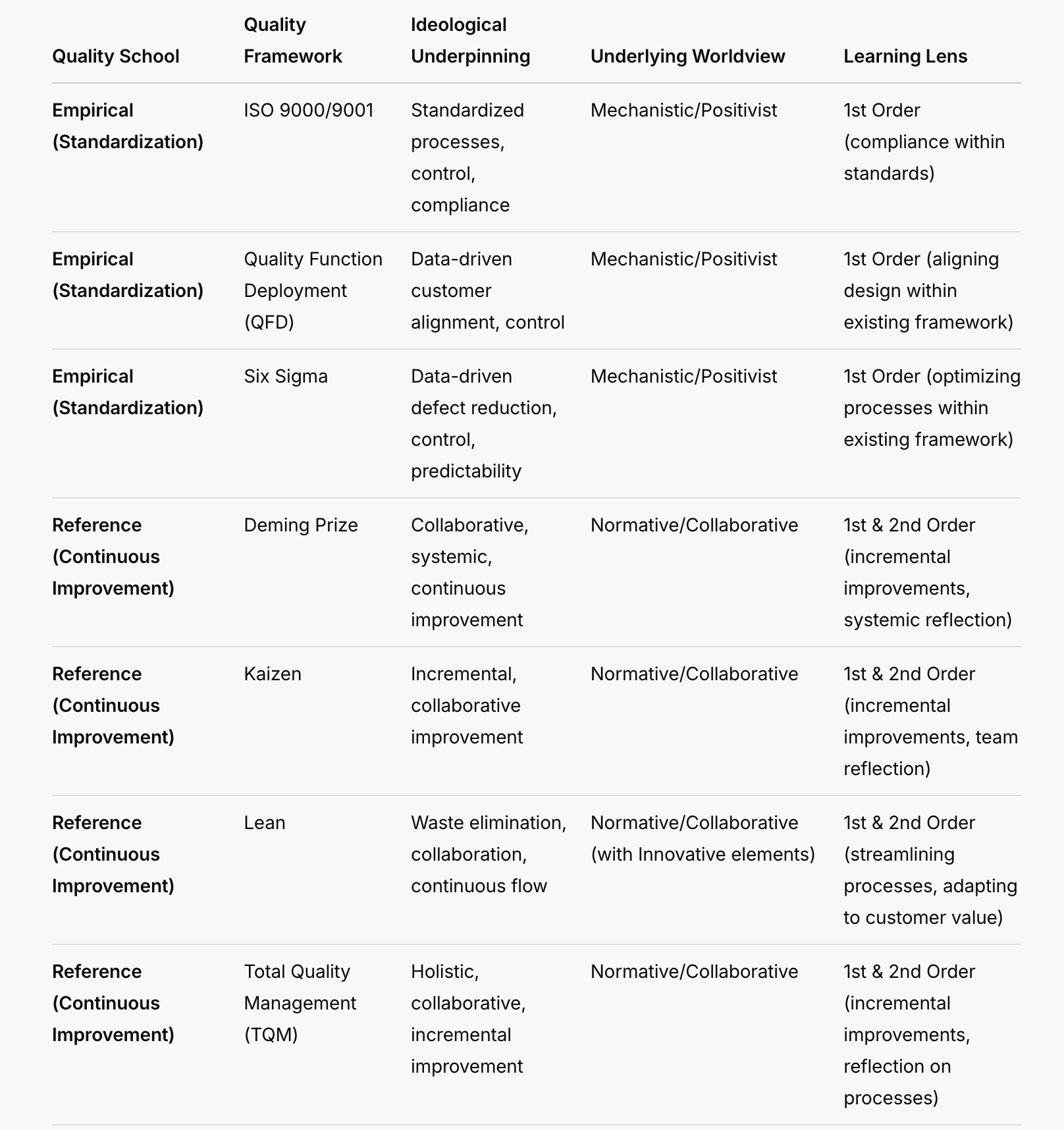
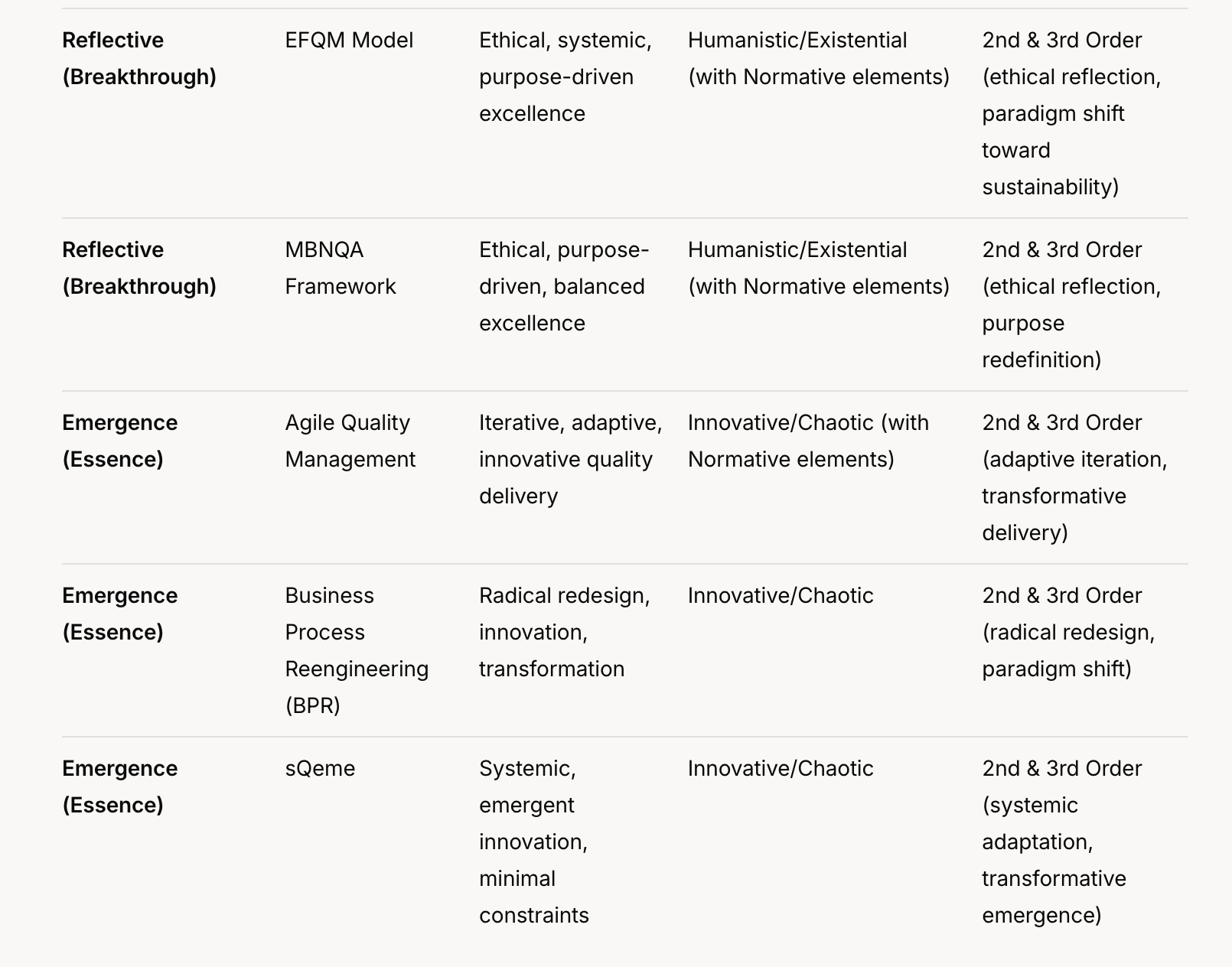
Quality frameworks and their associated tools can be mapped to the four schools of thought, reflecting their ideological underpinnings and the learning lens they facilitate. The table below organizes these frameworks by quality school, with alphabetical ordering within each school for clarity.
“ Quality frameworks are based on pre-assumptions.”
– Peter Cuijpers-
Empirical (Standardization):
Control and Predictability
Frameworks in the Empirical school focus on control and predictability, aligning with a mechanistic worldview. They use tools to standardize processes and ensure compliance, often enabling 1st order learning—incremental improvements within existing frameworks.
♦ ISO 9000/9001: Introduced by the International Organization for Standardization in 1987, ISO 9001 provides a standardized framework for quality management systems, focusing on documented processes and compliance. Tools like process audits and corrective action reports ensure consistency, enabling 1st order learning through adherence to standards.
♦ Quality Function Deployment (QFD): Developed in Japan in the 1960s, QFD translates customer requirements into technical specifications using tools like the House of Quality matrix. Its data-driven approach aligns design with customer needs, facilitating 1st order learning by optimizing within existing frameworks.
♦ Six Sigma: Originating at Motorola in 1986, Six It uses the DMAIC (Define, Measure, Analyze, Improve, Control) methodology and tools like control charts and process capability analysis to minimize variability. Six Sigma’s mechanistic approach ensures predictability, primarily facilitating 1st order learning by optimizing processes without questioning underlying goals.
Frameworks in the Empirical school focus on control and predictability, aligning with a mechanistic worldview. They use tools to standardize processes and ensure compliance, often enabling 1st order learning—incremental improvements within existing frameworks.
Reference (Continuous Improvement):
Collaboration and Incremental Change
Frameworks in the Reference school emphasize collaboration and incremental improvement, reflecting a normative worldview. They use tools to foster teamwork and continuous enhancement, enabling both 1st and 2nd order learning—optimizing processes and reflecting on their alignment with goals.
♦ Deming Prize: Established in 1951 by JUSE, the Deming Prize evaluates organizations on TQM principles, using tools like PDCA (Plan-Do-Check-Act) cycles to drive continuous improvement (1st order learning) and systemic reflection (2nd order learning).
♦ Kaizen: Also from Toyota, Kaizen emphasizes small, incremental improvements through employee involvement. Tools like Gemba walks and Kaizen events enable 1st order learning through process optimization and 2nd order learning by reflecting on process effectiveness.
♦ Lean: Originating from the Toyota Production System, Lean maximizes customer value by eliminating waste. Tools like value stream mapping, 5S, and Kanban streamline processes (1st order learning) and adapt to customer needs (2nd order learning), fostering a collaborative culture.
♦ Total Quality Management (TQM): Emerging in the 1950s through the work of Deming and Juran, TQM integrates quality into all organizational processes, focusing on customer satisfaction and employee involvement. Tools like Pareto charts, cause-and-effect diagrams, and quality circles support incremental improvements (1st order learning) while encouraging reflection on systemic alignment (2nd order learning).
Reflective (Breakthrough):
Ethical and Purpose-Driven Transformation
Frameworks in the Reflective school focus on ethical and purpose-driven change, aligning with a humanistic worldview. They use tools to facilitate reflection and transformation, enabling 2nd and 3rd order learning—questioning assumptions and redefining purpose.
♦ EFQM Model:
Introduced in 1992 by the European Foundation for Quality Management, the EFQM Model assesses performance across nine criteria, emphasizing ethical leadership and sustainability. Tools like self-assessment and radar charts enable 2nd order learning by reflecting on alignment with values and 3rd order learning by redefining organizational purpose toward sustainable excellence.
♦ Malcolm Baldrige National Quality Award :
Established in 1987 by the U.S. Congress, the MBNQA framework evaluates performance across seven categories, focusing on ethical leadership and results. Tools like the Baldrige Criteria for Performance Excellence support 2nd order learning through reflection on organizational effectiveness and 3rd order learning by redefining purpose to prioritize societal impact.
Emergence (Essence):
Innovation and Adaptability
Frameworks in the Emergence school emphasize innovation and adaptability, reflecting a chaotic worldview. They use tools to foster creativity and self-organization, enabling 2nd and 3rd order learning—adapting strategies and transforming paradigms.
♦ Agile Quality Management: Emerging from the Agile Manifesto (2001), Agile Quality Management focuses on iterative, adaptive quality delivery. Tools like Scrum boards and retrospectives enable 2nd order learning through iterative adaptation and 3rd order learning by redefining quality as a dynamic, customer-driven process.
♦ Business Process Reengineering: Introduced in the 1990s by Hammer and Champy, BPR radically redesigns processes for dramatic improvements. Tools like process mapping and simulation support 2nd order learning by rethinking strategies and 3rd order learning by shifting paradigms (e.g., from efficiency to customer-centricity).
♦ sQeme:
The Systemic Quality Emergence Model developed by Dutch quality experts, integrates the four schools, focusing on tools like systemic mapping and feedback loops enable 2nd order learning by adapting to complexity and 3rd order learning by redefining organizational identity through emergent innovation.
Showcases
Planning Across Domains
A Transformative Perspective
Learning Lenses in Quality Management
The concepts of 1st, 2nd, and 3rd order learning provide lenses to understand how quality frameworks facilitate organizational transformation (Argyris & Schön, 1978; Bateson, 1972).
– 1st order learning (single-loop) focuses on incremental improvements within existing frameworks, answering, “Are we doing things right?”
– 2nd order learning (double-loop) questions underlying assumptions, asking, “Are we doing the right things?”
– 3rd order learning (triple-loop) redefines principles and purpose, asking, “How do we decide what is right?”
Frameworks in the Empirical school, such as Six Sigma and ISO 9001, primarily enable 1st order learning by optimizing processes within established standards. Reference school frameworks, like TQM and Kaizen, facilitate both 1st and 2nd order learning, balancing incremental improvements with reflection on process alignment. Reflective school frameworks, such as EFQM and MBNQA, support 2nd and 3rd order learning by encouraging ethical reflection and purpose redefinition. Emergence school frameworks, like sQeme and Agile, enable 2nd and 3rd order learning by fostering adaptive innovation and paradigm shifts.
Conclusion
Aligning the Frameworks
The four schools of thought—Empirical, Reference, Reflective, and Emergence—offer a framework for understanding the ideological diversity of quality management. Each school’s philosophical principles shape its approach to change, from control and predictability to innovation and transformation.
By analyzing these frameworks through lenses of 1st, 2nd, and 3rd order learning, leaders can select tools that align with their organizational needs, whether optimizing processes, adapting strategies, or redefining purpose. Future research should explore how these frameworks can be integrated to create hybrid approaches, fostering a balanced, human-centered approach to quality across individual, group, and organizational levels.
References:
- Argyris, C., & Schön, D. A. (1978). Organizational learning: A theory of action perspective. Addison-Wesley.
- Bateson, G. (1972). Steps to an ecology of mind. Ballantine Books.
- Cuijpers, P. H. M. (2025a). What about Quality? The Essence of Quality Unveiled. Conscio.com. https://www.conscio.com/what-about-quality/
- Gennep, A. van. (1909). Les rites de passage: Étude systématique. E. Nourry.
- Gennep, A. van. (1960). The rites of passage (M. B. Vizedom & G. L. Caffee, Trans.; 1st ed. 1909). University of Chicago Press.
- Hardjono, T. W., & van Kemenade, E. (2021). The emergence paradigm in quality management: A way towards radical innovation. Springer.
- Juran, J. M. (1995). A history of managing for quality: The evolution, trends, and future directions of managing for quality. ASQC Quality Press. Myerhoff, B. (1982). Rites of passage: Process and paradox. In V. W. Turner (Ed.), Celebration: Studies in festivity and ritual (pp. 108–135). Smithsonian Institution Press.
- Turner, V. W. (1969). The ritual process: Structure and anti-structure. Aldine.
- Vinkenburg, H. H. M. (1995). Stimuleren tot perfectie [Stimulating to perfection]. University of Groningen.
- Wang, Y., & Huzzard, T. (2011). The impact of Lean thinking on organizational learning. OLKC 2011 Conference Proceedings.
Further Readings

Q4 Quality Compass
The Q4 Quality framework, a quality management tool, guides your quality journey with the QJS Compass across four dir...

Quality in contexts
This article redefines quality as a dynamic process of consciousness evolving in a three-stage quest with implication...

Thinking in Quality
This article maps quality frameworks to four schools—Empirical, Reference, Reflective, Emergence—analyzing their ...
Q4 Unleashed
Q4 redefines quality management. It integrates four paradigms into one cohesive framework, structured around four dir...

Quality as a Journey
Reframing Quality as a Heroic Journey towards Virtuosity suggests: a path made by walking to transform leaders, tea...
2025 © All Rights Reserved