
Quality in contexts
This article redefines quality as a dynamic process of consciousness evolving in a three-stage quest with implications for organizational theory. Offering a novel lens for sustainability and transformation studies.
Preprint 2025 © Conscio Press
Reframing Quality as an Heroic Journey of Consciousness
Quality is a multifaceted concept, yet its essence remains underexplored beyond technical and organizational frameworks. This article asks: How can integrating mythological and consciousness-based perspectives redefine quality in modern contexts? Through a thematic synthesis of historical, philosophical, and practical sources—from ancient philosophies to contemporary quality management—we propose quality as a heroic journey of consciousness, evolving through stages of order, transformation, and integration. Drawing on works like Campbell’s (2004) heroic narrative, Neumann and Liebscher’s (1954) consciousness evolution, and modern quality theories (Deming, 1982; Hardjono, 2016), we synthesize a framework linking quality to technical precision, human engagement, and ethical purpose. Findings suggest quality transcends utility, reflecting a conscious pursuit of excellence with implications for organizational theory and practice. Future empirical research is recommended to test this model.
Keywords: Organizational Change, Consciousness, Quality Management, Heroic Journey, Process, Philosophy, Ethics, Transformation
1. Introduction
Quality is a cornerstone of organizational success, yet its essence remains contested—often reduced to measurable standards or customer satisfaction, neglecting its deeper dimensions (Deming, 2018; Juran, 1995). Existing literature excels in technical definitions but lacks a holistic framework integrating historical, philosophical, and human-centric perspectives (Hardjono & Van Kemenade, 2021). This gap hinders a comprehensive understanding of quality’s role in modern organizations facing complexity, sustainability, and ethical demands.
This article addresses this gap by asking: How can integrating mythological and consciousness-based perspectives redefine quality in modern organizational contexts? We propose quality as a heroic journey of consciousness—a dynamic process evolving through stages of order, transformation, and integration, rooted in human experience and ethical purpose. This reframing draws on Joseph Campbell’s (2004) heroic narrative, Neumann and Liebscher’s (1954) consciousness evolution, and quality management theories (Deming, 1982; Hardjono, 2000), synthesizing them with Eastern philosophies and practical applications. Our contribution offers a novel conceptual framework for quality, bridging ancient wisdom with contemporary practice, with implications for organizational theory and future research.
2. Literature Review
Quality’s evolution spans technical, philosophical, and cultural domains. Historically, Mesopotamian standards (circa 3000 BCE) and Hammurabi’s Code (circa 1754 BCE) tied quality to accountability (Juran, 1995), while Egypt’s pyramids (circa 2630 BCE) reflected precision (Neumann & Liebscher, 1954). Confucian harmony, Daoist wu wei, and Buddhist mindfulness shaped Chinese crafts (551–479 BCE), embedding ethical and natural dimensions (Campbell, 1991). Greek thinkers—Aristotle’s telos and Plato’s Forms—introduced utility and idealism (Aristotle, Nicomachean Ethics; Plato, The Republic), with Vitruvius (circa 30–15 BCE) synthesizing these into firmitas, utilitas, and venustas.
Modern quality emerged with Shewhart’s SQC (1920s–1940s), followed by Deming’s TQM (1982) and Juran’s “fitness for use” (1995), emphasizing systems and customer focus (Shoji et al., 1993). The European Quality Movement (1998–2004) shifted toward transformation via dialogue (McAdam-O’Connell, 2004, 2005). Philosophically, Pirsig (1974) framed quality as metaphysical harmony, Ventegodt et al. (2005) as consciousness-driven well-being, and Neumann and Liebscher (1954) as archetypal evolution. Campbell’s (1991, 2004) heroic journey and art of living offer a mythic lens, aligning with ikigai and martial arts’ disciplined purpose.
3. Methodology
This study employs a qualitative, integrative literature review using thematic synthesis (Thomas & Harden, 2008). We analyzed 30+ sources across history, philosophy, and quality management, selected for their influence and diversity (e.g., Deming, 1982; Campbell, 2004; Neumann & Liebscher, 1954). Themes—order (technical precision), transformation (human engagement), integration (ethical purpose)—were inductively derived and mapped to Campbell’s heroic journey stages (call, trials, return), providing a conceptual framework. This method synthesizes disparate perspectives into a cohesive model, acknowledging limitations in empirical data but laying a foundation for future testing.
4. Quality’s Journey
Quality’s historical evolution aligns with consciousness’s development (Neumann & Liebscher, 1954) and Campbell’s (2004) heroic stages:
1. Call to Adventure (Ancient Order): Mesopotamian crafts and Hammurabi’s laws established quality as accountability, reflecting early consciousness of order. Egypt’s pyramids and Chinese crafts (Confucian harmony, Daoist flow) added precision and ethics, initiating the journey.
2. Trials and Transformation (Medieval to Industrial): Guilds (1100–1500 CE) and Vitruvius’s triad refined quality as mastery and utility, tested by the Industrial Revolution’s mass production and SQC’s technical focus—a heroic struggle for control.
3. Return with the Boon (Modern Integration): TQM (Deming, 1982; Juran, 1995) and the European Quality Movement (McAdam-O’Connell, 2005) integrated systems, human engagement, and transformation, returning quality as a holistic gift to society.
5. Philosophical Foundations
Quality’s historical evolution aligns with consciousness’s development (Neumann & Liebscher, 1954) and Campbell’s (2004) heroic stages:
1. Call to Adventure (Ancient Order): Mesopotamian crafts and Hammurabi’s laws established quality as accountability, reflecting early consciousness of order. Egypt’s pyramids and Chinese crafts (Confucian harmony, Daoist flow) added precision and ethics, initiating the journey.
2. Trials and Transformation (Medieval to Industrial): Guilds (1100–1500 CE) and Vitruvius’s triad refined quality as mastery and utility, tested by the Industrial Revolution’s mass production and SQC’s technical focus—a heroic struggle for control.
3. Return with the Boon (Modern Integration): TQM (Deming, 1982; Juran, 1995) and the European Quality Movement (McAdam-O’Connell, 2005) integrated systems, human engagement, and transformation, returning quality as a holistic gift to society.
6. Quality’s Heroic Journey
Below is a formal presentation of the three stages—Order, Transformation, and Integration. This conceptual framework reframes quality as a conscious, heroic pursuit, integrating precision, engagement, and purpose. I’ll expand each stage with a detailed description, integrating their historical and conceptual significance, and aligning them with a narrative of quality as a dynamic, consciousness-driven process. →
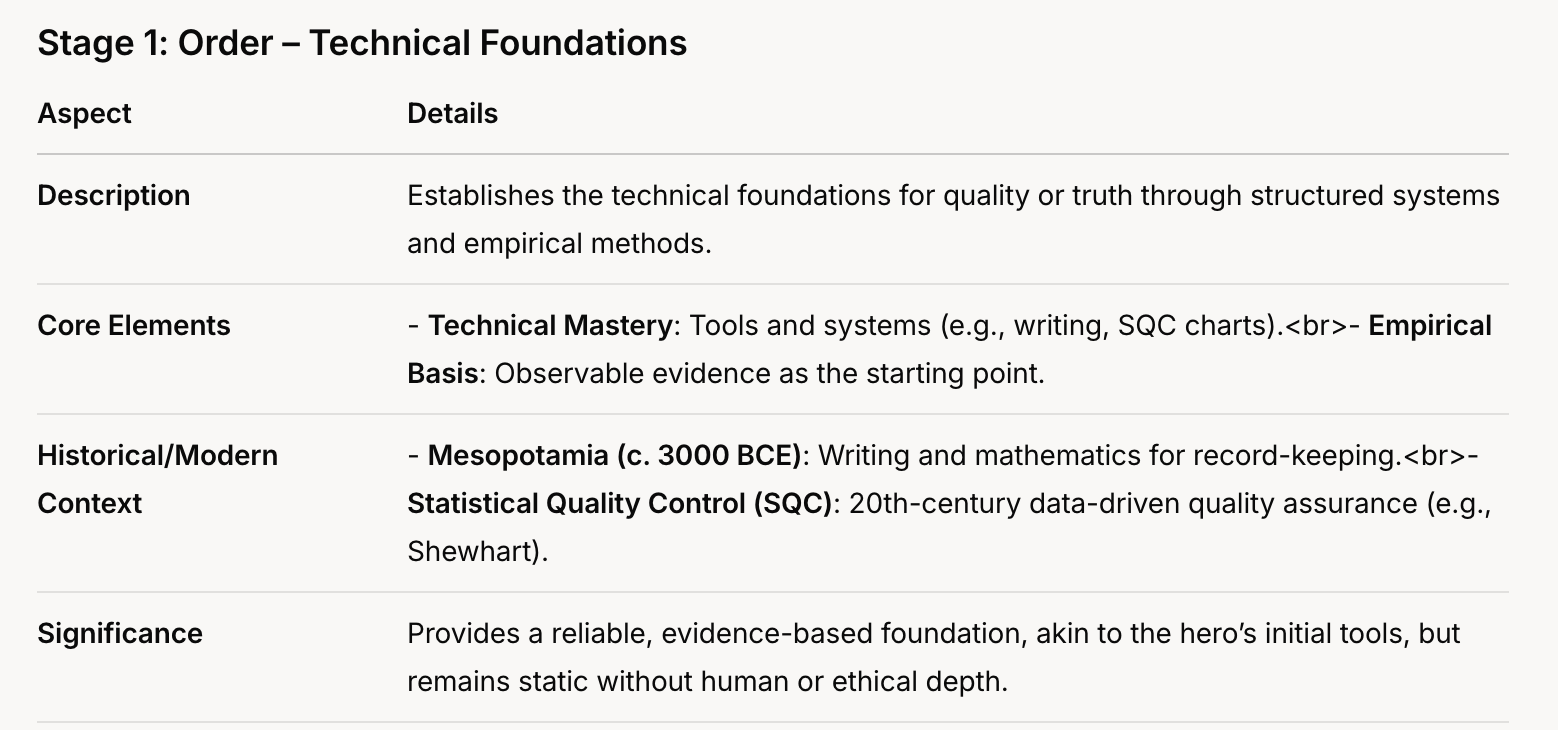
Stage 1: Order
– Technical Foundations. The first stage, “Order,” represents the establishment of technical foundations that underpin the pursuit of quality or truth. This stage is characterized by the development of structured systems and empirical methodologies aimed at achieving consistency, predictability, and control over material and intellectual realities. Historically, this is rooted in early civilizations like Mesopotamia, where foundational technologies—such as writing, mathematics, and early engineering—laid the groundwork for organized knowledge and production.→
In a modern context, this stage aligns with Statistical Quality Control (SQC), pioneered by figures like Walter Shewhart in the 20th century, which introduced rigorous, data-driven techniques to ensure product reliability and process stability.
Core Elements:
♦ Technical Mastery: Emphasis on tools, metrics, and systems (e.g., cuneiform records in Mesopotamia, control charts in SQC) to order chaotic phenomena.
♦ Historical Context: Mesopotamia’s invention of writing (circa 3000 BCE) enabled record-keeping and legal codes, while SQC formalized quality through statistical rigor.
Significance: Order provides the bedrock for quality by creating reliable foundations, yet it remains static—focused on technical precision rather than human or ethical dimensions. It’s the hero’s initial call, equipping them with tools for the journey ahead.
Stage 2: Transformation – Human Engagement.
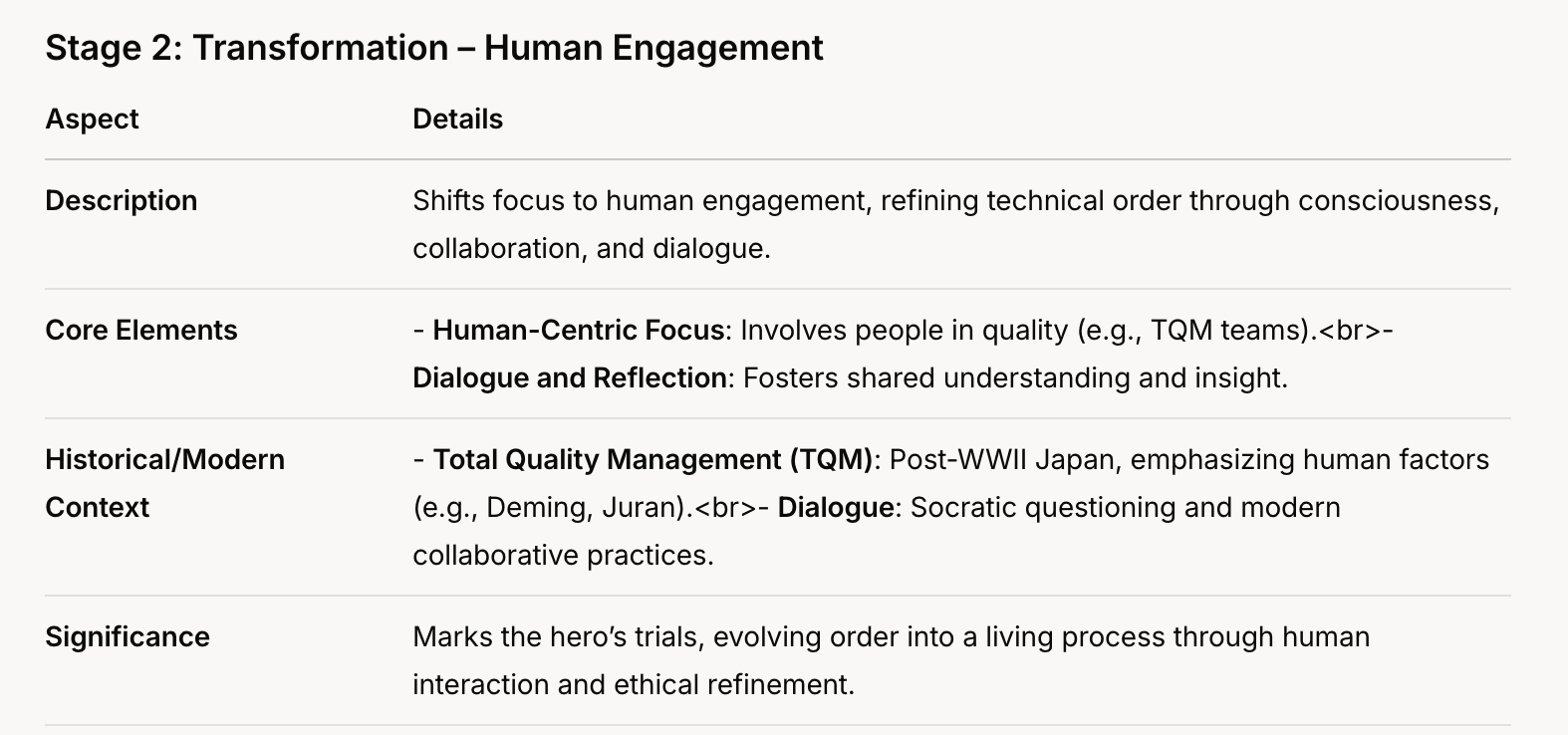
The 2nd stage, “Transformation,” shifts the focus from technical order to human engagement, emphasizing the role of consciousness, dialogue, and collaboration in refining quality or truth. This stage builds on the empirical foundations of Order by introducing relational dynamics, as seen in Total Quality Management (TQM), which emerged in the mid-20th century through contributions from W. Edwards Deming and Joseph Juran. TQM expands quality beyond statistics to include human factors—employee involvement, continuous improvement, and customer focus—while dialogue fosters shared understanding and collective insight.
Core Elements:
♦ Human-Centric Focus: Quality becomes a participatory process, engaging workers, stakeholders, and communities (e.g., TQM’s team-based problem-solving).
♦ Dialogue and Reflection: Open communication and critical discourse refine perceptions.
♦ Historical Context: TQM’s rise in post-WWII Japan transformed industrial quality by integrating human effort, while dialogue reflects philosophical traditions like Socratic questioning.
Significance: Transformation marks the hero’s trials, where technical order evolves through human interaction, shifting from isolated metrics to a living process. It introduces virtues like fidelity (to collective evidence) and humility (in collaborative correction), deepening the pursuit of truth.
Stage 3: Integration
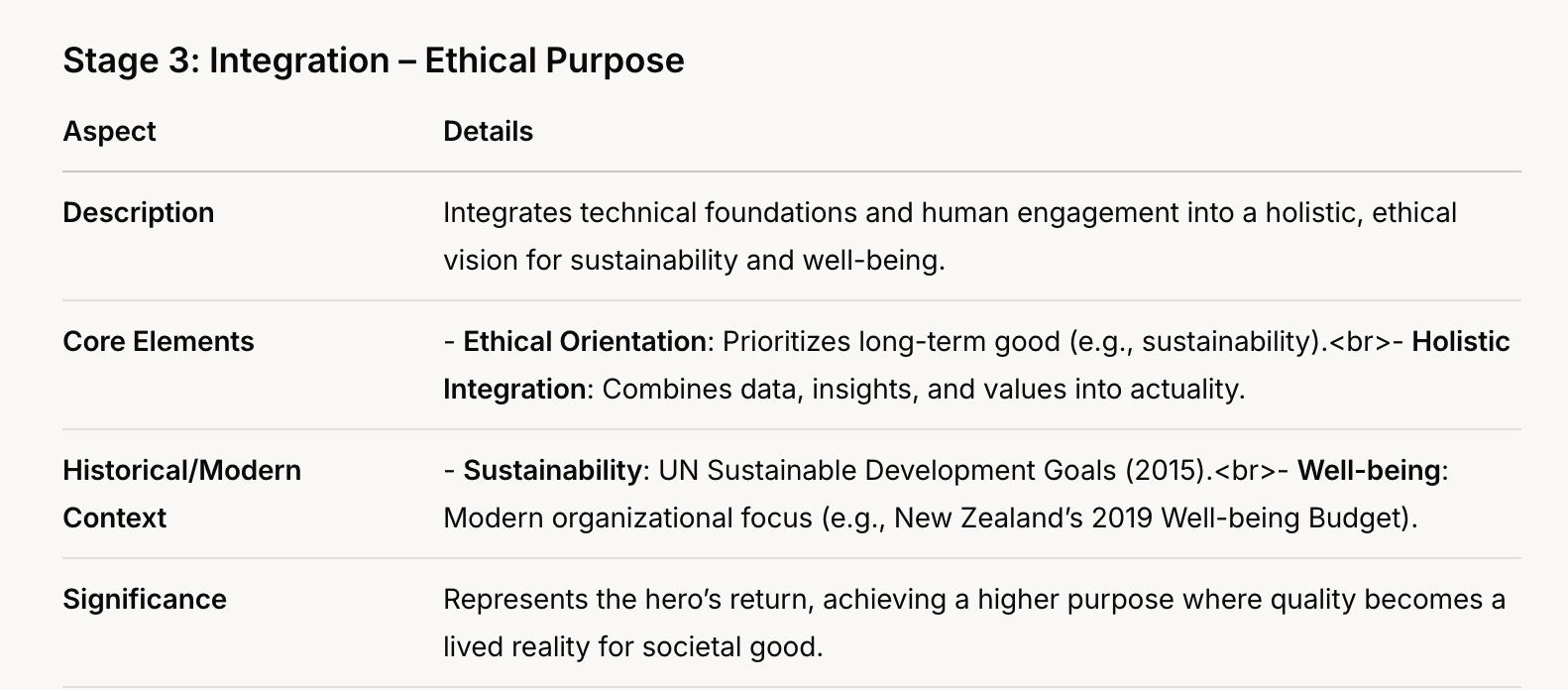
– The final stage, “Integration,” elevates quality or truth to an ethical purpose, integrating technical foundations and human engagement into a holistic vision that serves sustainability and well-being. This stage transcends immediate goals to address broader societal and ecological impacts, reflecting contemporary movements like sustainable quality management and well-being-focused organizational strategies.
Core Elements:
♦ Ethical Orientation: Quality is redefined to prioritize long-term good over short-term gains (e.g., sustainability practices reducing environmental harm).
♦ Holistic Integration: Combines empirical data, human insights, and ethical values into a unified reality (e.g., well-being metrics in organizational success).
♦ Contemporary Context: Draws on 21st-century trends like the United Nations Sustainable Development Goals (2015) and well-being economics (e.g., New Zealand’s 2019 Well-being Budget).
♦ Significance: Integration represents the hero’s return, where the journey culminates in a higher purpose. It transforms quality into a lived reality, not just a process, embodying truth as a virtuous, dynamic engagement with actuality that benefits individuals, organizations, and society.
7. Practical Applications
Practically, quality manifests across contexts:
♦ Manufacturing: Toyota’s kaizen and ikigai (Wang & Huzzard, 2011) and GE’s Six Sigma (Shoji et al., 1993) reflect order and transformation, aligning with Campbell’s trials.
♦ Services: Vinkenburg’s (2004) healthcare dialogue and McAdam-O’Connell’s (2005) European shift integrate human engagement and ethics—Campbell’s return.
♦ Sustainability: Patagonia’s practices embody Hardjono’s (2016) ethical integration, reflecting wu wei and ren.
8. Discussion
This reframing redefines quality as a journey, not a static metric, with implications for organizational theory—shifting focus from efficiency to purpose and consciousness. It positions quality as a transformative, ethical journey, relevant to both theory and practice in a rapidly shifting world. It bridges technical and human-centric views, offering a novel lens for sustainability and transformation studies. Limitations include its theoretical nature and broad scope, lacking empirical validation. Future research could test this framework in organizations, exploring how heroic stages influence quality outcomes.
Conclusion
Quality’s essence, as a heroic journey of consciousness, integrates technical precision, human engagement, and ethical purpose. From ancient crafts to modern innovations—ikebana’s harmony, martial arts’ discipline, Toyota’s kaizen, Patagonia’s ethics, healthcare’s care—this journey reflects a conscious pursuit of excellence, aligning with Campbell’s (2004) heroic arc and Neumann’s (1954) evolution. Future empirical studies are needed to validate this model, enhancing its practical impact.
Last Updated: 5 September 2025
References
- Campbell, J. (1991). Reflections on the Art of Living (K. Osbon, Ed.). HarperCollins.
- Campbell, J. (2004). The Hero with a Thousand Faces (Vol. 17). Princeton University Press.
- Cuijpers, P. H. M. (2025a). What about Quality? The Essence of Quality Unveiled. conscio.com.
- Cuijpers, P. H. M. (2025b). Thinking in Quality: Four Schools: Philosophical Principles & Learning Lenses in Organizational Transformation. conscio.com.
- Cuijpers, P. H. M., & Zinsmeister, T. L. (2025c). Reframing Quality as a Heroic Journey towards Virtuosity: A Transformative Path for Leaders, Teams, and Organizations. conscio.com.
- Cuijpers, P. H. M., & Zinsmeister, T. L. (2025d). Q4 Unleashed: Redefining Excellence with Common Sense and Values. conscio.com.
- Cuijpers, P. H. M., & Zinsmeister T. L. (2025e). Q4 Quality Compass: A Comprehensive Guide to unlock Quality Exellence. Conscio.com
- Cuijpers. P. H. M., Z., T. L. (2025d). Q4 Unleached. Redefining excellence with common sense and values. conscio.com.
- Cuijpers, P. H. M. (….). The Enmity Within: A First Account Witness- A Seekers Journey (complete manuscript). [upcoming]
- Deming, W. E. (1982). Quality, Productivity, and Competitive Position. MIT Press.
- Deming, W. E. (2000). The New Economics. MIT Press.
- Deming, W. E. (2018). Out of the Crisis. MIT Press.
- Elkington, J. (1997). Cannibals with forks: The triple bottom line of 21st century business. Capstone Publishing.
- Hardjono, T. W. (2000). The Four Phase model: Maturity of Organizations and Business Excellence. www.Hardjono.nl
- Hardjono, T. W. (2016). The Four Phase model: Drivers for increasing Competencies of Organizations Gouda, De Goudse School. .
- Hardjono, T. W., & Van Kemenade, E. (2021). The Emergence Paradigm. Springer.
- Hardjono, T. W., & van Marrewijk, M. (2001). Corporate Environmental Strategy, 8(4), 1-10.
- Juran, J. M. (1995). A History of Managing for Quality. ASQC Quality Press.
- McAdam-O’Connell, B. (2004). Tracing the Process. National University of Ireland.
- McAdam-O’Connell, B. (2005). Changing Conversations. National University of Ireland.
- Neumann, E., & Liebscher, M. (1954). The Origins and History of Consciousness (Vol. 42). Princeton University Press.
- Nilsson, L., et al. (1982). The Miracle of Life. Sveriges Television.
- Ofman, D. D. (2004). Core Qualities. Cyan Communications.
- Pirsig, R. M. (1974). Zen and the Art of Motorcycle Maintenance. William Morrow.
- Shiba, S., Walden, D., & Graham, A. (1993). A new American TQM: Four practical revolutions in management. Productivity Press.
-
Shewhart, W. A. (1931). Economic control of quality of manufactured product. D. Van Nostrand Company.
- Thomas, J., & Harden, A. (2008). Methods for thematic synthesis. BMC Medical Research Methodology, 8(45).
- Ventegodt, S., Flensborg-Madsen, T., Andersen, N.J., Nielsen, M., Mohammed, M., & Merrick, J. (2005). Global Quality of life (QOL) health and ability are primarily determined by our consciousness. research findings from Denmark 1991-2004. Social Indicators Research(71), 87-122.
- Wang, Y., & Huzzard, T. (2011). The Impact of Lean thinking on organizational learning. OLKC.
More Preprints

Quality in contexts
This article redefines quality as a dynamic process of consciousness evolving in a three-stage quest with implication...

Transcendental Realism
This preprint article introduces Transcendental Realism, redefining truth; as “a virtuous transcendence of perc...

2025 © All Rights Reserved