
What About Quality?
Introduction
The Essence of Quality Unveiled
Quality is a term invoked daily across diverse domains—manufacturing, healthcare, governance—yet its essence remains contested. What is the essence of quality? Is it a measurable attribute, a subjective experience, or a philosophical ideal? This article posits that quality’s essence lies in its multidimensionality—an evolving construct shaped by historical practices, philosophical inquiry, and practical implementation. From the meticulous craftsmanship of ancient artisans to the precision of modern industrial systems, quality has been a constant companion to progress, adapting to each era’s needs and aspirations.
Drawing on an extensive corpus of scholarly works (e.g., Deming, 1982, 2018; Hardjono & Kemenade, 2021; Hardjono & van Marrewijk, 2001; Hardjono, 2000, 2016; Vinkenburg, 2010; Ventegodt et al., 2005; Ofman, 2004; McAdam-O’Connell, 2004, 2005; Nilsson, Erikson, & Löfman, 1982; Neumann & Liebscher, 1954; Campbell, 1991, 2004), this study integrates diverse perspectives to define quality as a dynamic pursuit that balances technical rigor with human-centric values.
The analysis proceeds in four sections—historical evolution with a detailed timeline, philosophical foundations with comparative analysis, practical applications, and future directions—culminating in a synthesis that seeks to capture quality’s essence as both a practical necessity and a profound ideal.
See the full version on your computer.
This article maps quality frameworks to four schools—Empirical, Reference, Reflective, Emergence—analyzing their worldviews and tools. Through a learning lens (1st, 2nd, 3rd order), it reveals how frameworks like TQM, Lean and Six Sigma impacts the the way organizations, balancing control, Improve collaborate, and innovate.
Philosophical Foundations:
Unpacking Quality’s Deeper Meaning
What is the essence of quality through a philosophical lens? Quality transcends technicality, weaving a rich tapestry of thought. Pirsig’s Zen and the Art of Motorcycle Maintenance (1974) frames quality as a metaphysical harmony between rational precision and intuitive care—an ineffable awareness challenging Aristotle’s telos, resonating with Plato’s Forms, and contrasting Kant’s “disinterested pleasure” with practical mysticism (Vinkenburg, 2007b). This aligns with Asian philosophies reflecting a consciousness attuned to existence.
Ventegodt et al.’s Quality of Life Philosophy (2003a–2005) argues quality encompasses consciousness, happiness, and well-being, integrating these into organizational quality (Quality of Life Philosophy I, 2003a) and tying it to intentionality (Quality of Life Philosophy IV, 2003d), echoing mindfulness and broadening telos to life purpose (Ventegodt et al., 2005). This resonates with ikigai—quality as passion, mission, vocation, and profession—reflecting Daoist balance and Confucian duty. Deming’s (2000) System of Profound Knowledge—systems thinking, variation, epistemology, psychology—grounds quality in empirical dynamics, echoing Plato and Confucian balance (Deming, 2018). Hardjono and van Marrewijk (2001) extend this to social dimensions, modernizing Confucian harmony, while Ofman’s (2004) Core Quadrant model balances strengths and pitfalls, aligning with Aristotle and Buddhist self-awareness.
Eastern traditions deepen this. Confucianism’s moral quality persists in ethics, Daoism’s effortless quality informs sustainability, and Buddhism’s mindful quality shapes well-being. Ikebana embodies intentional simplicity, reflecting Daoist wu wei and Buddhist impermanence. Martial arts define quality as disciplined balance—kata blending precision and purpose, paralleling Ofman and Deming. Nilsson et al.’s (1982) The Miracle of Life presents quality as life’s wonder, aligning with Daoist reverence and Buddhist transience. Neumann and Liebscher’s (1954) The Origins and History of Consciousness ties quality to consciousness’s evolution—archetypes of order and beauty manifesting in creation, linking to Plato and Pirsig.
Joseph Campbell’s The Hero with a Thousand Faces (2004) frames quality as the hero’s journey—call, trials, and return—where excellence emerges through transformation, resonating with ikigai’s purpose and martial arts’ discipline. In Reflections on the Art of Living (1991), Campbell sees quality as living artfully, aligning with ikebana’s harmony and Confucian li—a conscious pursuit of meaning through action. McAdam-O’Connell’s (2005) “changing conversations” complements this, framing quality as transformative dialogue. This spectrum—from measurable standards to subjective depth, archetypal roots, and heroic living—reveals quality’s essence as a synthesis of precision, experience, and conscious purpose.
Historial Overview (1940s-2004)
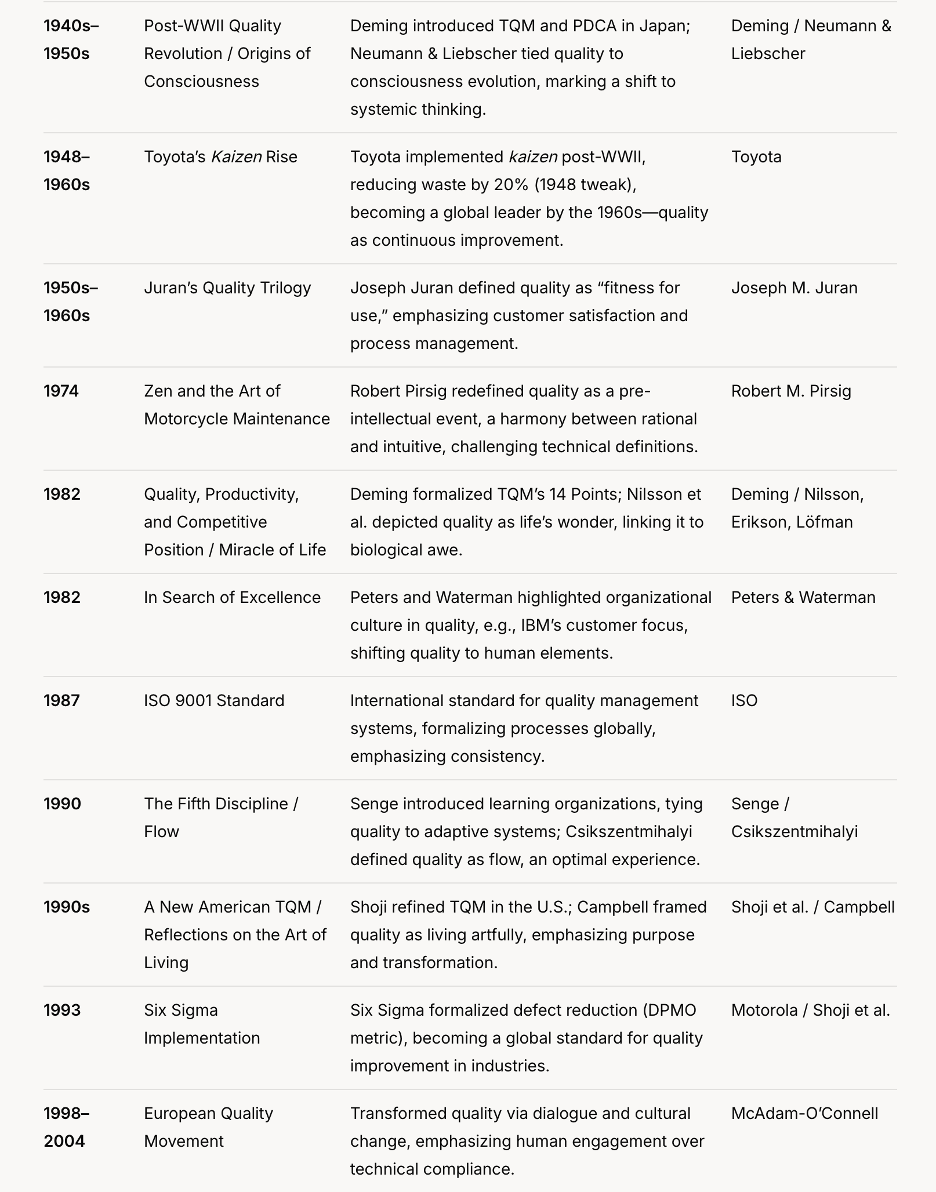
Quality Management Frameworks
Looking Glasses Defining Reality
Quality management frameworks have long been shaped by distinct ideologies of change, each rooted in a unique worldview that influences how change is perceived and achieved. These frameworks, often referred to as schools of thought, provide a lens through which we can understand quality’s evolution and its application across diverse contexts. Hardjono & van Kemenade (2021) identify four such schools: Empirical (Standardization), Reference (Continuous Improvement), Reflective (Breakthrough), and Emergence (Essence). Each school represents a different ideology of change and underlying worldview, reflecting a different worldview. that “every quality framework is based on a set of pre-assumption” Cuijpers (2025b).
1. The Empirical school,
Standardization, assumes change is achieved through consistency and control, ensuring predictable outcomes via standardized processes. Its mechanistic/positivist worldview sees the world as a predictable system to be controlled through objective data and centralized authority. For example, ISO 9001 (1987) standardizes processes globally, with over 1 million organizations certified (ISO, 2023), but its mechanistic approach often fails in dynamic contexts where adaptability is required.
3. The Reflective school,
Breakthrough, drives change through ethical and philosophical reflection, aligning with deeper values and purpose. Its humanistic/existential worldview sees the world as a human-centered system where quality reflects meaning and ethics. Pirsig’s (1974) concept of quality as harmony inspires guiding organizations to prioritize ethical transformation, though slow scaling can limit broader impact.
2. The Reference school
Continuous Improvement, promotes change through incremental collaboration and shared norms, improving processes over time. Its normative/collaborative worldview sees the world as a social system where quality emerges through collective agreement. Toyota’s kaizen (1948–1960s) exemplifies this, reducing waste by 20% through worker collaboration (Wang & Huzzard, 2011), though its incremental focus struggles with disruptive change,.
4. The Emergence school,
Reaching the Essence, assumes change emerges through innovation and potentiality, maximizing creativity with minimal constraints. Its chaotic worldview sees the world as a complex, unpredictable system where quality arises from adaptive innovation achieving local success, though scaling remains challenging (Grameen Bank, 2023).
Historial Evolution
Tracing Quality’s Path Through Time
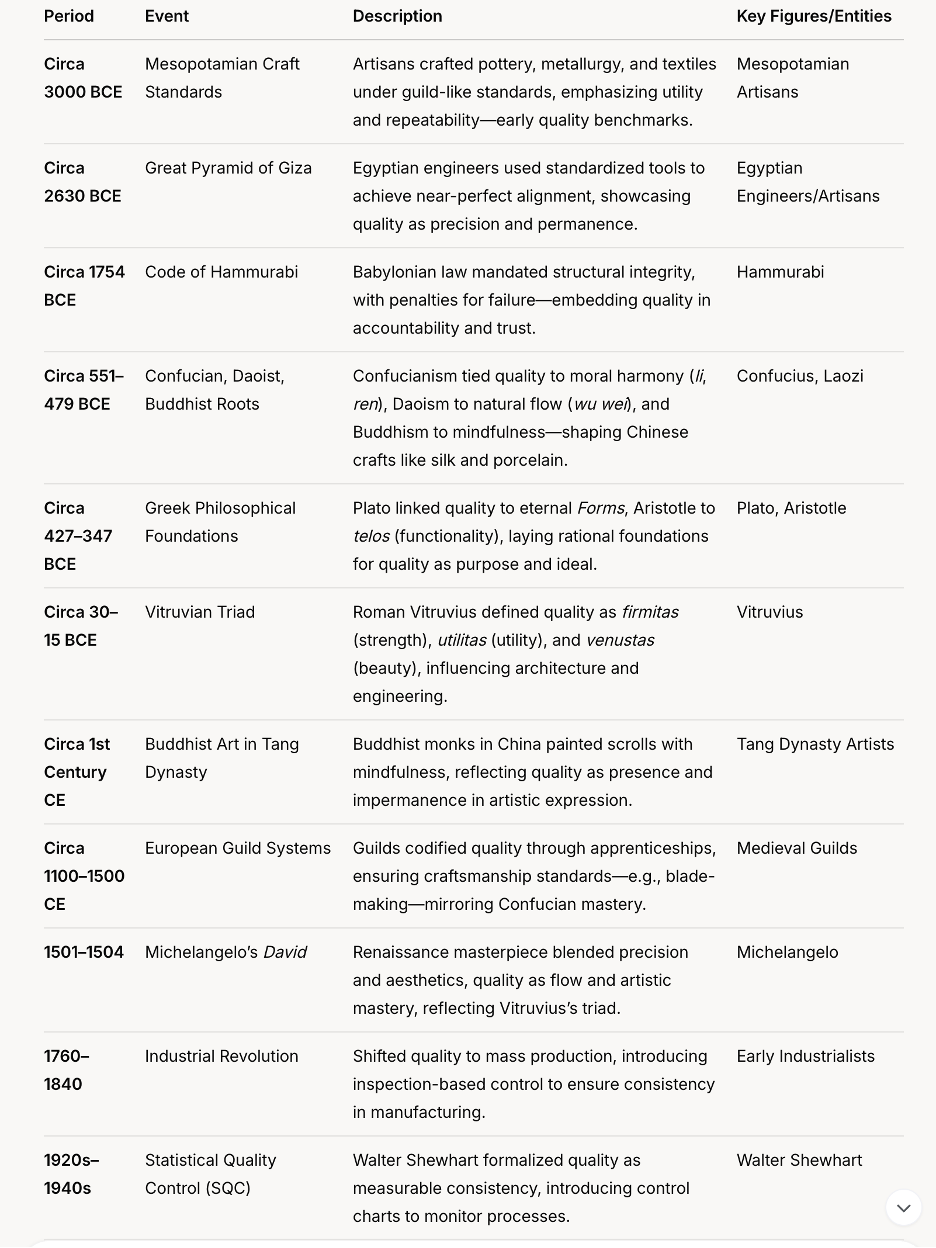
What is the essence of quality in history’s unfolding narrative? Quality’s story begins in antiquity, reflecting a rich interplay of cultural practices and the dawning of human consciousness. In Mesopotamia (circa 3000 BCE), artisans crafted pottery, metallurgy, and textiles under guild-like standards, emphasizing repeatability and societal utility—early precursors to Hardjono’s (2016) organizational competencies. Neumann & Liebscher’s The Origins and History of Consciousness (1954) suggest this period marks an “uroboric” stage of collective consciousness, where quality emerges as a practical expression of humanity’s nascent awareness of order and survival, rooted in archetypal patterns of creation. Joseph Campbell’s The Hero with a Thousand Faces (2004) frames this as the “call to adventure” in humanity’s heroic journey—quality as the first step toward mastering the environment, reflecting a primal quest for meaning and excellence. The Code of Hammurabi (circa 1754 BCE) formalized this commitment, mandating structural integrity with severe penalties, embedding quality in accountability and communal trust—a conscious step toward social responsibility (Juran, 1995).
Egypt’s Great Pyramid of Giza (circa 2630 BCE) exemplified quality as precision and permanence, its standardized tools and alignment symbolizing a leap in technical mastery and cultural aspiration. Neumann & Liebscher (1954) see this as mirroring cosmic order, while Campbell (2004) might interpret it as a “threshold crossing”—quality as a heroic act of transcending chaos through creation. In ancient China, Confucianism, Daoism, and Buddhism offered distinct lenses. Confucianism (circa 551–479 BCE) tied quality to moral excellence and harmony, with li (proper conduct) and ren (humaneness) guiding Han Dynasty (206 BCE–220 CE) silk and porcelain production—crafts blending skill with ethical value, reflecting a conscious integration of individual and societal good. Daoism, via Laozi’s Tao Te Ching, viewed quality as alignment with the Dao, where wu wei (effortless action) yielded natural excellence—a pre-rational unity Campbell (1991) might call “living in accord with the way” (Reflections on the Art of Living). Buddhism, introduced by the 1st century CE, emphasized quality as mindfulness and impermanence, evident in Tang Dynasty (618–907 CE) art, aligning with a consciousness of presence and transience.
Greece deepened this discourse philosophically. Aristotle (384–322 BCE) linked quality to telos—an object’s purpose—where a chair’s excellence lies in its function (Nicomachean Ethics), grounding quality in rational utility. Plato (427–347 BCE) envisioned it as eternal Forms, suggesting a higher consciousness seeking universal truths (The Republic). Roman Vitruvius (circa 30–15 BCE) operationalized quality as firmitas, utilitas, and venustas in De Architectura, shaping enduring infrastructure—Campbell (2004) might see this as the “return with the elixir,” quality as a gift to society. Medieval Europe’s guild systems (1100–1500 CE) codified quality through apprenticeships, mirroring Confucian mastery and signaling a collective consciousness of craft, later echoed in Deming’s (1982) continuous improvement.
The Industrial Revolution (1760–1840) shifted quality to mass production, with Shewhart’s statistical quality control (SQC) in the 1920s–1940s formalizing it as measurable consistency (Vinkenburg, 1995). Neumann & Liebscher (1954) interpret this as a “heroic” phase, asserting dominance over nature, while Campbell (2004) might view it as a “trial” in the heroic journey—overcoming chaos through systems, yet limited by its reactive scope. Post-World War II, Deming and Juran revolutionized quality with TQM. Deming’s Quality, Productivity, and Competitive Position (1982) introduced PDCA and 14 Points, transforming Japanese industry (Deming, 2018), a “mastery of the boon” in Campbell’s terms. Juran’s A History of Managing for Quality (1995) defined quality as “fitness for use,” aligning with Aristotle’s telos. Japan’s kaizen, rooted in Confucian harmony, Daoist flow, and Buddhist mindfulness, reflects a mature consciousness of purpose (Shoji et al., 1993).
In Europe, McAdam-O’Connell’s Tracing the Process of Transformation and Change (2004) and Changing Conversations (2005) document the European Quality Movement (1998–2004), shifting quality from compliance to transformation via dialogue—mirroring Confucian li and Buddhist mindfulness, a heroic return to human-centric values. Historically, quality’s essence emerges as a journey—technical, ethical, and conscious—echoing Campbell’s narrative arc.
Historial Overview (3000 BCE-1940s)
Practical Applications:
Quality Across Contexts
What is the essence of quality in practice? Applications bridge philosophy and action. Toyota’s Production System integrates Lean with TQM, empowering workers with kaizen and ikigai, reflecting Deming’s (2018) systems, Ofman’s (2004) strengths, and martial arts’ focus (Wang & Huzzard, 2011). General Electric’s Six Sigma echoes Shewhart and Mesopotamian accountability (Shoji et al., 1993), per the American Society for Quality (2009). In services, Vinkenburg’s (2004) Kwaliteit van zorg enhances healthcare trust via dialogue, aligning with Ventegodt et al.’s (2005) quality, Pirsig’s harmony, and Buddhist mindfulness. Dienstverlening (2006) highlights collaboration, supported by Weggelaar-Jansen (2015), aligning with Hardjono’s (2016) competencies and ikebana’s balance (Vinkenburg, 1995). Hardjono’s (2000) Four Phase Model mirrors martial arts’ progression, refined in Hardjono (2016).
Ofman’s (2004) model drives quality through strengths, addressing pitfalls, aligning with Hardjono and Confucian virtue. Al-Najjar and Jawad (2011) note ISO 9001 barriers, suggesting Hardjono’s (2000) readiness, akin to guilds. McAdam-O’Connell’s (2004) European Quality Movement shows dialogue transforming care, reflecting Confucian li (McAdam-O’Connell, 2005). Nilsson et al.’s (1982) The Miracle of Life inspires healthcare quality—e.g., a doctor honoring life’s wonder, enhancing care with Confucian ren. Botswana’s governance (Alexander & Kaboyakgosi, 2012) and Patagonia’s sustainability (Hardjono & Marrewijk van, 2001) merge Eastern and Western ethics. Campbell’s (1991) art of living frames quality as a heroic act—e.g., a craftsman’s dedication—synthesizing Deming’s systems, Pirsig’s harmony, and Neumann’s consciousness.
Historial Overview (2000-2020-Future)

Future Directions:
Quality’s Next Frontier
What is the essence of quality in the future? AI, IoT, and real-time monitoring enable proactive control, extending Deming’s (2018) variation management and Roman firmitas (Al-Hakim & Chen, 2014). Sustainability, as in Patagonia, aligns with Daoist harmony and Hardjono’s (2016) adaptability (Hardjono & Marrewijk van, 2001). Ventegodt et al.’s (2005) consciousness-driven quality, Nilsson et al.’s (1982) life’s wonder, and Campbell’s (2004) heroic journey envision quality as well-being and purpose—e.g., healthcare honoring dignity. Ofman’s (2004) resilience, Hardjono’s (2000) maturity, Shiba (2006-2007), and Weick (1991) adapt Deming and martial arts to complexity, integrating technology, ethics, and consciousness (Hardjono, 2016).
Synthesis:
Distilling Quality’s Core
Philosophically, it balances Pirsig’s (1974) harmony, Ventegodt’s (2005) consciousness, Deming’s (2000) systems, Hardjono and Marrewijk’s (2001) social focus, Ofman’s (2004) virtues, Nilsson et al.’s (1982) wonder, Neumann and Liebscher’s (1954) depth, Campbell’s (1991, 2004) heroic art, and Eastern concepts. Practically, it adapts through learning, dialogue, and harmony (Vinkenburg, 2004; Hardjono, 2016; McAdam-O’Connell, 2005), and in the future, it embraces technology, sustainability, and life’s value (Al-Hakim & Chen, 2014). This aligns with Schijndel van (2016), Weggelaar-Jansen (2015), and McAdam-O’Connell (2005), portraying quality as a journey of systems, people, purpose, and consciousness—a heroic pursuit reflecting ancient wisdom and modern aspirations.
Conclusion
Embodying excellence into our future.
What is the essence of quality, as unveiled here? It is a synthesis of historical roots, philosophical depth, practical adaptability, and forward-looking potential—a resilient force from Hammurabi to sustainable paradigms, evolving with consciousness and purpose. Philosophical contrasts—Pirsig’s harmony, Ventegodt’s consciousness, Deming’s rigor, Hardjono’s ethics, Ofman’s strengths, Aristotle’s telos, Kant’s aesthetics, Plato’s idealism, Nilsson et al.’s wonder, Neumann and Liebscher’s evolution, Campbell’s heroic journey, and Eastern traditions—bridge precision with values, revealing quality as measurable and profound. As complexity grows, quality guides progress and embodies excellence—a pursuit from antiquity to our future.
References:
- Al-Hakim, L., & Chen, J. (2014). Quality Innovation: Knowledge, Theory, and Practices. Information Science Reference.
- Al-Najjar, S. M., & Jawad, M. K. (2011). ISO 9001 implementation barriers and misconceptions. International Journal of Business Administration, 2(3).
- Alexander, K., & Kaboyakgosi, G. (2012). A Fine Balance: Assessing the Quality of Governance in Botswana. Idasa.
- American Society for Quality. (2009). Guide to the Quality Body of Knowledge (QBOK). ASQ.
- Anvari, A., et al. (2011). A study on Total Quality Management and Lean Manufacturing. World Applied Sciences Journal, 12(9), 1585-1596.
- Campbell, J. (1991). Reflections on the Art of Living: A Joseph Campbell Companion (K. Osbon, Ed.). HarperCollins Publishers.
- Campbell, J. (2004). The Hero with a Thousand Faces (Commemorative Edition ed., Vol. 17th). Princeton University Press.
- Cuijpers, P. H. M. (2025b). Thinking in Quality: Four Schools: Philosophical Principles & Learning Lenses in Organizational Transformation. conscio.com.
- Deming, W. E. (1982). Quality, Productivity, and Competitive Position. MIT Press.
- Deming, W. E. (2000). The New Economics. MIT Press.
- Deming, W. E. (2018). Out of the Crisis, Reissue. The MIT Press.
- Hardjono, T. W. (2000). The Four Phase Model: Maturity of Organizations and Business Excellence.
- Hardjono, T. W. (2016). The Four Phase Model: Drivers for Increasing Competencies of Organizations.
- Hardjono, T. W., & Kemenade van, E. (2021). The Emergence Paradigm in Quality Management. Springer.
- Hardjono, T. W., & van Marrewijk, M. (2001). The social dimensions of business excellence. Corporate Environmental Strategy, 8(4), 1-10.
- Juran, J. M. (1995). A History of Managing for Quality. ASQC Quality Press.
- McAdam-O’Connell, B. (2004). Tracing the Process of Transformation and Change: A Case Study of European Quality 1998-2003. National University of Ireland, Cork.
- McAdam-O’Connell, B. (2005). Changing Conversations in the Process of Transformational Change: European Quality Movement 1998–2004.
- Neumann, E., & Liebscher, M. (1954). The Origins and History of Consciousness (Vol. 42). Princeton University Press.
- Nilsson, L., Erikson, B. G., & Löfman, C. O. (1982). The Miracle of Life. A. S. N. Bebe Nixon; Sveriges Television.
- Ofman, D. D. (2004). Core Qualities: A Gateway to Human Resources. Cyan Communications.
- Pirsig, R. M. (1974). Zen and the Art of Motorcycle Maintenance. William Morrow and Company.
- Schijndel van, B. (2016). De praktische betekenis van kwaliteitskundige theorieën. SIGMA, 2, 38-42.
- Shiba, S. (2006-2007). Seeing large complex systems and the interdependency. Journal of Innovation, 12(2), 6-24.
- Shoji, S., et al. (1993). A New American TQM. Productivity Press.
- Ventegodt, S., et al. (2003a). Quality of Life Philosophy I. TheScientificWorldJOURNAL, 3, 1164–1175.
- Ventegodt, S., et al. (2003d). Quality of Life Philosophy IV. TheScientificWorldJOURNAL, 3, 1199–1209.
- Ventegodt, S., et al. (2005). Global quality of life. Social Indicators Research, 71, 87-122.
- Vinkenburg, H. H. M. (1995). Stimuleren tot Perfectie. University of Groningen.
- Vinkenburg, H. H. M. (2004). Kwaliteit van zorg; een goed gesprek doet wonderen. Kwaliteit in Praktijk, B2.
- Vinkenburg, H. H. M. (2006). Dienstverlening; paradigma’s, deugden en dilemma’s. Kwaliteit in Praktijk, B1(5).
- Vinkenburg, H. H. M. (2007b). Pirsig over kwaliteit; een gebeurtenis. Synaps, 22, 23-26.
- Vinkenburg, H. H. M. (2010). Naar een derde school in de kwaliteitskunde? Synaps, 31, 3-5.
- Wang, Y., & Huzzard, T. (2011). The impact of Lean thinking on organizational learning. OLKC.
- Weggelaar-Jansen, J. W. M. (2015). Learning to Improve, Improved Learning. Erasmus Universiteit Rotterdam.
- Weick, K. E. (1991). The nontraditional quality of organizational learning. Organization Science, 2(1), 116-124.
Further Readings

Performance Teams
Performance Teams in today’s fast-paced, competitive Business Landscape are the engine of commercial success.
...
Helpings Hidden Harm
The hidden harm of the helping professions and the negative impact caused by the expert model on customers and profes...

Dynamics of Choice
The Dynamics of Choice is a dance between agency, context and stimuli in personal, business and organizational life. ...

Clashing Titans
Tangling with Titans, Fordist waltz of Traditional Business Management Methods and Tools (TBMM) against the adaptive ...

The Funnel of Truth
Investigate your Funnel of Truth and discover how your Perception of Reality hinders you to grasp the factual Actuali...

Burden of Stress
Release the burden of stress by finding meaning in life, connecting with others, reclaiming your well-being and relax...

Info Snapping Strategies
Info Snapping Strategies is the art of capturing critical information amplified by AI to master the rhythm of the Inf...

Exploring Relaxation
Explore the science, heritage, and practice of relaxation. Address the impact of stress across personal, professional...
Beyond the Expert Trap
Tired of harming others and falling into the Expert-Trap? Join the League to study and practice GuideWork™ an advan...

Illusion of Control
Change initiatives often assume control is attainable, yet complexity and unpredictability prevail. Embracing emerge...

The Concept of Self
The ‘Self’ unfolds as a journey of discovery—mind, body, and spirit weaving a rich tapestry. It traces ...

Q4 Unleashed
Q4 redefines quality management. It integrates four paradigms into one cohesive framework, structured around four dir...
The Art of Exposure
The Art of Exposure, a rare talent with jazz rhythm and compassion as its tool, offers a sense of direction in human ...

Evolution of Science
The evolution of science’s, from ancient history to modern genomics, unveils science’s dynamic evolution, a restl...

Group Dynamics
A Historical Analysis of Group Dynamics: From 1895 crowd theories to modern insights, exploring, concepts, theories a...

Luck & Chances
In “Luck and Chance: A Multidisciplinary Exploration”, we delve into probability theory. Stripping away c...
Thinking in Quality
This article maps quality frameworks to four schools—Empirical, Reference, Reflective, Emergence—analyzing their ...

2025 © All Rights Reserved