
What is Mystagogy
Mystagogy explores and investigates the origins, theories, key concepts and core principles of the work of mystagogues and their humble role in initiating religious dialogue regarding direct experiences with the divine.
Introduction
History, Theories, Concepts & Principles
Mystagogy, derived from the Greek mystagogia means “leading into the mysterie”. Originally it is a theological and pedagogical concept rooted in the Christian tradition, particularly associated with the catechetical and liturgical practices of the early Church. It refers to the process of initiating individuals into the deeper spiritual and symbolic meanings of sacred rituals, especially the sacraments, to foster a transformative encounter with the divine.
This article explores the historical development, core concepts, guiding principles, theoretical frameworks, the role of contemporary mystagogues, and their work regarding the study and reflection on people’s direct experiences with God, with an emphasis on phenomenological and hermeneutical tools for studying lived experiences.
For the full version open your laptop or fire up your computer.
The 4 Cornerstones
Initiation
Emphasizes the surrender to a transformative experience and the impact of mercy.
Interpretation
Activates study and reflection to grasp the deeper meaning of the devine presence.
Learning
Focuses on direct experience over theories encouraging embodied practices.
Transformation
Empowers individuals to translate their experiences into daily acts of compassion.
Historical Development
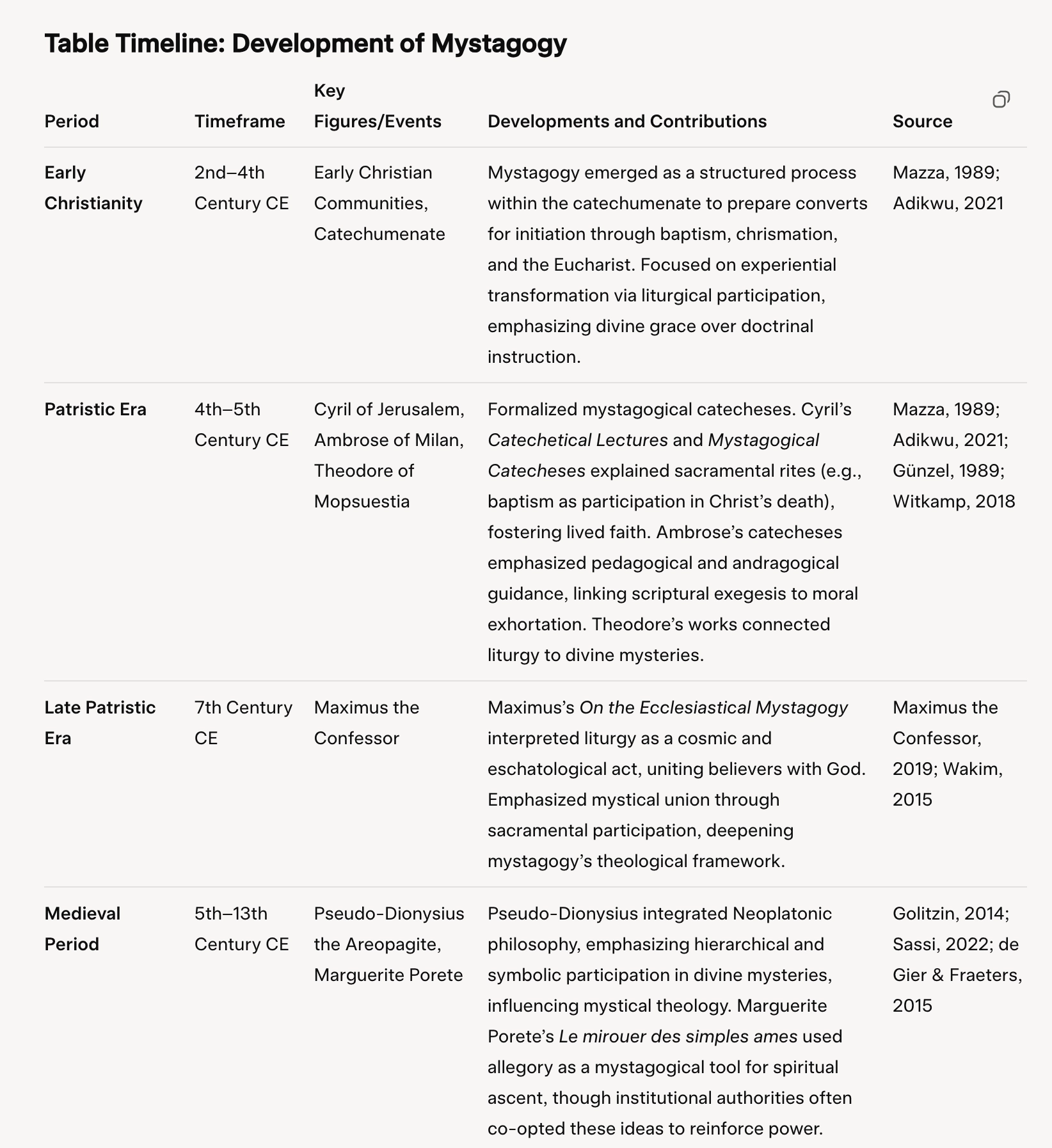
Mystagogy emerged in the early Christian centuries as a structured process within the catechumenate, designed to prepare converts for initiation through Baptism, Chrismation, and the Eucharist.
The term is notably associated with the Catechetical Lectures and Mystagogical Catecheses of figures like Cyril of Jerusalem, Ambrose of Milan, and Theodore of Mopsuestia. These patristic writings, particularly from the 4th and 5th centuries, provided detailed explanations of sacramental rites to neophytes post-initiation, deepening their understanding of the mysteries they had experienced (Mazza, 1989). For example, Cyril of Jerusalem’s mystagogical lectures elucidated the symbolic and spiritual significance of baptismal immersion and eucharistic participation, fostering a lived faith (Adikwu, 2021).
In the early Church, mystagogy was not merely instructional but experiential, aiming to transform the initiate’s perception of reality through participation in the liturgy. Ambrose of Milan’s Mystagogical Catecheses emphasized the pedagogical and andragogical dimensions, guiding adults into the Christian mysteries through scriptural exegesis and moral exhortation (Günzel, 1989). Similarly, Maximus the Confessor’s On the Ecclesiastical Mystagogy (7th century) interpreted the liturgy as a cosmic and eschatological act, uniting the believer with God (Maximus the Confessor, 2019; Wakim, 2015).
During the medieval period, mystagogy evolved through figures like Pseudo-Dionysius the Areopagite, whose works integrated Neoplatonic philosophy, emphasizing hierarchical and symbolic participation in divine mysteries (Golitzin, 2014; Sassi, 2022). The concept also appeared in mystical theology, as seen in Marguerite Porete’s Le mirouer des simples ames, where allegory served as a mystagogical tool for spiritual ascent (de Gier & Fraeters, 2015).
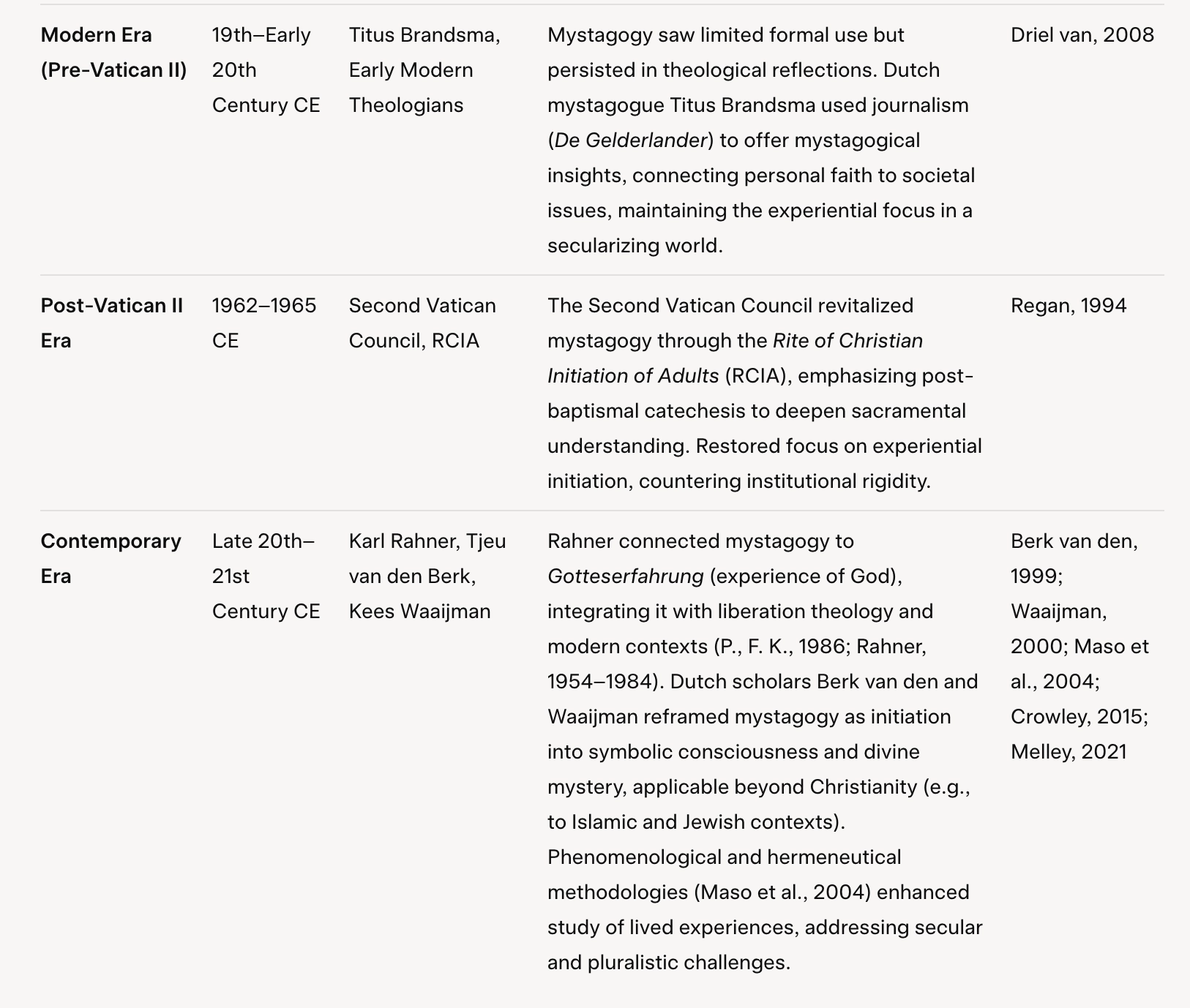
In the modern era, mystagogy has been revitalized, particularly in Catholic and Orthodox traditions. Scholars like Karl Rahner have connected mystagogy to the experience of God (Gotteserfahrung), integrating it with modern theological frameworks (Fischer, 1986; Rahner, 1954–1984). Dutch scholars, including Tjeu van den Berk and Kees Waaijman, have further explored mystagogy as an initiation into symbolic consciousness and divine mystery, respectively (Berk van den, 1999; Waaijman, 2000).
Timeline
Key Concepts
♦ Initiation into Mysteries:
Mystagogy is the process of guiding individuals into the sacred mysteries of faith, particularly through the sacraments. It moves beyond doctrinal instruction to an experiential encounter with the divine (Hughes, 1999).
♦ Symbolic Interpretation:
Mystagogy relies on interpreting the symbolic elements of rituals, such as water in baptism or bread in the Eucharist, to reveal their spiritual significance (Mueller-Jourdan, 2013).
♦ Transformative Experience:
The goal is to transform the initiate’s worldview, fostering a deeper connection with God and the community of faith (Van Loon et al., 2018).
♦ Liturgical Participation:
Mystagogy is inherently liturgical, as the mysteries are experienced through active participation in worship (Mazza, 1989; Ready, 2017).
♦ Mystical Unity:
Drawing from thinkers like Weizsäcker, mystagogy emphasizes the experience of unity with the divine, transcending rational explanation (Weizsäcker von, 1977).
Modern Mystagogy
The Role of Phenomenology & Hermeneutics
The work of modern mystagogues is significantly enhanced by the application of phenomenology and hermeneutics, which serve as critical tools for studying lived experiences and analyzing their validity in the context of divine encounters. These methodologies enable mystagogues to engage with the subjective and intersubjective dimensions of spiritual experiences, ensuring a rigorous yet open approach to understanding the presence of the divine.
1. Studying the lived Experience:
Phenomenology, as a method for studying the structures of subjective experience, is particularly relevant to mystagogy’s focus on direct encounters with the divine. By bracketing preconceived notions and focusing on the “lived experience” of individuals, phenomenology allows mystagogues to explore how people perceive and interpret moments of transcendence, awe, or unity with God (Maso et al., 2004). For instance, Maso et al. (2004) outline empirical phenomenological research as a means to capture the richness of experiential data, enabling mystagogues to understand the essence of spiritual encounters without imposing institutional frameworks. Similarly, Maso (2001) integrates phenomenology with ethnography, emphasizing the importance of contextualizing spiritual experiences within the cultural and social settings in which they occur, such as in secular or nonreligious environments (Maso, 2001). This approach aligns with Rahner’s concept of Gotteserfahrung, which posits that divine experiences are universal and accessible to all, regardless of religious affiliation (Rahner, 1954–1984).
2. Analyze the meaning:
Hermeneutics, the art and science of interpretation, complements phenomenology by providing a framework for mystagogues to analyze the meaning of spiritual experiences. By applying hermeneutical principles, mystagogues interpret the symbols, narratives, and rituals that individuals encounter, helping them articulate the significance of their experiences in relation to the divine (Waaijman, 2000). For example, Dutch scholar Waaijman emphasizes hermeneutical engagement with mystical texts and experiences, guiding individuals to uncover the “secret of God” through reflective interpretation (Waaijman, 2000). This process is crucial for transcending dogmatic constraints, as it prioritizes the individual’s personal narrative over standardized theological interpretations.
3. Making Sense of Every Day life:
Maso (1984) introduces ethnomethodology as a method for studying how individuals make sense of everyday life, which is applicable to mystagogy in understanding how people construct meaning from their spiritual experiences (Maso, 1984). Ethnomethodology complements phenomenology by focusing on the social practices and interactions that shape spiritual understanding, allowing mystagogues to validate experiences within communal and cultural contexts. For instance, a mystagogue might use ethnomethodological insights to explore how a community’s shared rituals reinforce an individual’s sense of divine presence, as seen in the communal integration emphasized by de Jong-van Campen (2009).
4. Assessing the validity:
Phenomenology and hermeneutics also provide tools for assessing the validity of spiritual experiences, ensuring they are authentic and meaningful. Phenomenological analysis, as described by Maso et al. (2004), involves rigorous documentation and reflection on experiential data, allowing mystagogues to distinguish genuine encounters from subjective projections or cultural influences. Hermeneutics aids in evaluating the coherence and transformative impact of these experiences, as mystagogues guide individuals to integrate their encounters into ethical and spiritual growth (Vosman, 2001). For example, Weizsäcker’s emphasis on the ineffable unity of mystical experience highlights the challenge of validating such moments, which phenomenology and hermeneutics address by grounding them in descriptive and interpretive rigor (Weizsäcker von, 1977).
By employing phenomenology, hermeneutics, and complementary methods like ethnomethodology, modern mystagogues can systematically study and validate the lived experiences of individuals, enabling a deeper understanding of divine encounters that transcends institutional dogma. These tools empower mystagogues to foster inclusive, transformative spirituality that resonates with both religious and nonreligious seekers.
Theoretical Frameworks
Mystagogy is underpinned by several theoretical frameworks:
Patristic Theology:
Early Christian mystagogy, as articulated by Cyril, Ambrose, and Theodore, is rooted in a theology of participation, where sacraments mediate divine grace (Witkamp, 2018).
Mystical Theology:
Influenced by Pseudo-Dionysius and Maximus, mystagogy is framed as a journey toward divine union, integrating Neoplatonic and Christian elements (Golitzin, 2014; Wakim, 2015).
Pedagogical Theory:
Modern scholars like Schambeck view mystagogy as a form of religious education, emphasizing experiential and transformative learning (Schambeck, 2006; Elshof, 2017).
Symbolic Anthropology:
Dutch scholars like van den Berk propose mystagogy as an initiation into symbolic consciousness, aligning with anthropological perspectives on human sense-making (Berk van den, 1999; Vosman, 2001).
Liberation Theology:
Rahner and others connect mystagogy to the experience of God in marginalized contexts, emphasizing social justice and spiritual liberation (Fischer, 1986).
The Work of Mystagogues
In contemporary contexts, modern mystagogues play a vital role in initiating dialogue serving as a humble facilitator to have meaningful converzations about personal experiences with the devine presence whether religious or nonreligious, prioritizing direct encounters over institutional doctrines or dogmas. Rather than leading individuals into the sacred, mystagogues support people in understanding how the grace of God invites them into his mysteries, facilitating a personal and transformative engagement with the divine (Rahner, 1954–1984; Mazza, 1989). This approach reflects a return to the experiential core of mystagogy, which seeks to transcend rigid dogma’s and frameworks to foster an intimate personal, transformative relationship with the devine.
♥ Fascilitating Personal Reflection: Modern mystagogues assist individuals in interpreting their spiritual experiences, such as moments of awe, transcendence, or unity, without confining them to predefined theological categories.
Karl Rahner’s theology of Gotteserfahrung (experience of God) emphasizes that every person has an innate capacity for divine encounter, which mystagogues help articulate (Rahner, 1954–1984; P., F. K., 1986). For example, Rahner’s Spiritual Exercises encourages individuals to explore Ignatian spirituality as a direct path to God, bypassing overly dogmatic structures (Rahner, 1967).
♥ Transcending Institutional Dogma: Mystagogues in the modern era, as noted by Crowley (2015), address the challenge of nonbelief by focusing on universal human experiences of the sacred rather than institutional prescriptions. Dutch scholar Tjeu van den Berk frames mystagogy as an initiation into symbolic consciousness, where individuals engage with symbols (e.g., art, nature, or rituals) to encounter the divine beyond ecclesiastical boundaries (Berk van den, 1999).
Vosman (2001) critiques Berk’s approach, advocating for a moral-theological grounding that ensures mystagogy remains rooted in ethical living, yet both emphasize personal experience over rigid doctrine.
♥ Fostering Inclusive Spirituality: Modern mystagogues create spaces for diverse spiritualities, including those outside traditional religious frameworks. Waaijman (2000) describes mystagogy as an initiation into the “secret of God,” accessible to all who seek meaning, regardless of institutional affiliation. This aligns with Weizsäcker’s view of mystical unity as an ineffable experience that transcends rational or doctrinal explanation (Weizsäcker von, 1977).
♥ Adapting to Secular Contexts: In an increasingly secular world, mystagogues help individuals navigate spiritual experiences in nonreligious settings, such as through fasting and meditation. Crowley (2015) highlights how mystagogues address contemporary skepticism by guiding people to recognize divine presence in everyday life, aligning with Rahner’s notion of the “anonymous Christian” who experiences God implicitly (Rahner, 1954–1984).
♥ Supporting Transformative Integration: Modern mystagogues facilitate the integration of divine experiences into daily life, helping individuals translate moments of transcendence into ethical and communal action. For example, Dutch mystagogues like Titus Brandsma used journalism to guide readers toward spiritual reflection, connecting personal experience with broader societal values (Driel van, 2008).
“ Grace is the liberating experience of receiving everything without doing anything.”
Conclusion
Mystagogy is a rich and multifaceted concept that bridges liturgy, theology, and pedagogy. Its historical roots in the early Church have evolved into a modern practice that continues to support believers in their journey towards the mysteries of faith. Grounded in experiential learning, symbolic interpretation, and communal integration, mystagogy facilitates sense0making processes with individuals in their encounter with the divine.
By focusing on God’s grace as the primary agent, mystagogues enable individuals to recognize and embrace the divine initiative in their religious-spiritual journey, deepening their awareness of sacred mysteries (Waaijman, 2000). The integration of phenomenology and hermeneutics further enhances this work, providing robust tools for studying and validating lived spiritual experiences. This dynamic interplay of history, theory, and practice underscores mystagogy’s enduring relevance in current and future religious development.
References:
• Adikwu, P. (2021). The Theology of Mystagogy in Cyril of Jerusalem: An Application in the Catholic Diocese of Zaria. Seton Hall University Dissertations and Theses (ETDs), 2951
• Aich, B. J. (2024). Review of Liturgy and Sacrament, Mystagogy and Martyrdom: Essays in Theological Exegesis, by Jeffrey L. Morrow. Review of Biblical Literature
• Berk van den, T. (1999). Mystagogie. Inwijding in het symbolisch bewustzijn. Meinema. [Dutch source]
• Beumer, J. (1993). Intimiteit & Solidariteit. Over het evenwicht tussen dogmatiek, mystiek en ethiek [Dissertation, Leiden University]. Leiden. [Dutch source]
• Birzu, V. (2017). La cristallisation de la spiritualité orthodoxe dans les IVe et Ve siècles. L’émergence de l’œuvre de Saint Diadoque.
• Bîrzu, H. V. (n.d.). Psychopedagogy and mystagogy. Academia.edu
• Crowley, P. (2015). Mystagogy and mission: The challenge of nonbelief and the task of theology. Theological Studies, 76(1), 7-28.
• de Gier, I., & Fraeters, V. (2015). Allegory and Mystagogy in Marguerite Porete’s Le mirouer des simples ames. Ons Geestelijk Erf, 86(1), 3-23.
• de Jong-van Campen, A. M. G. (2002). Mystagogie Als Inwijding in Geloof en Gemeenschap. International Journal for Philosophy and Theology, 63(3), 281-310.
• de Jong-van Campen, A. M. G. (2009). Mystagogie in werking: Hoe menswording en gemeenschapsvorming gebeuren in christelijke inwijding [Dissertation, Tilburg University]. Zoetermeer.
• Driel van, S. (2008). De mystagoog Titus Brandsma, Een onderzoek naar de mystagogische laag in artikelen van Titus Brandsma in het Dagblad de Gelderlander [Thesis, Radboud Universiteit te Nijmegen]. Nijmegen.
• Elshof, A. J. M. (2017). Mystagogy, religious education and lived catholic faith. Journal of Religious Education, 65(2), 87-98.
• Golitzin, A. (2014). Mystagogy: A monastic reading of Dionysius Areopagita. Cistercian Publications.
• Günzel, U. (1989). Die mystagogischen Katechesen des Ambrosius von Mailand: Ein Beitrag zur Pädagogik und Andragogik der christlichen Antike. Bonn.
• Hoff, J. (2017). Mystagogy Beyond Onto-Theology: Looking Back to Post-Modernity with Nicholas of Cusa. Brill.
• Howells, E., & McIntosh, M. A., (Eds.). (2020). The Oxford Handbook of Mystical Theology. Oxford Academic
• Hughes, K. (1999). Saying Amen: A mystagogy of sacrament. Liturgy Training Publications
• Johnson-Miller, B. C. (2018). Catechesis, mystagogy, and pedagogy: Continuing the conversation. Christian Education Journal, 15(1), 88-102.
• Johnson-Miller, B. C., & Espinoza, B. D. (2018). Catechesis, mystagogy, and pedagogy: Continuing the conversation. Christian Education Journal, 15(2), 156-170.
• Lettens, D. (1971). Mystagogie et Mystification. Evaluation de l’œuvre de Marcel Griaule [Dissertation, Katholieke Universiteit Nijmegen]. Nijmegen. Presse Lavigerie, •
• Lombaard, C. (2020). Considering mystagogy as method in Biblical Spirituality. HTS Teologiese Studies/Theological Studies, 76(1), a212413.
• Maso, I. (1984). Verklaren in het dagelijks leven: een inleiding in etnomethodologisch onderzoek [Explaining in everyday life: an introduction to ethnomethodological research]. Wolters-Noordhoff.
• Maso, I. (2001). Phenomenology and ethnography. In P. Atkinson, A. J. Coffey, S. Delamont, J. Lofland, & L. H. Lofland (Eds.), Handbook of ethnography (pp. 136-144). Sage Publications.
• Maso, I., Andringa, G., & Heusèrr, H. (2004). De rijkdom van ervaringen. Theorie en praktijk van empirisch fenomenologisch onderzoek. LEMMA.
• Maximus the Confessor. (2019). On the Ecclesiastical Mystagogy. St Vladimir’s Seminary Press
• Mazza, E. (1989). Mystagogy: A theology of liturgy in the patristic age. Pueblo Books.
• Meconi, D. V. (2008). Becoming Gods by Becoming God’s: Augustine’s Mystagogy of Identification. Augustinian Studies, 39(1), 61-74.
• Melley, P. D. (2021). Roots and branches: The origins and potential of mystagogy in religious education today. Journal of Religious Education, 69(2), 123-135.
• Mueller-Jourdan, P. (2013). Mystagogie. In Reallexikon für Antike und Christentum (Vol. 25: Mosaik – Nymphaeum). Hiersemann.
• Fischer, K. P. (1986). Gotteserfahrung: Mystagogie in der Theologie Karl Rahners und in der Theologie der Befreiung. M-Grünewald-Verlag.
• Polidori, V. (2015). Towards a critical edition of Photius’ Mystagogy of the Holy Spirit. Studi sull’oriente cristiano, 19(1), 5-18
• Porosło, K. (2021). Mistagogia liturgiczna i nowa ewangelizacja. Roczniki Teologiczne, 68(8), 95-111.
• Rahner, K. (1954–1984). Schriften zur Theologie (Vols. 1–16). Benziger Verlag.
• Rahner, K. (1967). Spiritual Exercises [Betrachtungen zum ignatianischen Exerzitienbuch] (K. Baker, Trans.; 1st (1965) ed.). Herder & Herder
• Ready, G. (2017). Towards a Renewed Mystagogy of Orthodox Christian Worship. Logos: A Journal of Eastern Christian Studies, 58(1–4), 57–96
• Regan, D. (1994). Experience the mystery: Pastoral possibilities for Christian mystagogy. Liturgical Press
• Sassi, N. (2022). Rhetorical Strategies as Technologies of Mystagogy in Pseudo-Dionysius the Areopagite. Medioevo Greco. Rivista di storia e filologia bizantina, 22
• Schambeck, M. (2006). Mystagogisches Lernen. In M.
• Schambeck (Ed.), Mystagogisches Lernen, in: Religionsdidaktik. Ein Leitfaden für Studium, Ausbildung und Beruf, Hg. G. Hilger, S. Leimgruber, & H.-G. Ziebertz, München 2010, 400-415 (pp. 408-412). Echter-Verlag
• Schoot, H., Verburgt, J., & Vijgen, J. (2019). Initiation and Mystagogy in Thomas Aquinas: Scriptural, Systematic, Sacramental and Moral, and Pastoral Perspectives. Peeters Publishers.
• Simon, W. (Ed.). (n.d.). Art. Mystagogie. In Lexikon für Theologie und Kirche (Vol. 7, pp. 570-572).
• Spezzano, D. (n.d.). “Awe-Inspiring, in Truth, Are the Mysteries of the Church”: Eucharistic Mystagogy and Moral Exhortation in the Preaching of St. John Chrysostom.
• Tanner, J. P. (2013). The Cost of Discipleship: Losing One’s Life for Jesus’ Sake. Journal of the Evangelical Theological Society, 56(1), 43-61.
van der Leeuw, G. (1948). Sacramentstheologie. Callenbach.
• Van Loon, H., De Nie, G., Op de Coul, M., & Van Egmond, P. (Eds.). (2018). Prayer and the Transformation of the Self in Early Christian Mystagogy. Late Antique History and Religion, 18. Peeters.
• Vosman, F. (2001). Een ziel met alle kleuren van de regenboog. Een moraaltheologische kritiek op de mystagogie-opvatting van Tjeu van den Berk. In H. • Lombaerts, J. Maas, & J. Wissink (Eds.), Beeld en gelijkenis. Inwijding, kunst en religie. Zoetermeer.
• Waaijman, K. (2000). Mystagogie: Inwijding in het geheim van God. Kok. [
• Wakim, R. (2015). La Mystagogie de Maxime le Confesseur: L’être ecclésial et l’unité à Dieu. Proche-Orient Chrétien, 65(3-4), 235-253.
• Weizsäcker von, C. F. (1977). Der Garten des Menschlichen. Beiträge zur geschichtlichen Anthropologie. Hanser Verlag.
• Witkamp, N. (2018). Tradition and Innovation: Baptismal Rite and Mystagogy in Theodore of Mopsuestia and Narsai of Nisibis. Brill.
• Zhu, F. (2019). Complexity, Mystagogy, and the Limits of the ‘Analytical’ Learning Cycle. Proceedings of DiGRA 2019 Conference: Game, Play and the Emerging Ludo-Mix.
Further Readings

Build Your Academy
Build you Academy is our custom service, co-designing, co-leading and co-facilitating top-notch In-company training a...

What is Agogics
Learn more about the origin, concept, theories and methods of Agogics and the applications in modern human and organi...

Learning to lead
Learning to lead embodies a hybrid, human-centric framework that empowers professionals to attain mastery in agogics,...

2025 © All Rights Reserved